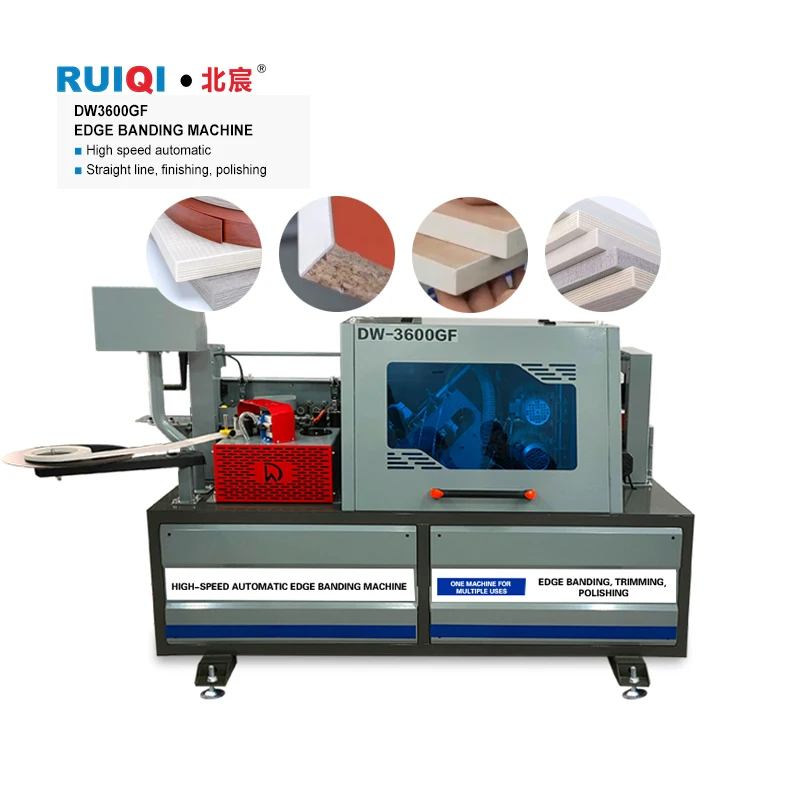
Precision Configuration First — Every DW3600GF ships with voltage confirmation and electrical schematics matched to your local grid, because a 4.9 kW edge bander that cannot be powered on arrival solves nothing.
Technical Specifications
| Parameter |
Value |
| Model |
DW-3600GF |
| Product Type |
Automatic Compact Edge Banding Machine with Pre-milling |
| Voltage & Frequency |
380V, three-phase, four-wire |
| Total Power |
4.9 kW |
| Overall Dimensions (L×W×H) |
2200×650×1250 mm |
| Net Weight |
320 kg |
| Edge Banding Type |
Straight edge banding |
| Edge Band Height Range |
0–50 mm |
| Edge Band Thickness Range |
0.3–3 mm |
| Minimum Panel Length |
200 mm |
| Feed Speed |
0–14 m/min |
| Transmission Motor Power |
180 W |
| Trimming Motor Power |
800 W × 2 |
| Trimming Speed |
24000 r/min |
| Polishing Motor Power |
400 W × 2 |
| Air Supply Requirement |
0.4–0.6 MPa |
| Standard Functions |
Gluing, rough trimming, fine trimming, front and rear end trimming, scraping, polishing, vacuuming |
| Language Options |
Chinese and English (customizable to Spanish or other languages) |
| Certification |
CE |
Application Suitability
| Application |
Material or Output |
| Custom cabinet door edge finishing |
MDF and particleboard with PVC or melamine edge banding |
| Wardrobe and shelving panel processing |
Plywood panels with veneer or ABS banding up to 3 mm |
| Small-batch furniture production runs |
Solid wood panels requiring pre-milling before gluing |
| Workshop-scale joinery output |
Mixed substrate batches cycling between MDF and plywood |
Why Voltage Verification Comes Before the Quotation
Machines quoted without confirming local supply arrive as dead weight — the automatic compact edge banding machine specifications must align with your facility's electrical infrastructure before production begins.
A 380V three-phase four-wire supply is the baseline; if your workshop runs on a different standard, transformer lead time alone can stall commissioning by weeks.
I have watched a unit sit in a Gulf workshop for three weeks because the local frequency was never cross-checked against the motor winding rating. That delay was not a shipping problem. It was a specification gap that should have been closed before the purchase order was signed. Every DW3600GF leaving our floor now carries an electrical schematic confirming the destination voltage and frequency. [NEED_CITE: voltage and frequency standards by export market]

Footprint and Feed Speed Matching
The DW-3600GF occupies a 2200×650 mm floor footprint, which places it within reach of workshops that do not have dedicated edge banding bays. Technical buyers evaluating automatic compact edge banding machine specifications against their upstream sliding table saw output should note the 0–14 m/min feed speed range and the 200 mm minimum panel length. If your saw is cutting narrow offcuts below that threshold, those pieces will need an alternative finishing route.
Pre-Milling and Substrate Preparation
The integrated pre-milling station removes a thin layer from the panel edge before the glue roller makes contact. This matters most when working with particleboard that has rough-cut edges from the saw — the exposed core can trap air pockets that weaken the bond line. By leveling the substrate surface first, the gluing station achieves more consistent adhesion across MDF, plywood, and particleboard alike. [NEED_CITE: edge banding adhesion requirements for engineered wood panels]
Trimming Speed and Band Material Behavior
The twin 800 W trimming motors spin at 24000 r/min, which is a configuration suited to PVC and thin veneer banding up to 3 mm thickness. At lower speeds, the cutters tend to tear rather than shear through PVC, leaving visible chatter marks that the scraping and polishing stations cannot fully correct. The dual-head setup splits the load between rough trimming and fine trimming, so the fine cutter only removes the residual overhang rather than the full band excess. For a production manager, this means the finished edge on a 0.4 mm PVC strip should arrive at the assembly bench without secondary hand-sanding.
The Cost of Skipping Specification Alignment
Ordering a machine on station count alone, without verifying compressed air capacity or feed speed compatibility, surfaces as downtime during commissioning. A compressor that cannot sustain 0.4 MPa at continuous draw will cause the pneumatic cylinders to stutter mid-cycle, producing uneven pressure on the band during gluing. [NEED_CITE: pneumatic system requirements for woodworking edge banders]
The polishing motors draw 400 W each, and if the workshop circuit was designed only for lighter bench tools, repeated breaker trips become a daily interruption. These are not defects — they are configuration mismatches that a thorough review of the automatic compact edge banding machine specifications would have prevented before the order was placed.
Sourcing with Engineering Backing
In-house manufacturing means the cutting mechanisms and trimming assemblies on the DW3600GF are built and tested on the same floor, not assembled from third-party sub-contracts with no traceability.
Voltage, language, and panel thickness range customization are handled as standard line items, not special engineering requests that add weeks to lead time. The four-stage QC process includes a pre-shipment verification run where your specified edge band thickness and substrate type are processed through all six stations. An engineer-led configuration review ensures the DW3600GF is matched to your actual feed volume and material mix, not to a higher-tier model you do not need. Factory test records are available before dispatch.
Documentation & Verification
- CE declaration of conformity covering the DW3600GF mechanical and electrical assemblies
- Electrical schematic with confirmed 380V three-phase wiring for your destination market
- Factory test record on your specified edge band thickness and panel substrate before dispatch
- Operation and maintenance manual supplied in the operator language agreed at order confirmation
- Spare parts list with trimming cutter and polishing wheel consumable part numbers
Installation, Commissioning & Support
- Floor space allocation of at least 2200×650 mm with rear clearance for vacuum extraction hose routing
- Dedicated three-phase 380V circuit rated above 4.9 kW total draw with proper grounding
- Compressed air line delivering stable 0.4–0.6 MPa at continuous flow for pneumatic cylinder operation
- First-run parameter setup for trim speed, glue temperature, and feed rate matched to your banding material
- Operator training on the multilingual control panel covering station selection and fault code reading
- Scheduled trimming cutter inspection and polishing wheel replacement intervals documented in the manual
What We Need from Your Side to Configure Correctly
Share the substrate types and edge banding materials you process most often, along with your typical panel dimensions and daily throughput target. Confirm the available voltage and frequency at your facility, the compressed air supply capacity, and the control panel language your operators require. If you have upstream saws or downstream drilling stations already in place, provide their feed heights and cycle times so the DW3600GF can be matched to your existing line without bottlenecks.
Frequently Asked Questions
Q: How do I confirm the DW3600GF voltage matches my workshop supply?
A: The standard configuration is 380V three-phase four-wire. Before ordering, provide your facility voltage and frequency so we cross-check against the motor winding and control transformer ratings. An electrical schematic confirming compatibility is included with every shipment, and any deviation from the standard supply is addressed before production begins.
Q: Which trimming setup handles PVC versus wood veneer edge banding?
A: The dual 800 W trimming motors at 24000 r/min handle both PVC and veneer within the 0.3–3 mm thickness range. Rough trimming removes the bulk overhang while fine trimming cleans the residual edge. For thicker wood veneer, feed speed should be reduced to prevent cutter chatter and ensure a clean shear cut.
Q: How does the feed speed range relate to my sliding table saw output?
A: The DW3600GF feeds at 0–14 m/min with a 200 mm minimum panel length. Match the upper feed speed to your saw cycle so panels arrive faster than the bander can process them. Panels shorter than 200 mm must be finished by an alternative method, as the conveyor and pressure rollers cannot hold them securely.
Q: What compressed air capacity does the machine need at full cycle?
A: The pneumatic system requires a stable 0.4–0.6 MPa supply at continuous draw. The cylinders controlling band pressure, end trimming, and scraping all depend on consistent air delivery. A compressor that drops below 0.4 MPa under load will cause uneven gluing pressure and incomplete trimming cycles.
Q: Is the pre-milling station included as standard on the DW3600GF?
A: Yes, the pre-milling station is a standard integrated function on this model. It levels the panel edge before the glue roller applies adhesive, which is especially important for particleboard with rough saw cuts. Removing the uneven substrate surface improves bond consistency across all six downstream processing stations.