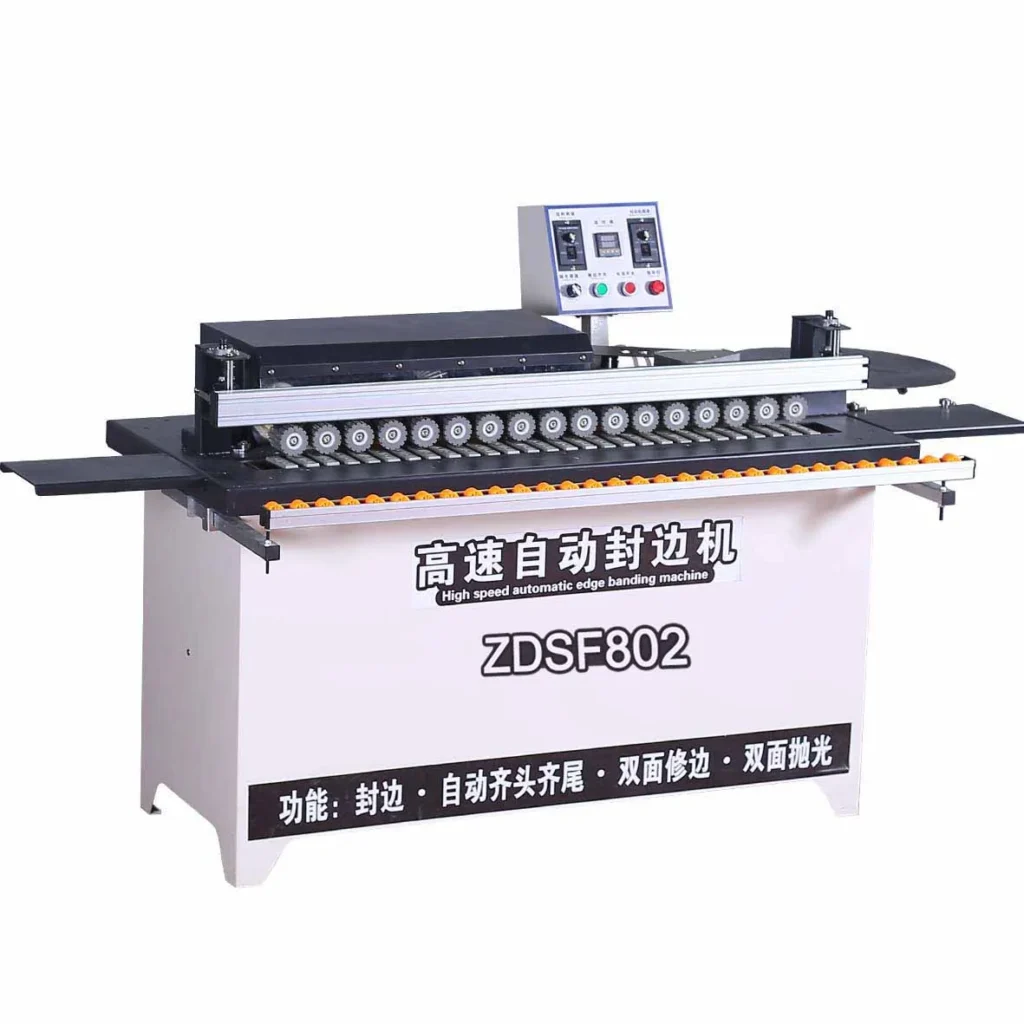
Voltage Verification Built In — the F802 automatic edge banding machine is dispatched only after matching confirmed local electrical standards to its 4kW drive and 1kW heating circuit, preventing the three-week transformer delay that halts entire cabinet lines.
Technical Specifications
| Parameter |
Value |
| Model |
F802 |
| Product Type |
Automatic Edge Banding Machine |
| Edge Type |
Straight line |
| Rated Voltage |
220V |
| Rated Power |
4 kW |
| Heating Power |
1000 W (heat-up time 5–10 min) |
| Trimming Motor Power |
800 W × 2 |
| Polishing Motor Power |
180 W × 2 |
| Suction Power |
1200 W |
| Rated Air Pressure |
0.4–0.6 MPa |
| Feed Speed |
0–10 m/min |
| Conveyor Belt Speed |
0–10 m/min |
| Strip Thickness Range |
0.5–2.5 mm |
| Sheet Thickness Range |
10–50 mm |
| Glue Pot Capacity |
4000 ml |
| Control Panel |
Digital display of glue pot temperature, independent switch |
| Pressure Beam |
One-piece, double rows of pressure wheels |
| Conveyor Belt Material |
Silicone |
| Belt Breaking Method |
Pneumatically controlled |
| Extension Support |
Extendable fluent strips for large plates |
| Overall Dimensions (L×W×H) |
130 × 65 × 75 cm |
| Machine Weight |
150 kg |
| Warranty |
1 year |
Application Suitability
| Application |
Material or Output |
| Cabinet door and carcass edge banding |
MDF, particleboard with PVC edge strips |
| Custom furniture panel edging |
Plywood and melamine-faced board with veneer strips |
| Small workshop straight-line production |
Boards 10–50 mm thick, strips 0.5–2.5 mm |
Why Voltage Must Be Locked Before Production Starts
An automatic edge banding machine specified without confirmed local voltage is a machine that will not run when the container opens. I watched a Dubai cabinet line sit idle for three weeks because a 380V unit was shipped to a 415V site — the main motor tripped on first power-up, and a replacement transformer had to be air-freighted from China. The F802 is rated at 220V, and every order requires a signed technical confirmation sheet stating local voltage, frequency, and plug configuration before the unit enters production.
[NEED_CITE: voltage and frequency standards by export market]
Selecting Feed Speed Against Panel Surface Sensitivity
The silicone conveyor belt and double-row pressure wheels on the F802 Automatic Edge Banding Machine specifications are designed to transport panels without leaving surface marks, which matters when running pre-finished melamine or veneered boards through a small workshop environment. Feed speed is adjustable from 0 to 10 m/min, letting operators slow the line for delicate PVC veneer on thin particleboard and increase pace for thicker MDF stock where surface scratching is less of a concern.
Glue Pot Capacity and Continuous Run Behaviour
A 4000 ml glue pot with a 1000 W heating element means the F802 can sustain longer production runs between refills compared to entry-level banders with smaller reservoirs. The digital temperature display lets the operator monitor adhesive viscosity in real time, which is critical when switching between EVA hot-melt formulations for different ambient workshop temperatures. Heat-up from cold takes five to ten minutes, so morning start-up delay is kept within a single shift preparation window. [NEED_CITE: EVA hot-melt adhesive operating temperature ranges]
Panel Thickness Range and Downstream Assembly Tolerance
The F802 handles sheet thickness from 10 to 50 mm and strip thickness from 0.5 to 2.5 mm, covering the common range for cabinet carcasses, shelving, and door panels in custom furniture production. Dual 800 W trimming motors perform upper and lower trimming in a single pass, followed by dual 180 W polishing motors that remove residual adhesive and smooth the strip edge. When trimming is inconsistent, panels fail to seat flush during assembly — a tolerance issue that only surfaces once the cabinet carcase is being clamped on the bench.
Pneumatic End Cutting and Operator Workload
The pneumatically controlled belt breaking mechanism handles end cutting without requiring the operator to manually score and snap the edge strip, reducing fatigue during repetitive runs of identical panel sizes. Combined with the extendable fluent strip supports, larger panels can be fed and received by a single operator, which is a practical consideration for workshops running with minimal floor staff.

The Cost of Skipping the Utility Audit
Workshops that order an edge bander without confirming compressed air supply often discover on installation day that their existing compressor cannot sustain the 0.4–0.6 MPa requirement, causing the pneumatic end cutter to stall mid-cycle. Similarly, specifying a machine that draws 4 kW on a circuit already shared with other equipment leads to nuisance tripping that operators learn to work around — until a voltage dip damages the heating element. These are not theoretical failures; they show up repeatedly on service call logs. [NEED_CITE: common causes of pneumatic tool failure in small workshops]
Manufacturing Depth Behind the Specification Sheet
The F802 is built in a facility with proprietary cutting mechanism patents, and its tolerance claims are backed by multi-stage precision grinding of components rather than catalogue assertions. Voltage configuration from 110 V to 440 V is available as standard, so the same machine platform can serve a 220 V workshop in Southeast Asia or a 415 V plant in the Middle East without redesign. Every unit passes through four quality control stages — incoming material, in-process, finished product, and pre-shipment verification — before it is crated.
Documentation & Verification
- Electrical schematic and voltage confirmation document signed before production begins
- Factory test record using your specified panel thickness and edge strip material
- Machine specification sheet with confirmed motor ratings and air pressure requirements
- Operation and maintenance manual in the agreed operator language
- Spare parts list matched to the F802 trimming and polishing consumables
Installation, Commissioning & Support
- Dedicated 220V circuit with capacity exceeding 4 kW total draw for the F802 drive and heating systems
- Compressed air line rated to minimum 0.6 MPa with moisture trap installed upstream of the machine
- 130 × 65 × 75 cm footprint requires level floor with clearance on both sides for panel infeed and outfeed
- First-run parameter setting covers glue pot temperature calibration against your specific adhesive formulation
- Silicone conveyor belt inspection and pressure wheel alignment included in commissioning checklist
What to Include With Your Enquiry
Provide your local voltage and frequency, the panel materials and thicknesses you run most frequently, and the edge strip types you intend to use — PVC, ABS, or wood veneer. If your workshop has existing upstream saws or downstream boring machines, include their feed heights so the F802 can be positioned correctly in the line flow. State your operator's working language so the control panel labels and manual are prepared accordingly.
Frequently Asked Questions
Q: Can the F802 be configured for voltage standards other than 220V?
A: Yes. The machine platform supports voltage configuration from 110 V to 440 V. The required voltage and frequency must be confirmed in writing and signed on the technical confirmation sheet before production starts, so the motor winding, heating element, and control transformer are all matched to your site supply.
Q: How does the 4000 ml glue pot affect run time between refills?
A: A larger reservoir reduces the frequency of adhesive top-ups during continuous production. The digital temperature display allows the operator to monitor glue condition without interrupting the feed, which is particularly useful when running long batches of identical cabinet panels with PVC edge strips.
Q: Can the control panel and manual be provided in my operator's language?
A: Multilingual control panel labels and operation manuals are available as part of the standard configuration. Specify the required language at the enquiry stage so documentation is prepared before the machine ships rather than translated locally after arrival.
Q: What panel and strip thickness ranges does the F802 support?
A: The F802 handles sheet thickness from 10 to 50 mm and edge strip thickness from 0.5 to 2.5 mm. This covers the standard range for MDF, particleboard, and plywood used in cabinet and custom furniture production. For requirements outside this range, higher-tier models in the product family should be evaluated.
Q: How do I verify trimming quality matches my assembly requirements?
A: Request a factory test record showing the F802 running your specific panel material and edge strip before shipment. The test should demonstrate upper and lower trimming and polishing results so you can inspect edge quality against your own assembly fit standards before the machine leaves the factory.