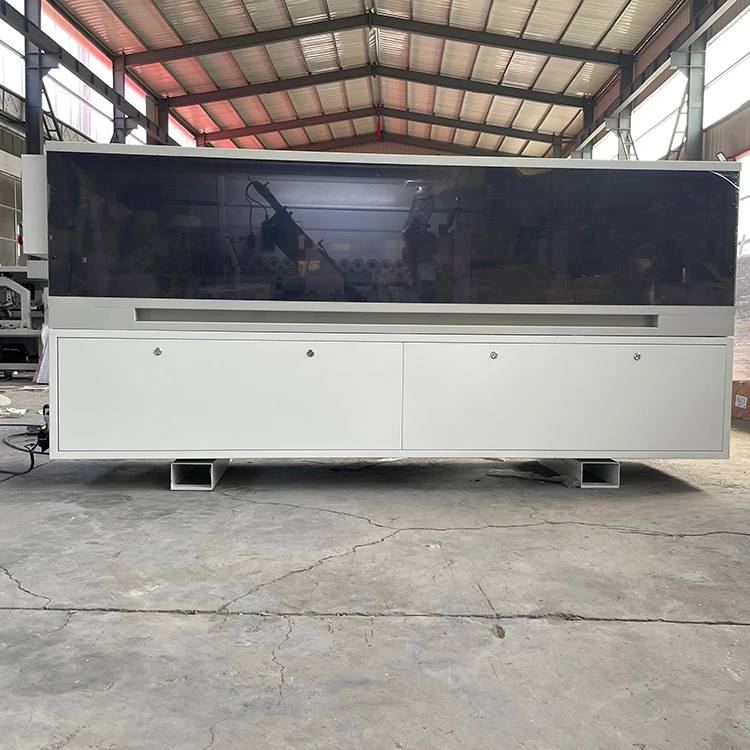
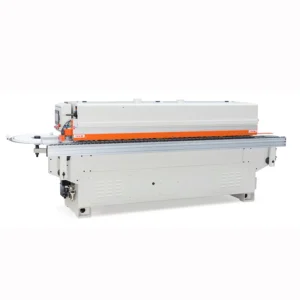
In-house tolerance verification — ZDS280B and ZDS280C edge banding specifications are validated at the factory with your actual panel material before shipment, not just claimed on a data sheet.
Technical Specifications
| Parameter |
Value |
| Model |
ZDS280B / ZDS280C |
| Product Type |
Automatic Edge Banding Machine |
| Main Function (ZDS280B) |
Gluing, End Trimming, Fine Trimming, Buffing |
| Main Function (ZDS280C) |
Gluing, End Trimming, Fine Trimming, Scraping, Buffing |
| Working Pressure |
0.6-0.8 MPa |
| Panel Thickness Range |
10-55 mm |
| Edge Thickness Range |
0.4-3 mm |
| Conveyor Belt Speed |
15 m/min |
| Min. Panel Width |
45 mm |
| Min. Panel Length |
80 mm |
| Rated Power |
7.5 kW |
| Net Weight (ZDS280B) |
650 kg |
| Net Weight (ZDS280C) |
800 kg |
| Overall Dimensions (ZDS280B) |
2300×700×1250 mm |
| Overall Dimensions (ZDS280C) |
2800×700×1250 mm |
| Fuselage Construction |
14 mm high-strength steel plate, frame-type structure, high-temperature quenching treatment |
| Conveyor Guide Rail Material |
HT260 |
| Conveying Motor |
Taiwan brand, with thermal protection system |
| Head Guide Rail |
Taiwan brand |
| Pneumatic System |
German Festo or Taiwan AirTAC cylinder and safety valve, AirTAC magnetic switch |
| Electrical Components |
Delixi/Chint air switches and contactors, Japanese Omron travel switches |
Application Suitability
| Application |
Material or Output |
| Panel furniture edge banding |
MDF and particleboard with PVC edge banding |
| Cabinet and wardrobe door production |
Plywood panels with melamine edge banding |
| Custom board processing |
Solid wood panels with veneer edge banding up to 3 mm |
| Corner rounding and edge finishing |
Finished boards requiring fine trimming and buffing |
What "Verified Tolerance" Actually Means for Edge Quality
The automatic edge banding machine specifications on paper matter less than what the machine does with your exact PVC stock and glue on a Tuesday afternoon.
I have seen edge banders of this class fail in humid workshops where the glue pot temperature drifted, leaving visible glue lines that only showed up after assembly. A tolerance figure is meaningless if the factory test was run on a material you will never use. That is why sending your actual edge banding strip and panel sample before production starts changes the entire commissioning outcome [NEED_CITE: factory testing protocols for edge banding equipment].

Station Configuration and Where Each Model Fits
The ZDS280B runs four stations — gluing, end trimming, fine trimming, and buffing — which handles standard PVC and melamine work where a clean trimmed edge is sufficient. The ZDS280C adds a scraping station between fine trimming and buffing, removing the micro-ripple that fine trimming leaves on the banding surface. If your panels go straight into cabinet assembly without additional hand finishing, that scraping pass is the difference between a visible edge transition and one that reads as flush.
How Fuselage Mass Affects Trimming Accuracy
At 15 m/min conveyor speed, any chassis flex translates directly into end-trimming error on the leading and trailing edge of the panel. The 14 mm high-strength steel frame on both models, heat-treated after welding, exists to absorb the vibration that lighter sheet-metal frames cannot. I have watched lighter machines chatter on the end trim cut when panel length exceeded 1200 mm, producing a stepped edge that downstream drilling stations then had to compensate for [NEED_CITE: structural rigidity requirements in woodworking machinery]. The HT260 cast iron guide rail material on the conveyor adds damping that complements the frame mass.
Reading the Specification Sheet Beyond the Headline Numbers
The panel thickness range of 10-55 mm covers everything from 9 mm MDF drawer sides up to 45 mm blockboard shelving, but the real constraint is the 45 mm minimum panel width — anything narrower risks the pressure rollers losing contact. The 0.4-3 mm edge thickness range accommodates thin melamine through to thick PVC, though glue pot temperature and roller pressure need recalibration at each extreme. The 7.5 kW rated power is adequate for the four- and five-station configurations but leaves limited headroom if a pre-milling unit is added later. The pneumatic requirement of 0.6-0.8 MPa means your compressor must deliver clean, dry air consistently or the Festo and AirTAC cylinders will wear prematurely.
The Cost of Skipping the Voltage Confirmation Step
One buyer in East Africa received a woodworking edge banding unit wired for 380V 50Hz, only to discover the local grid ran at 60Hz — the conveyor motor oversped, trimming stations went out of sync, and commissioning stalled for a week. The voltage configurable from 110V to 440V option exists for a reason. Always confirm your facility's exact supply before the machine enters production, because rewiring a control cabinet on site is costly and risks voiding the CE declaration [NEED_CITE: voltage and frequency standards by export market].
Why Specification Transparency Matters Here
The ZDS280B and ZDS280C are listed with component-level detail — Taiwan brand conveyor motor, Omron travel switches, Delixi contactors — so you can trace spares locally without depending on a single supply chain. The four-stage QC process includes a pre-shipment test run with your sample material, not just a dry cycle. Engineer-led configuration means the quotation accounts for your panel dimensions and edge material before the order is placed. The factory welcomes visits so you can witness the test yourself.
Documentation & Verification
- Machine specification sheet matching your confirmed voltage and frequency
- Factory test record run on your submitted panel and edge banding samples
- Electrical schematic with circuit layout for local electrician reference
- Operation and maintenance manual in your chosen language
- CE declaration of conformity and ISO 9001 certificate copies
- Packing photographs showing securing points for ocean freight
Installation, Commissioning & Support
- Foundation must be level concrete; the ZDS280C at 800 kg needs no anchor bolts but requires vibration isolation pads
- Dedicated 7.5 kW circuit with correct breaker rating; confirm phase sequence before energizing the conveyor motor
- Pneumatic supply at 0.6-0.8 MPa with inline filter-regulator-lubricator within 3 meters of the machine
- Glue pot temperature calibrated against your specific hot-melt adhesive during the first production shift
- Spare scraper blades and buffing wheels shipped with the ZDS280C for initial consumable coverage
- Daily cleaning of the glue roller and weekly conveyor belt tension check to maintain feed accuracy
What to Share When Requesting a Quotation
Provide the exact panel materials, thickness range, and edge banding type you run most frequently so the station configuration can be matched to your output. Confirm your workshop voltage and frequency, available floor space relative to the machine footprint, and whether your upstream saw and downstream boring equipment operate on a compatible feed rate. If your edge banding stock is unusual, sending a physical sample enables a meaningful factory test before the machine ships.
Frequently Asked Questions
Q: Which model handles melamine edge banding without visible glue lines?
A: The ZDS280C with its scraping station removes the fine trimming marks that melamine tends to show more than PVC does. For melamine below 1 mm thickness, the scraping pass is particularly valuable because melamine is brittle and chips easily if only trimmed. The ZDS280B can handle melamine but may require more hand finishing downstream.
Q: Can the 380V configuration be changed to match a 220V local supply?
A: Voltage is configurable across the 110V to 440V range, and the motor winding, contactor ratings, and control transformer are all matched to your confirmed supply before assembly. This must be specified at the quotation stage so the correct components are sourced. Retrofitting voltage after the machine is built is impractical and costly.
Q: How does the 15 m/min feed speed integrate with a CNC panel saw upstream?
A: At 15 m/min, the ZDS280 series processes roughly one standard cabinet side panel every ten to twelve seconds depending on panel length. A CNC beam saw cutting at a comparable rate can feed this edge bander without bottlenecking, provided panel transfer between stations is organized to avoid operator delay.
Q: Does the control panel support multiple languages for operator training?
A: Multilingual control panels are available and should be specified at the order stage. The operation manual is produced in the agreed language to match, ensuring that commissioning and daily troubleshooting do not stall due to translation gaps on the shop floor.
Q: What minimum workshop space does the ZDS280C require with material staging?
A: The ZDS280C measures 2800×700×1250 mm, but you need at least 1.5 meters of clearance on the infeed and outfeed sides for panel handling and an additional meter on the operator side for adjustment access. Total working footprint is approximately 5.8 meters long by 2.2 meters wide including operator zone.