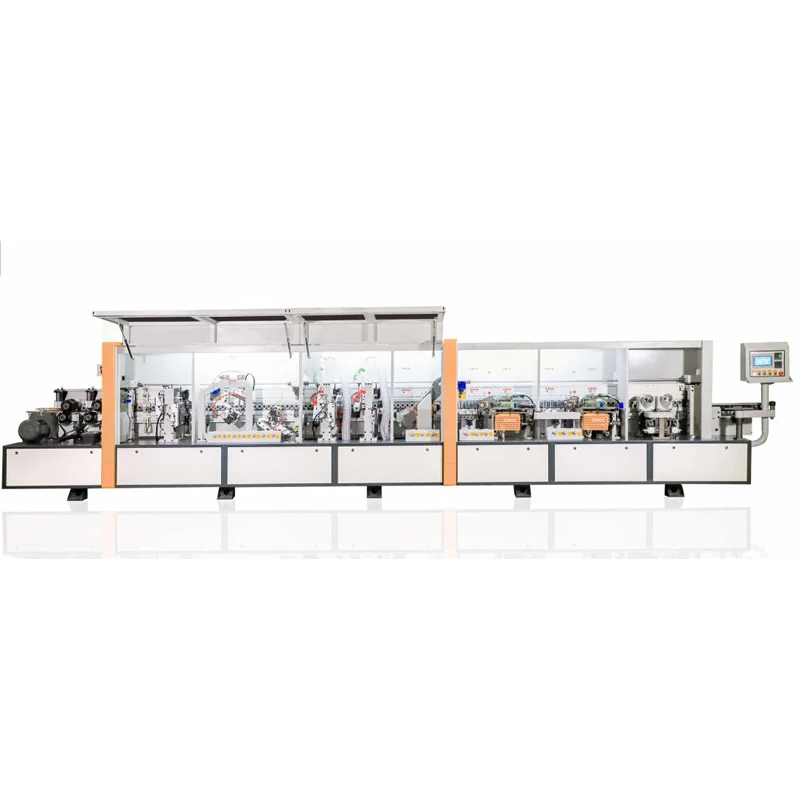
Verified Tolerance Mapping — Every ZDS-468JJ parameter from pre-milling depth to trimming rpm is documented before shipment, so technical buyers can match specifications directly against production requirements without guessing.
Technical Specifications
| Parameter |
Value |
| Model |
ZDS-468JJ |
| Product Type |
Automatic Linear Edge Banding Machine |
| Main Functions |
Pre-milling, Gluing 1, Gluing 2, End trimming, Rough trimming, Fine trimming, Corner rounding, Scraping, Buffing 1, Buffing 2 |
| Voltage |
380V-3HP (configurable from 110V to 440V) |
| Total Power |
18.5 kW |
| Working Pressure |
0.6 MPa |
| Panel Thickness Range |
10–60 mm |
| Edge Band Thickness Range |
0.4–3 mm |
| Min. Panel Size |
300×60 mm / 150×150 mm |
| Overall Dimensions |
8000×900×1600 mm |
| Weight |
2300 kg (source value — verify against manufacturer catalog) |
| Pre-milling Unit |
Diamond cutters, 12,000 rpm, 2×2.2 kW, max. depth of cut 2 mm, cutter width 65 mm |
| End Trimming Unit |
Two high-frequency motors, 0.37 kW each, 12,000 rpm |
| Rough Trimming System |
Two high-frequency motors, 0.75 kW each, 12,000 rpm, 6-teeth flat cutters, manual thickness adjustment |
| Fine Trimming System |
Two high-frequency motors, 0.75 kW each, 12,000 rpm, 6-teeth R2 cutters, manual thickness adjustment |
| Corner Rounding Unit |
Four-motor profiling with tracking and trimming |
| Edge Scraping Unit |
Electro-pneumatically controlled blowing |
| Buffing Unit |
Upper and lower double buffing |
| Glue System |
Double glue pot, optional PUR device, optional Quick Sol Unit with upper melt and dual pre-melt |
| Control System |
PLC control system |
| Key Features |
Narrow plate auxiliary device, flexible edge scraping, 6 sets pressing rollers, optional slotting device |
Application Suitability
| Application |
Material or Output |
| Custom furniture panel edging |
MDF and plywood with PVC or ABS edge banding |
| Cabinet door and carcass production |
Particleboard with 0.4–3 mm melamine or ABS edging |
| Panel processing for joinery workshops |
Solid wood panels requiring pre-milling before edge application |
| High-volume board finishing lines |
MDF, plywood and particleboard substrates in sequential processing |
Why the Voltage Question Must Come Before the Quotation
A machine built for the wrong grid standard is dead weight on the factory floor until an external transformer arrives.
I once shipped a full-function edge bander to a Dubai job site configured at 380V/50Hz, only to discover the local supply was 220V/60Hz. The site contractor waited three weeks for a step-up transformer while the installation crew sat idle and penalty clauses started accumulating. That single oversight cost far more than the transformer itself. Every export market runs on different voltage and frequency standards [NEED_CITE: voltage and frequency standards by export market], and a unit wired for the wrong combination will either fail to start or damage its high-frequency trimming motors within hours. The ZDS-468JJ is configurable from 110V to 440V, but the correct configuration must be locked in before production begins — not discovered at the port of destination.

Reading the ZDS-468JJ Automatic Edge Banding Machine Specifications Against Your Line
A technical buyer evaluating automatic edge banding machine specifications needs to know where this model sits relative to production demand. The 18.5 kW total power draw places it in the mid-range bracket for full-function linear edge banders, meaning the electrical infrastructure in most established furniture factories can absorb it without a dedicated substation upgrade. The 8000 mm overall length defines the floor space commitment — plan for infeed and outfeed conveyors on both ends when laying out the cell. The PLC control system allows parameter storage for recurring panel profiles, reducing changeover time between batch runs.
Trimming Station Configuration and Edge Finish Quality
The transition from rough trimming to fine trimming defines the visible edge quality on finished panels. The ZDS-468JJ allocates separate high-frequency motors to each stage: 0.75 kW at 12,000 rpm for rough trimming with flat cutters, then the same motor rating with R2 profile cutters for fine trimming. This separation means the rough station removes the bulk of excess banding material while the fine station produces the final contour. The corner rounding unit uses four motors for profiling and tracking, supporting multiple edge profiles including rounded and diamond corners [NEED_CITE: edge profiling standards in furniture panel manufacturing]. Manual thickness adjustment on both trimming stations means the operator sets the cutter position for each edge band thickness change — a deliberate choice that simplifies maintenance at the cost of slower changeovers compared to pneumatic adjustment.
How Core Parameters Translate on the Shop Floor
The pre-milling station deserves close attention because it determines how well the machine compensates for panel sizing inaccuracies from the saw. Two diamond cutter heads running at 12,000 rpm with a maximum 2 mm depth of cut and 65 mm cutter width can clean up minor tear-out on MDF and particleboard edges before the glue is applied. If your panels arrive from the beam saw with visible chipping on the cut face, this station removes it — but only up to 2 mm, so the upstream saw must still hold reasonable tolerances. The 10–60 mm panel thickness range covers standard furniture board stock as well as thicker shelving and worktop substrates. The 0.6 MPa working pressure requirement means the existing compressed air system must deliver consistent pressure; a drop below this threshold causes the pressing rollers and pneumatic scraping units to lose effectiveness, leaving visible glue lines or incomplete scraping on the finished edge.
The Cost of Skipping Specification Verification
When a technical buyer approves a purchase based on a brochure summary without examining station-level detail, problems surface during commissioning. A factory running predominantly 0.4 mm PVC edging may find the manual thickness adjustment on the rough and fine trimming stations acceptable for short runs, but operators handling frequent changeovers between 0.4 mm and 3 mm ABS will spend measurable time resetting cutter positions. Compressed air supply is another frequent blind spot: if the workshop compressor cannot sustain 0.6 MPa under continuous draw, the electro-pneumatic scraping unit and pressing rollers will perform inconsistently [NEED_CITE: compressed air sizing for pneumatic woodworking equipment]. These are not machine defects — they are specification mismatches that a thorough pre-order review would have caught.
What Backs the Numbers on the Sheet
In-house manufacturing with patented cutting mechanisms means the pre-milling tolerance claims are verifiable against physical test cuts, not copied from a catalog template. The full product family from entry-level to full-function allows a workshop to specify the ZDS-468JJ now and add compatible upstream or downstream units later without changing the equipment supplier. Voltage and control panel language customization is treated as standard configuration, not a special request, so the machine arrives matching the local grid and the operator's reading language. A four-stage quality control process covers incoming material inspection through pre-shipment verification, and the factory test record documents actual performance on your specified panel thickness range before the crate is sealed.
Documentation & Verification
- CE declaration of conformity covering the ZDS-468JJ trimming and glue system safety requirements
- Electrical schematic confirming your specified voltage and frequency before production starts
- Factory test record on your panel thickness and edge band material combination before dispatch
- Operation and maintenance manual in the agreed operator language with illustrated spare parts list
- Packing photographs showing crate condition and component securing before container loading
Installation, Commissioning & Support
- 8000×900 mm footprint requires level concrete flooring with clearance for infeed and outfeed material flow
- 18.5 kW total power demands a dedicated circuit breaker rated above continuous draw with correct voltage matching
- 0.6 MPa compressed air supply must be verified at the machine inlet before first startup
- PLC parameter setup for panel thickness range 10–60 mm and edge band thickness 0.4–3 mm during commissioning
- Diamond pre-milling cutter heads and high-frequency trimming motors require scheduled inspection intervals documented in the manual
- Narrow plate auxiliary device and flexible edge scraping unit calibrated to your most common board width during site training
Preparing Your Specification Enquiry
To receive an accurate configuration proposal for the ZDS-468JJ, share your primary panel substrate types and thickness distribution, the edge banding materials and thicknesses you run most frequently, and the local voltage and frequency at the installation site. Include the language requirement for the PLC interface and operation manual. If your line includes upstream saws or downstream boring stations, note their throughput so the feed speed can be matched accordingly.
Frequently Asked Questions
Q: What panel thickness and edge band thickness ranges does the ZDS-468JJ cover, and how do they map to common substrates?
A: The machine handles panel thickness from 10 to 60 mm and edge band thickness from 0.4 to 3 mm. This covers standard MDF, plywood and particleboard furniture panels with PVC, ABS or melamine edging. Thicker panels such as worktop substrates fall within range, while very thin stock below 10 mm sits outside the design envelope.
Q: Is the 380V-3HP voltage fixed, or can the machine be configured for other local standards?
A: The ZDS-468JJ is configurable from 110V to 440V. The correct voltage and frequency must be confirmed before production begins so the motors and control system match your site supply. An electrical schematic and voltage confirmation document are issued for approval prior to build.
Q: How does the double glue pot system work in practice during color changeovers?
A: Two separate glue pots allow different adhesive colors to remain loaded simultaneously. When switching between light and dark edge banding within the same shift, the operator selects the alternate pot through the PLC without draining or cleaning the first. An optional PUR device and Quick Sol Unit are available for moisture-reactive adhesive applications.
Q: Can the PLC control interface language be customized for the local operator?
A: Yes, multilingual control panels are available as standard configuration. The agreed language is set during the specification confirmation stage so the interface, alarm messages and parameter labels are readable from first startup. The operation manual is also produced in the same language.
Q: How do the optional slotting device and Quick Sol Unit affect the machine layout?
A: Adding the slotting device extends the overall machine length and may increase total power draw beyond the base 18.5 kW. The Quick Sol Unit with upper melt and dual pre-melt system modifies the glue application section. Both options require updated electrical schematics and floor layout drawings before order confirmation.