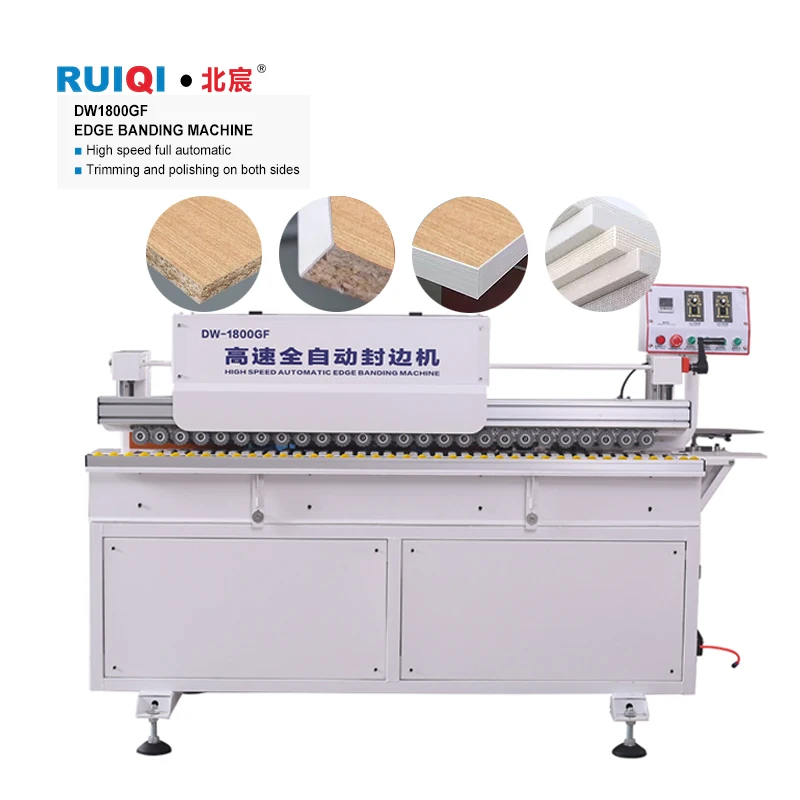
Precision-Matched Configuration — every electrical, mechanical and control parameter of the DW1800 automatic edge banding machine is documented and confirmed before the unit leaves the factory.
Technical Specifications
| Parameter |
Value |
| Model |
DW1800 |
| Product Type |
Automatic Edge Banding Machine |
| Total Power |
4.9 kW |
| Voltage Options |
380V / 220V / 415V (frequency to be confirmed per market) |
| Control System |
PLC (brand and model confirmed at order) |
| Feed Speed |
0–14 m/min |
| Edge Banding Thickness |
0.3–3 mm |
| Edge Banding Height |
0–50 mm |
| Minimum Sheet Length |
200 mm |
| Minimum Sheet Width |
100 mm |
| Trimming Motor Power |
800 W × 2 |
| Trimming Motor Speed |
24,000 r/min |
| Polishing Motor Power |
380 W × 2 |
| Vacuum Power |
550 W |
| Glue Pot Capacity |
4,000 ml |
| Air Source Pressure |
0.4–0.6 MPa |
| Standard Functions |
Double-sided gluing, front/rear alignment, top/bottom trimming, flexible edge scraping, top/bottom polishing, dust extraction |
| Language Options |
Chinese and English standard; additional languages available on request |
| Plug Options |
EU, USA, AU, UK configurations available |
| Overall Dimensions (L×W×H) |
220 × 65 × 125 cm |
| Net Weight |
320 kg |
| Certification |
CE, ISO 9001 |
Application Suitability
| Application |
Material or Output |
| Custom cabinet door and carcass production |
MDF, particleboard, plywood with PVC or melamine edge banding |
| Wardrobe and shelving panel finishing |
ABB boards and melamine-faced chipboard with 0.4–2 mm PVC strips |
| Joinery workshop small-batch runs |
Solid wood panels and veneer banding on furniture components |
| Contract furniture panel processing |
Plywood and blockboard with wood veneer or ABS edge strips |
| Office and retail fixture manufacturing |
Organic glass plates and high-pressure laminate panels within thickness range |
Why the Voltage Question Should Come Before the Price on Every Automatic Edge Banding Machine Specification
A machine wired for 380V/50Hz that arrives in a 220V/60Hz workshop does not run — it sits on the floor until a transformer or rewinding solves the problem.
Over the years I have watched panels plants take delivery of woodworking equipment only to discover the motor nameplate does not match their incoming supply. The cost of a step-down transformer, the downtime waiting for an electrician, and the risk of premature motor failure from incorrect frequency all erase whatever was saved on the purchase price. Confirming voltage, phase and frequency at the quotation stage — not after the container is loaded — is the single most practical step a buyer can take. [NEED_CITE: voltage and frequency standards by export market]

Feed Speed Range and What It Means for Your Daily Panel Volume
The DW1800 covers a feed speed range from 0 to 14 m/min. A slower feed at 4–6 m/min gives the glue more open time on porous substrates like raw particleboard, while 10–14 m/min suits sealed melamine surfaces where adhesion is less demanding. Matching the speed to the substrate prevents both starved glue joints and squeeze-out that contaminates the trimming station. This is where automatic edge banding machine specifications matter beyond the brochure number.
Eight Integrated Stations in a Single 2.2-Metre Frame
From the front alignment roller through double-sided gluing, end cutting, rough and fine trimming, profile scraping, and top/bottom polishing, every station sits on one bed. The compact 220 × 65 cm footprint means the unit fits into a cell between a panel saw and a boring machine without requiring a dedicated room. Operators load at one end and receive a finished panel at the other, eliminating the intermediate handling that chips freshly trimmed edges. [NEED_CITE: CE machinery directive requirements for industrial equipment]
Reading the Numbers That Actually Affect Edge Quality
The 800 W × 2 trimming motors running at 24,000 r/min are the specification I look at first. Higher spindle speed produces a cleaner shear cut on PVC and veneer, reducing the visible chatter marks that show up under LED cabinet lighting. The 0.3–3 mm banding thickness range covers standard 0.4 mm melamine through 2 mm PVC and 3 mm ABS, so the same unit handles both economy shelving and premium wardrobe fronts. The 4,000 ml glue pot holds enough adhesive for continuous runs without mid-batch refills, and the 0.4–0.6 MPa air pressure window aligns with standard workshop compressors. Panel length down to 200 mm and width down to 100 mm lets you edge-band small drawer sides and filler strips that larger machines simply cannot grip.
The Hidden Cost of Skipping the Specification Conversation
When a buyer orders on price alone without verifying the trimming configuration or air pressure requirement, the machine may arrive with scraping blades set for a banding thickness the workshop never uses. Operators then spend hours adjusting, producing scrap panels in the process. I once saw a batch of high-gloss cabinet doors rejected because the fine trim left a 0.5 mm step that caught light at certain angles — a problem traced back to a feed speed that was too high for the 1 mm acrylic strip. Every panel scrapped is material, labour and delivery deadline lost. [NEED_CITE: tolerance impact on downstream cabinet assembly]
What You Receive Beyond the Machine Itself
The DW1800 ships with a factory test record run on the buyer's specified panel thickness and banding material, not a generic run-off. An electrical schematic confirms the voltage and plug configuration before wiring begins on the assembly floor. The four-stage QC process — incoming material, in-process, finished unit and pre-shipment — means each station is checked under load, not just powered on. Custom control panel language is set before dispatch so the operator reads instructions in their working language from day one. Engineer-led configuration ensures the unit matches the actual panel mix and daily volume of the workshop it enters.
Documentation & Verification
- CE declaration of conformity covering the DW1800 mechanical and electrical safety scope
- Electrical schematic confirming ordered voltage, frequency and plug type before dispatch
- Factory test record on buyer-specified panel material and edge banding thickness
- Machine specification sheet with verified trimming tolerance and feed speed data
- Operation and maintenance manual supplied in the buyer's chosen language
- Spare parts list with part numbers matching the as-built station configuration
Installation, Commissioning & Support
- 220 × 65 cm footprint requires a level concrete floor with clearance for panel infeed and outfeed
- Dedicated 380V or 220V circuit matched to the confirmed 4.9 kW total draw
- Arrives partially assembled; trimming and polishing stations require on-site alignment
- First-run calibration of glue temperature and roller pressure for your specific banding material
- Operator training on PLC menu navigation in the agreed control panel language
- Trimming blades and scraping tools listed as consumables with reorder part numbers
What to Share When Requesting a Quotation
Send the panel materials you run most often — MDF, particleboard, plywood or solid wood — along with the edge banding type and thickness range. Specify your workshop voltage, phase and frequency so the motor and control transformer are wound correctly. Mention any upstream panel saw and downstream boring machine so feed height and throughput can be aligned across the line.
Frequently Asked Questions
Q: How do I confirm the DW1800 voltage matches my workshop supply?
A: Provide your incoming voltage, phase and frequency at the enquiry stage. An electrical schematic is issued for approval before production begins, confirming the motor winding, control transformer and plug type. This avoids costly on-site rewiring or transformer purchases after delivery.
Q: What control panel languages can be specified?
A: Chinese and English are standard. Additional languages are configured before dispatch based on buyer request. The PLC interface labels and alarm messages are translated so operators can read instructions and fault codes without a secondary translation step.
Q: How should I choose feed speed for different panel materials?
A: Porous substrates like raw particleboard benefit from slower feed speeds that allow longer glue open time, while sealed melamine surfaces tolerate faster feeds. The 0–14 m/min range lets you set speed per material. A sample test on your actual boards confirms the optimal setting before production starts.
Q: What documents verify the specifications before and after shipment?
A: You receive a confirmed machine specification sheet, electrical schematic, factory test record run on your panel material, CE declaration and an operation manual in your chosen language. Packing photographs and customs documentation are also supplied for logistics tracking.
Q: How does the DW1800 fit into an existing panel processing line?
A: With a 220 × 65 cm footprint and 125 cm working height, it aligns with standard panel saws and boring machines. Share your upstream and downstream equipment details so infeed and outfeed heights match, preventing panel damage during transfer between stations.