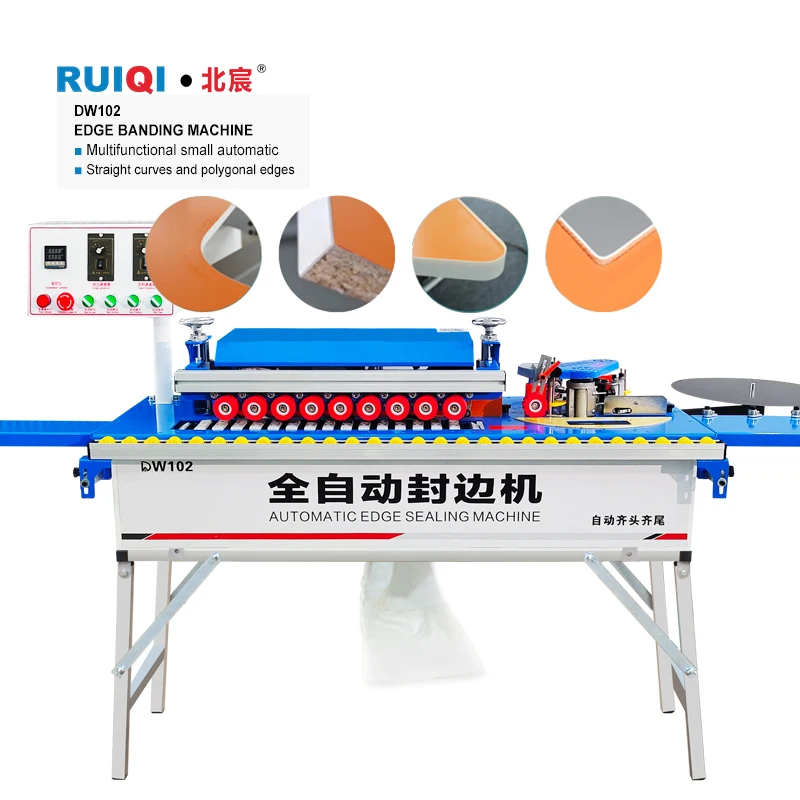
Voltage-verified configuration — every DW102 ships only after its electrical schematic is cross-checked against the destination site's supply frequency and phase, eliminating commissioning stalls that arise from mismatched utility input.
Technical Specifications
| Parameter |
Value |
| Model |
DW102 |
| Product Type |
Automatic Edge Banding Machine |
| Total Power |
3800 W |
| Voltage & Frequency |
220V / 380V / customization (frequency to be confirmed) |
| Overall Dimensions (L × W × H) |
128 × 47 × 69 cm |
| Net Weight |
75 kg |
| Minimum Panel Length |
25 cm |
| Minimum Panel Width |
5 cm |
| Edge Banding Height |
0–50 mm |
| Edge Banding Thickness |
0.3–3 mm |
| Edge Feed Motor Power |
20 W |
| Transmission Motor Power |
60 W |
| Trimming Motor Power |
650 W × 2 |
| Polishing Motor Power |
180 W × 2 |
| Vacuum Power |
1200 W |
| Glue Pot Capacity |
1000 ml |
| Air Source Pressure |
0.5–0.8 MPa |
| Standard Functions |
Curved and straight edge banding, edge trimming, polishing, automatic head-and-tail cutting, vacuum hold-down |
| Feed Speed |
(basis to be confirmed) |
| Panel Thickness Range |
(basis to be confirmed) |
| Tolerance |
(basis to be confirmed) |
| Language Options |
Chinese / English default; Spanish and other languages customizable |
| Assembly State |
Fully assembled, ready to operate |
Application Suitability
| Application |
Material or Output |
| Cabinet door edge finishing |
MDF and plywood with PVC or veneer banding |
| Custom furniture short-run production |
Particleboard and blockboard with melamine edge |
| Joinery workshop automation upgrade |
Polymer doors and solid wood panels on curved and straight profiles |
| Small-batch panel processing |
Mixed substrate runs requiring quick banding thickness changes |
Why the Voltage Question Should Come Before the Price
An edge bander that cannot be energized on arrival stops the entire line, not just one station.
I once configured a unit for an Eastern European cabinet factory and missed a local 400 V / 50 Hz neutral requirement during the drawing phase. The machine tripped the main breaker on first power-up, and the client's production floor sat idle for two weeks while a transformer was sourced locally. Since then, I pull the electrical engineer into every pre-order review to confirm phase, frequency, and grounding against the buyer's actual panel board [NEED_CITE: voltage and frequency standards by export market]. When evaluating DW102 edge banding machine specifications, the utility confirmation is the single most consequential line item — more so than feed speed or trimming motor wattage, because a machine that cannot run cannot be evaluated at all.

Mapping the DW102 Envelope to Your Upstream and Downstream Stations
A standalone edge bander only performs as well as its fit within the surrounding workflow. The DW102 edge banding machine specifications define a 25 cm minimum panel length and a 5 cm minimum width, which means small offcut pieces from a sliding table saw can be banded without manual fixturing. Matching this footprint to the output rate of your panel saw and the cycle time of your boring station prevents bottleneck accumulation at either end of the cell.
Curved and Straight Edge Capability in One Pass
Workshops that handle both radius-front cabinet doors and standard rectangular shelving benefit from a single machine covering both geometries. The DW102 performs curved and straight edge banding within the same fixture setup, switching between profiles without tooling changeover. This reduces the number of handling passes and keeps edge quality consistent across mixed-order batches [NEED_CITE: edge banding process standards for MDF and plywood substrates].
Reading the Power and Trimming Configuration
The twin 650 W trimming motors remove excess banding material from the top and bottom edge in a single pass, which is adequate for PVC and veneer up to 3 mm thickness on MDF and particleboard. The 180 W × 2 polishing motors follow immediately to smooth the trimmed edge, producing a finish that does not require secondary hand-sanding before assembly. The 1200 W vacuum hold-down motor secures lighter panels — particularly thin MDF stock — against lateral drift during feed, a factor that directly affects the consistency of the glue line. Glue pot capacity at 1000 ml supports sustained runs without frequent refill pauses, though the actual thermal recovery rate of the pot should be verified for high-volume EVA adhesives [NEED_CITE: EVA glue pot temperature ranges for wood panel edge banding].
The Hidden Cost of a Specification Gap at Order Time
Purchasing an edge bander on listed features alone, without written confirmation of panel thickness range and feed speed, surfaces as a throughput mismatch once the machine is integrated into a live production cell. Panels that exceed the undocumented thickness limit jam the feed rollers; panels that fall below the lower threshold skip the trimming station entirely. Neither failure damages the machine, but both halt downstream assembly and inflate scrap counts. The remedy is a pre-shipment factory test record that documents the exact panel range used during verification, signed against the buyer's specified substrate [NEED_CITE: pre-shipment inspection documentation for woodworking machinery].
Why Source the DW102 Through This Configuration Channel
In-house manufacturing with patented cutting mechanisms means the trimming geometry can be reviewed at the engineering level, not only at the brochure level. Voltage and language customization are treated as standard order-line items rather than special requests, so the control panel arrives readable by the operator on day one. A four-stage quality control sequence — incoming material, in-process, finished product, and pre-shipment verification — catches tolerance drift before the crate is sealed. Engineer-led configuration recommendations are issued within one working day of receiving the buyer's panel schedule and utility data. Factory visits are welcomed for buyers who want to witness a live test run on their own sample stock.
Documentation & Verification
- Electrical schematic confirming your local voltage and frequency before production starts
- Machine specification sheet listing confirmed panel thickness range and feed speed
- Factory test record run on your specified MDF or plywood substrate
- Operation and maintenance manual in the language your operators read
- Spare parts list matched to DW102 trimming and polishing consumables
- Packing photographs for condition verification at destination port
Installation, Commissioning & Support
- Allocate a dedicated 3800 W circuit with correct phase and grounding per the confirmed schematic
- Position the 128 × 47 × 69 cm frame with clearance for long-panel feed and operator access
- Machine arrives fully assembled; connect compressed air at 0.5–0.8 MPa and power
- First-run calibration of trimming and polishing heads against your banding material thickness
- Review vacuum hold-down pressure settings for your thinnest and heaviest panel stock
- Establish a preventive schedule for glue pot cleaning and trimmer blade replacement
Requesting a Configuration Proposal
Send the substrate types and panel thickness range you process most frequently, along with the voltage and frequency available at your facility. Include the language your operators require for the control interface, and note any upstream saw or downstream boring equipment whose throughput the edge bander must match. If you have sample panels available, a test run before shipment can be arranged to validate edge finish and dimensional tolerance on your actual stock.
Frequently Asked Questions
Q: How do I confirm the panel thickness range and feed speed for the DW102?
A: These values are not published in the current data sheet, so a formal request to the engineering team is necessary. Provide your most common panel thickness and material type, and a specification sheet will be issued listing the confirmed range along with a factory test record demonstrating the machine running your substrate before dispatch.
Q: What voltage documentation is issued before the DW102 ships?
A: An electrical schematic confirming phase, voltage, and frequency is reviewed and signed off before production begins. This document is included in the shipping package alongside the machine specification sheet, ensuring the on-site electrician can connect the unit without sourcing additional transformers or adapters.
Q: Can the DW102 handle both curved and straight edge profiles?
A: Yes. The machine performs curved and straight edge banding in the same setup, supported by automatic head-and-tail cutting and vacuum hold-down. This means radius-front cabinet doors and rectangular shelf panels can be processed in a single batch without tooling changeover or manual repositioning.
Q: What compressor capacity does the 0.5–0.8 MPa air requirement imply?
A: The air source must sustain 0.5–0.8 MPa at the machine inlet under continuous duty. Upstream filtration for moisture and particulates is recommended to protect the pneumatic cylinders in the trimming and polishing stations. Your compressor supplier can size the unit based on the total CFM draw of all pneumatic stations on the line.
Q: How should I match the DW102 throughput to my existing saw and boring machines?
A: Share the cycle time and panel output rate of your sliding table saw and multi-boring station so the engineering team can map feed speed against the line balance. This prevents accumulation at the edge bander infeed or idle time at the boring station, keeping the cell synchronized across mixed-order production runs.