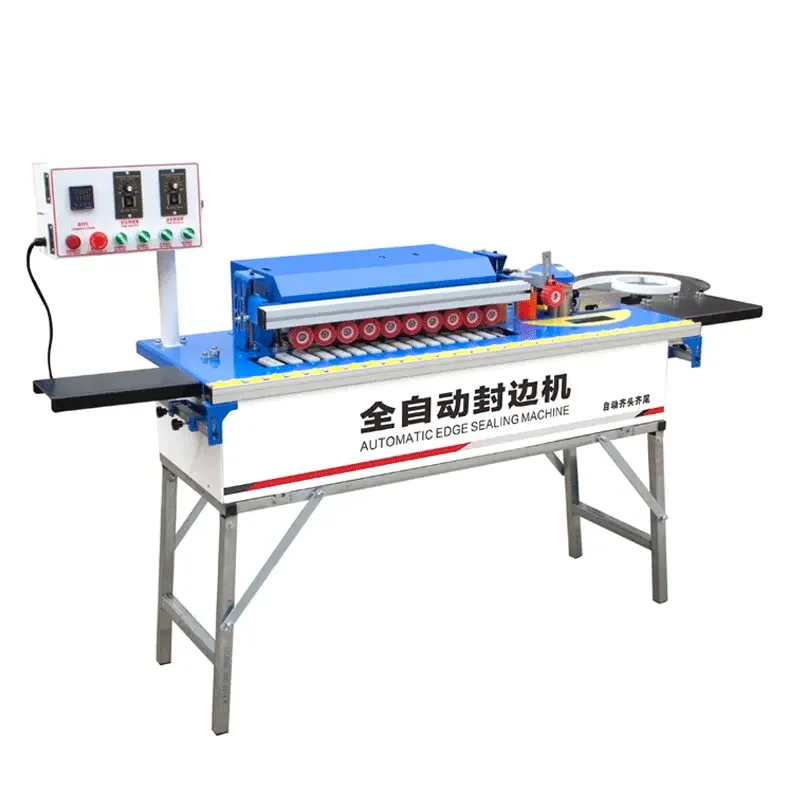
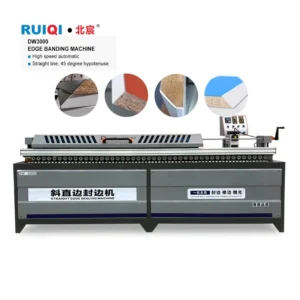
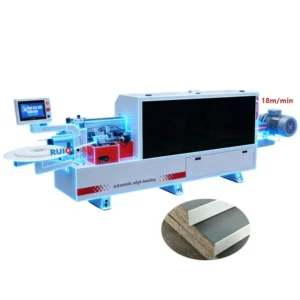
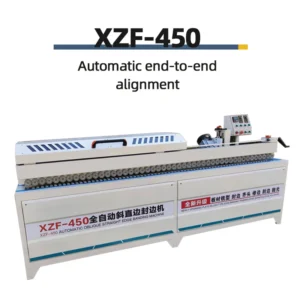
Custom voltage and language configuration as standard — every DW102 is wired to match your site's exact electrical standard before it leaves the factory, verified on the test bench before dispatch.
Technical Specifications
| Parameter |
Value |
| Model |
DW102 |
| Product Type |
Automatic Edge Banding Machine |
| Rated Power |
3800W total |
| Voltage & Frequency |
220V/380V/customization (frequency to be confirmed) |
| Motor Configuration |
Trimming 650W×2, Polishing 180W×2, Vacuum 1200W, Edge 20W, Transmission 60W |
| Overall Dimensions (L×W×H) |
128×47×69 cm |
| Net Weight |
75 kg |
| Minimum Sheet Length |
25 cm |
| Minimum Sheet Width |
5 cm |
| Edge Banding Height |
0–50 mm |
| Edge Banding Thickness |
0.3–3 mm |
| Glue Pot Capacity |
1000 ml |
| Air Supply |
0.5–0.8 MPa |
| Language Options |
Chinese and English standard; Spanish or other languages customizable |
| Trimming Stations |
Automatic head and tail cutting, edge trimming, polishing |
| Dust Extraction |
Vacuum included, 1200W |
| Key Features |
Curved and straight edge banding, integrated edge trimming, polishing, automatic head-and-tail, dustless operation |
Application Suitability
| Application |
Material or Output |
| Cabinet door and drawer front edge sealing |
MDF, particleboard with PVC or veneer banding |
| Wardrobe and shelving panel finishing |
Plywood and blockboard with 0.3–3 mm edge tape |
| Polymer door profile edge treatment |
Polymer substrates requiring curved edge sealing |
| Small-batch custom furniture components |
Solid wood panels and wood composite boards |
| Joinery workshop straight and curved edges |
Medium density fiberboard and plywood panels |
What "Compatible with Your Panels" Actually Means in Edge Banding Machine Specifications
Confirm your substrate thickness and banding material range against the machine's feed envelope before the order is placed — not after the crate is opened.
I have seen edge banding machines of this class arrive at workshops where the PVC banding thickness sat outside the accepted range, and the feed rollers could not maintain consistent pressure on the panel edge. The result was visible glue lines and delamination within the first production run [NEED_CITE: edge banding adhesion failure causes in furniture manufacturing]. The DW102 covers edge banding thickness from 0.3 mm to 3 mm and handles panel heights up to 50 mm, but these numbers must be cross-checked against the actual materials sitting on your shop floor. A technical buyer comparing edge banding machine specifications should request a processing test using their own substrate samples before committing to a purchase order.

Mapping Motor Allocation to Your Daily Duty Cycle
The DW102 distributes its 3800W total power across dedicated motors for trimming, polishing, vacuum extraction, and panel transmission. This separation matters when you evaluate edge banding machine specifications against continuous production demands. The twin 650W trimming motors handle head-and-tail cutting plus edge profiling, while the 180W polishing pair finishes the edge surface. Understanding which motor governs which station helps you assess whether the machine will sustain your expected cycle without thermal stress building up in any single drive unit.
Feed Speed, Panel Dimensions, and Line Integration
The minimum sheet dimensions of 25 cm length and 5 cm width define the smallest workpiece this machine will reliably accept through the feed path. Technical buyers evaluating edge banding machine specifications need to verify whether these minimums align with their smallest production formats — narrow drawer sides or small shelf brackets, for instance [NEED_CITE: minimum workpiece dimensions for automatic feed systems in woodworking]. The air supply requirement of 0.5–0.8 MPa must also be factored into your workshop's existing compressor capacity. If your upstream cutting station produces panels below these minimums, a manual pass-through or an auxiliary feed table may be necessary before the panel enters the banding sequence.
How Trimming Station Configuration Affects Edge Finish
The DW102 sequences automatic head-and-tail cutting, edge trimming, and polishing in a single linear pass. The two 650W trimming motors remove excess banding material at the panel ends and along the top and bottom edges, while the 180W polishing motors smooth the trimmed surface. For MDF and particleboard, this multi-stage approach reduces the fiber tear that single-stage trimming often leaves behind. The 1000 ml glue pot capacity determines how many linear meters of banding can be completed before a refill is required — production planners should calculate this against their typical batch sizes to assess whether continuous running is feasible or whether scheduled stops will be needed.
The Real Cost of Skipping Voltage Confirmation
I once visited a furniture factory where a newly delivered edge bander sat idle for three weeks because the local supply was 220V single-phase and the machine had been built for 380V three-phase. The rewinding cost exceeded the shipping savings the buyer thought they had negotiated. With the DW102 available in 220V, 380V, or custom configurations, the voltage and frequency must be documented in writing before production begins. This is not a checkbox — it is the difference between commissioning on arrival and commissioning after an expensive transformer installation [NEED_CITE: industrial machinery voltage mismatch incidents in Southeast Asian markets].
Why Technical Buyers Choose This Configuration
The DW102 sits within a product family that allows a workshop to start with this compact unit and scale to higher-capacity models from the same manufacturer without retraining operators on an unfamiliar control layout. Voltage and language customization are treated as standard order parameters rather than special requests, meaning the operation manual and control panel will match the operators who will run the machine daily. A four-stage quality control process covers incoming material inspection, in-process assembly checks, finished product testing, and pre-shipment verification — each documented and available for review. The factory test record is run on your specified substrate and banding material, not on a generic sample, so edge quality is validated before the machine is crated.
Documentation & Verification
- Electrical schematic confirming your specified voltage and frequency before build commencement
- Factory test record documenting edge sealing quality on your submitted panel and banding samples
- Machine specification sheet with all dimensional and power values listed for cross-reference
- Operation and maintenance manual delivered in the agreed language for your floor operators
- Packing photographs and spare parts list included in the dispatch documentation set
Installation, Commissioning & Support
- Verify workshop floor can support 75 kg net weight within the 128×47×69 cm footprint before delivery
- Confirm dedicated electrical circuit matches the specified 220V or 380V configuration with correct frequency
- Compressed air supply must deliver 0.5–0.8 MPa cleanly to the machine's pneumatic connections
- Initial glue pot temperature calibration should be performed on your actual banding material during first run
- English-language control panel as standard, with alternative languages configurable before shipment
Request a Configuration Quote
To receive an accurate specification proposal for the DW102, share your primary substrate types and their thickness range, your local voltage and frequency standard, the edge banding materials you run most frequently, and whether your operators require a specific control panel language. If you have a target throughput in linear meters per shift, include that so the glue pot capacity and motor duty cycle can be evaluated against your production plan.
Frequently Asked Questions
Q: How do I confirm the correct voltage and frequency for my workshop before ordering?
A: Share your local electrical supply standard — both voltage and frequency in Hz — during the inquiry stage. The DW102 is configurable across 220V, 380V, and custom voltages. An electrical schematic is produced and sent to you for confirmation before the machine is built, preventing the situation where a machine arrives on site and cannot be powered without an external transformer.
Q: The feed speed in meters per minute is not listed — how do I get a verified number?
A: Feed speed depends on the specific motor and transmission configuration selected for your order. Request a verified m/min value as part of the formal quotation, and provide your upstream and downstream station speeds so the engineer can confirm the DW102 will synchronize with your existing line without creating a bottleneck or forcing panels to queue at the infeed.
Q: What tolerance can I expect, and how is it validated before shipment?
A: Tolerance values are confirmed during the factory test, which is run on your actual substrate and banding material samples. Request a factory test record that documents measured edge overhang and trimming accuracy on your panels. This record serves as your verification document and should be reviewed before you authorize shipment of the machine.
Q: Will the 1000 ml glue pot support continuous production runs?
A: The 1000 ml capacity covers a defined length of edge banding before refill is needed, and that length depends on your banding thickness and glue application rate. Share your typical batch size and daily linear meter target so the engineer can assess whether the DW102's glue pot supports uninterrupted running or whether planned refill pauses should be factored into your shift planning.
Q: How do I confirm the machine handles all the banding materials in my production mix?
A: The DW102 accepts edge banding thickness from 0.3 mm to 3 mm and panel heights from 0 to 50 mm. Submit samples of each banding material you use — PVC, veneer, or ABS — along with your panel substrates, and request a processing test. The resulting test record will show edge adhesion quality and trimming finish for each material combination before you place the order.