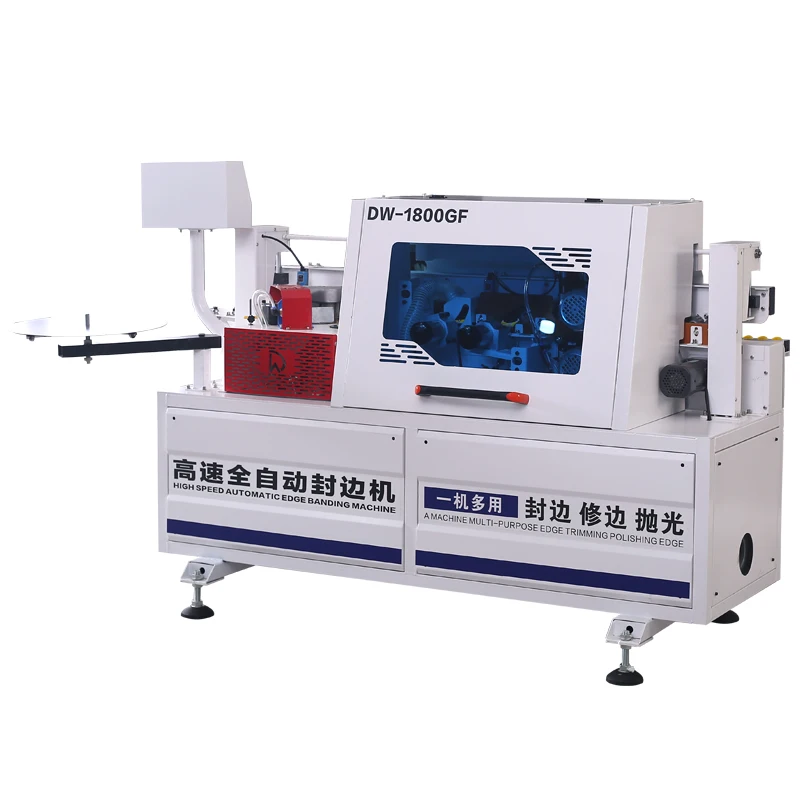
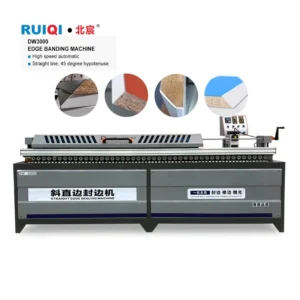
Precision-machined trimming stations — dual 800W motors running at 24,000 r/min deliver the edge finish quality your cabinet panels need before assembly.
Technical Specifications
| Parameter |
Value |
| Model |
DW1800 |
| Product Type |
High Speed Straight Line Automatic Edge Bander |
| Total Power |
4.9 kW |
| Voltage Options |
380V / 220V / 415V |
| Feed Speed Range |
0–14 m/min |
| Edge Banding Thickness |
0.3–3 mm |
| Edge Banding Height |
0–50 mm |
| Minimum Sheet Length |
200 mm |
| Minimum Sheet Width |
100 mm |
| Trimming Motor Power |
800W × 2 |
| Trimming Spindle Speed |
24,000 r/min |
| Polishing Motor Power |
380W × 2 |
| Edge Drive Power |
160W |
| Transmission Drive Power |
180W |
| Vacuum Power |
550W |
| Air Source Pressure |
0.4–0.6 MPa |
| Glue Pot Capacity |
4000 ml |
| Machine Dimensions |
220 × 65 × 125 cm |
| Machine Weight |
320 kg |
| Control Panel Language |
Chinese and English standard; Spanish and other languages available upon request |
| Plug Options |
EU, USA, AU, UK |
| Key Features |
Double-sided gluing, top and bottom trimming, top and bottom polishing, front and rear alignment, flexible edge scraping, dust suction |
Application Suitability
| Application |
Material or Output |
| Cabinet door and carcass edge banding |
MDF and particleboard with PVC or melamine edge banding |
| Custom furniture panel processing |
Plywood and ABB boards with veneer or PVC strips |
| Shelving and storage unit edging |
Solid wood panels and organic glass plates of similar hardness |
| Small-batch joinery production |
Mixed substrate runs where banding thickness varies between 0.3 mm and 3 mm |
Why the Voltage Question Must Come Before the Quotation
A machine wired for the wrong frequency will run, but the trimming motors will not hit rated speed — and your edge finish pays the price.
In my years handling export orders from Shandong, I have seen edge banders arrive at workshops overseas only to sit idle because the local supply was 220V/60Hz while the machine left the factory configured for 380V/50Hz. The DW1800 edge banding machine specifications list three voltage options, but selecting the correct one requires confirming both voltage and frequency before the electrical schematic is finalized. A transformer is not a real solution — it adds cost, introduces voltage drop under load, and creates a failure point that your maintenance team did not budget for [NEED_CITE: voltage and frequency standards by export market].

Matching Feed Speed to Your Line Throughput
The 0–14 m/min variable feed speed on the DW1800 is driven by two independent motors: a 160W edge drive and a 180W transmission drive. This separation matters when you are running panels of different thicknesses through the same shift. Heavier boards demand more traction from the transmission belt, and having independent control prevents the edge feed from slipping against the banding strip. For a cabinet line where the panel saw upstream cuts batches of 30–50 panels before switching dimensions, this speed range lets the operator dial in the right pace without stopping the line to change mechanical settings.
Trimming Station Configuration and Edge Finish Quality
The DW1800 carries two 800W trimming motors spinning at 24,000 r/min, handling both top and bottom trimming in a single pass. After trimming, the flexible edge scraping station removes the micro-ridges that high-speed cutters leave on PVC banding. This sequence — trim, scrape, polish — is what separates a visible glue line from a clean edge that passes visual inspection at assembly. When you compare DW1800 edge banding machine specifications against alternatives, the presence of flexible scraping as a standard station rather than an add-on is a meaningful distinction for shops running PVC and veneer banding daily [NEED_CITE: edge banding quality standards in furniture assembly].
Reading the Numbers That Actually Matter
Start with the banding thickness range of 0.3–3 mm. This covers everything from thin PVC foils used on cabinet carcasses to 3 mm solid wood strips for visible door edges. The 0–50 mm edge banding height means the machine handles standard 18 mm board as well as thicker worktop panels without tooling changes. The 4000 ml glue pot capacity is sized for continuous runs without frequent refills — on a 14 m/min feed rate processing 200 mm wide panels, the pot sustains production through a full shift of typical cabinet components. The double-sided gluing system applies adhesive to both the panel edge and the banding strip, which is necessary when bonding to porous substrates like particleboard where single-sided application leaves starved glue joints.
What Happens When Configuration Is an Afterthought
A buyer once ordered a machine rated for 380V without checking that their facility in South America ran 220V three-phase. The machine shipped, the compressor could not build sufficient pressure, and the air source dropped below the 0.4 MPa minimum needed for the pneumatic pressing rollers. The edge banding peeled off every panel until they installed a dedicated compressor [NEED_CITE: pneumatic pressure requirements for edge banding adhesion]. The DW1800 supports multiple voltage configurations, but only if the correct one is locked into the production order. Similarly, ordering a machine with a Chinese-only control panel for a workshop where operators read Spanish means commissioning stalls until someone translates the interface.
Why Technical Buyers Source This Equipment Here
In-house manufacturing with proprietary cutting mechanisms means the trimming spindles and scraping tools are built and tested under one roof, not assembled from third-party sub-kits. Every DW1800 goes through a four-stage quality control sequence covering incoming material inspection, in-process checks, finished product verification, and pre-shipment testing — so the tolerance claim on your machine is backed by an actual test record, not a brochure statement. Voltage and language customization are treated as standard configuration steps, not special requests. The engineer-led quotation process delivers a formal specification within 24 hours, including the electrical schematic matched to your facility's supply [NEED_CITE: CE machinery directive requirements for industrial equipment].
Documentation & Verification
- CE declaration of conformity covering the DW1800 edge bander and its electrical safety classification
- Machine specification sheet listing confirmed voltage, plug type, and language for your order
- Electrical schematic with voltage and frequency locked to your facility before production begins
- Factory test record showing actual trimming tolerance measured on your specified panel substrate
- Operation and maintenance manual delivered in your agreed language with illustrated troubleshooting
- Spare parts list identifying consumable trimming blades, polishing wheels, and scraping tools
Installation, Commissioning & Support
- The 220 × 65 cm footprint requires a level concrete floor with clearance for panel infeed and outfeed on both sides
- A dedicated circuit matching the confirmed voltage (380V, 220V, or 415V) must be installed before the 4.9 kW total load is connected
- The machine ships fully assembled at 320 kg — position it, connect power and the 0.4–0.6 MPa air supply, and it is ready for calibration
- First-run commissioning includes setting the feed speed, glue temperature, and trimming depth for your specific board and banding combination
- Consumable spare parts for the trimming and polishing stations should be identified and stocked before the first production shift
What to Include in Your Inquiry
To configure the DW1800 correctly, share the panel substrates you run most often, the edge banding materials and thickness range, and your local voltage and frequency. If you have upstream panel saws or downstream boring machines, mention their throughput so the feed speed can be matched. Specify the control panel language your operators need.
Frequently Asked Questions
Q: How is the trimming tolerance verified on different substrates before the DW1800 ships?
A: Each machine undergoes a pre-shipment test using the panel material and banding type you specify. The factory test record documents actual measured dimensions after trimming, scraping, and polishing. This record ships with the machine so you can verify the results against your assembly requirements upon arrival.
Q: My workshop runs on a non-standard voltage — how is the correct configuration confirmed?
A: The DW1800 supports 380V, 220V, and 415V configurations. During the quotation stage, we request your facility voltage and frequency, then produce an electrical schematic for your approval before production starts. This prevents the common problem of machines arriving wired for a supply that does not match local infrastructure.
Q: Can the control panel and manual be delivered fully in Spanish for my operators?
A: Chinese and English are standard on the control interface. Spanish and other languages are available upon request and confirmed during the specification stage. The operation and maintenance manual is also translated into the agreed language so operators can handle daily adjustments and basic troubleshooting independently.
Q: How does the 0–14 m/min feed speed match with upstream panel saws in a cabinet line?
A: The variable feed speed lets you synchronize the DW1800 with different cutting batch sizes. If your panel saw produces 40 panels per cycle, the operator can run at higher speed for that batch, then slow down for smaller runs or thicker boards. Independent edge and transmission motors maintain consistent feed without slipping.
Q: What consumable spare parts should I stock for the first year of operation?
A: The trimming blades, polishing wheels, and flexible scraping tools are the primary wear items. We provide a spare parts list with part numbers and recommended quantities based on your expected production volume. A pre-packed consumable kit can be included with the initial shipment so replacements are on hand before the first tool change is needed.