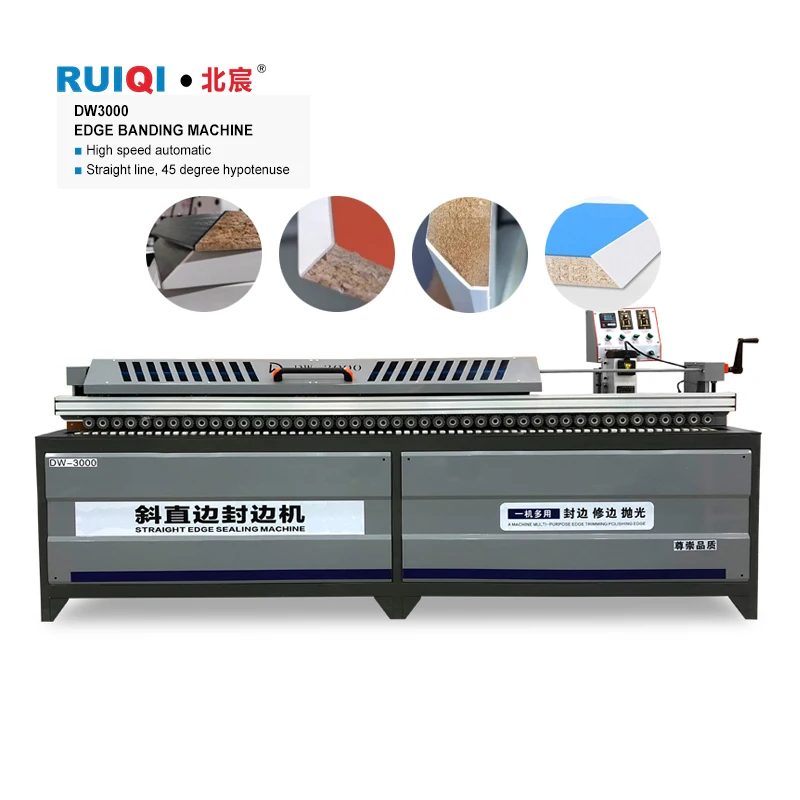
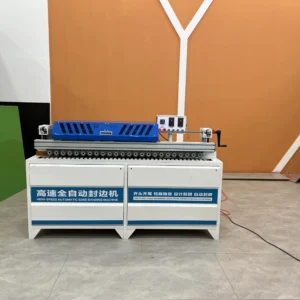
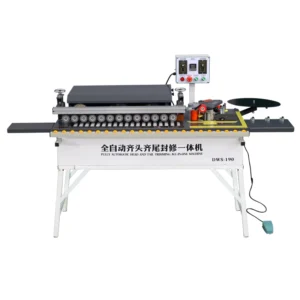
In-house manufacturing with verified tolerance — Every DW3000 automatic edge banding machine is built on our production floor with patented cutting mechanisms, tested against your panel samples before it leaves the factory.
Technical Specifications
| Parameter |
Value |
| Model |
DW3000 |
| Product Type |
Automatic Edge Banding Machine |
| Total Power |
11 kW |
| Voltage |
380V / 415V (configurable from 110V to 440V) |
| Feed Speed |
0–12 m/min |
| Pre-milling Motor |
2.2 kW |
| Heating Power |
2.2 kW × 2 |
| Edge Power / Speed |
160 W / 0–12 m/min |
| Transmission Power / Speed |
180 W / 0–12 m/min |
| Trimming Power |
2.2 kW × 2 |
| Polishing Power |
0.4 kW × 2 |
| Vacuum Power |
550 W |
| Glue Pot Capacity |
4000 ml |
| Air Source Pressure |
0.5–0.7 MPa |
| Minimum Sheet Length |
300 mm |
| Minimum Sheet Width |
150 mm |
| Edge Banding Height |
0–50 mm |
| Edge Banding Thickness |
0.3–3 mm |
| Trimming Stations |
3 spindle motors |
| Oblique Pressure Wheels |
8 groups, adjustable 30–90° |
| Standard Features |
Pre-milling, straight and oblique edge banding, trimming, scraping, polishing, high-power vacuuming |
| Machine Dimensions |
2990 × 650 × 1300 mm |
| Machine Weight |
430 kg |
Application Suitability
| Application |
Material or Output |
| Custom cabinet door edging |
MDF and particleboard with 0.3–3 mm PVC banding |
| Straight wardrobe panel finishing |
Plywood and melamine boards with PVC or veneer strips |
| 45-degree bevel edge profiles |
Solid wood panels and MDF requiring oblique banding |
| Mixed batch joinery production |
Multiple substrate types in a single shift |
Why Voltage Verification Must Come Before the Price Tag
An automatic edge banding machine specifications sheet is only useful if the voltage and frequency match your workshop's actual grid supply.
I have stood in a Dubai workshop watching an installer stare at a silent machine because the local supply was 415V/60Hz while the unit was configured for 380V/50Hz. A transformer had to be shipped from overseas, and the carpentry crew sat idle for weeks. That gap between a quoted spec and a real power grid is where projects stall [NEED_CITE: voltage and frequency standards by export market]. Confirming electrical compatibility is the first step in evaluating any Automatic Edge Banding Machine specifications, not an afterthought once the crate arrives.

Mapping Feed Speed to Daily Panel Volume
The DW3000 runs at 0–12 m/min, which gives a joinery shop the flexibility to slow down for thick veneer on solid wood or push toward the upper range for high-volume PVC runs on particleboard. The variable feed is controlled through the transmission system at 180 W, maintaining consistent pressure across the pressure wheel groups. Matching this speed to your downstream assembly cycle prevents bottlenecks where edged panels pile up faster than the boring station can process them.
Straight and Oblique Capability on One Machine Floor
Most workshops that need 45-degree bevel edging end up running panels through two separate stations or two separate machines. The eight oblique pressure wheel groups on the DW3000 adjust from 30 to 90 degrees, allowing both straight and angled profiles without reconfiguring the line [NEED_CITE: CE machinery directive requirements for industrial edge finishing equipment]. This matters when a single cabinet order includes both flat-edged carcass panels and beveled door fronts.
Reading the Motor Configuration Against Your Quality Standard
The pre-milling motor at 2.2 kW prepares the panel edge before the glue station, removing saw marks and ensuring a flat bonding surface. This directly affects whether you see visible glue lines on MDF substrates — a common complaint when pre-milling is underpowered or absent. The three spindle trimming motors handle rough and fine trimming in sequence, followed by scraping and dual 0.4 kW polishing motors. Each station has a measurable impact on the final edge profile, and understanding these Automatic Edge Banding Machine specifications lets you predict output quality rather than discover defects during assembly.
The Hidden Cost of Skipping the Pre-Shipment Test
When a buyer accepts a machine without requesting a test run on their own panel stock, the first sign of trouble often appears on the assembly floor. Panels that look acceptable at the edge bander may show gaps at the joint when fitted into a cabinet carcass. Tolerance issues that could have been caught in a factory test instead surface as rework, wasted banding material, and missed delivery deadlines [NEED_CITE: woodworking panel assembly tolerance standards]. A pre-shipment test with your specific MDF thickness and PVC banding gauge eliminates this uncertainty.
Why Technical Buyers Source This Model Here
The DW3000 is built entirely in-house with proprietary cutting mechanisms that hold verifiable tolerance on the trimming stations. Every unit passes through four inspection stages — incoming material, in-process assembly, finished product, and pre-shipment verification — before crating. Voltage and control panel language are confirmed in writing before production begins, so the operator in your workshop reads instructions in a language they understand. Engineer-led configuration recommendations are delivered as formal quotations within 24 hours, mapping motor ratings and feed rates to your stated production requirement.
Documentation & Verification
- CE declaration of conformity covering the DW3000 trimming and polishing motor assembly
- Machine specification sheet with confirmed voltage, frequency, and all motor ratings
- Electrical schematic showing wiring configuration for your local power supply
- Factory test record run on your specified panel thickness and banding material
- Operation and maintenance manual in your agreed language before dispatch
- Spare parts list with trimming spindle and pressure wheel replacement references
Installation, Commissioning & Support
- Floor space requirement based on 2990 × 650 mm footprint with operator clearance on three sides
- Dedicated electrical circuit sized for 11 kW total draw at confirmed voltage and frequency
- Machine arrives assembled; verify leveling on workshop floor before powering the glue pot heaters
- First-run parameter setting for feed speed, glue temperature, and trimming depth with your panel stock
- Operator training on oblique pressure wheel adjustment for 30–90 degree bevel transitions
- Scheduled inspection cycle for the three trimming spindle motors and flexible edge scraper
What to Include in Your Inquiry
Send your panel substrate type, thickness range, and the edge banding material and gauge you run most often. Include your local voltage and frequency so the electrical configuration is locked before production. If you are integrating the DW3000 into an existing line, note the feed height and throughput of your upstream panel saw and downstream boring station so we can confirm compatibility.
Frequently Asked Questions
Q: How do I verify the stated tolerance on my panel material before the machine ships?
A: Request a pre-shipment test using your own MDF or particleboard samples and your standard PVC banding thickness. The factory runs the full cycle — pre-milling, gluing, trimming, scraping, polishing — and provides a test record with measured edge quality results so you can evaluate output against your assembly requirements before authorizing dispatch.
Q: What happens if my local grid frequency does not match the quoted specification?
A: Motor speeds, heater response, and feed rates all shift when frequency is wrong, and the machine may not start at all. Confirm your exact voltage and Hz with your electrician, state it in the inquiry, and verify it again on the electrical schematic before production. The DW3000 is configurable across a wide voltage range to match local conditions.
Q: Can the control panel be supplied in my operator's language?
A: Yes. Multilingual control panels are available and should be specified at the quotation stage. Confirming the language before production avoids commissioning delays where an operator cannot read the interface, which is a common cause of setup errors in the first weeks after installation.
Q: How do I match the 0–12 m/min feed speed to my daily panel volume?
A: Calculate your average panels per shift and the linear meters of edging per panel, then map that against the upper feed range with time allocated for loading and trimming transitions. This determines whether the DW3000 capacity aligns with your output target or if a higher-speed model is needed.
Q: When should I plan upstream and downstream machines around this edge bander?
A: If your panel saw output exceeds what the edge bander can process in a shift, or if your boring station sits idle waiting for edged panels, the line is unbalanced. Share your full production flow so the throughput at each station can be matched during the layout phase.