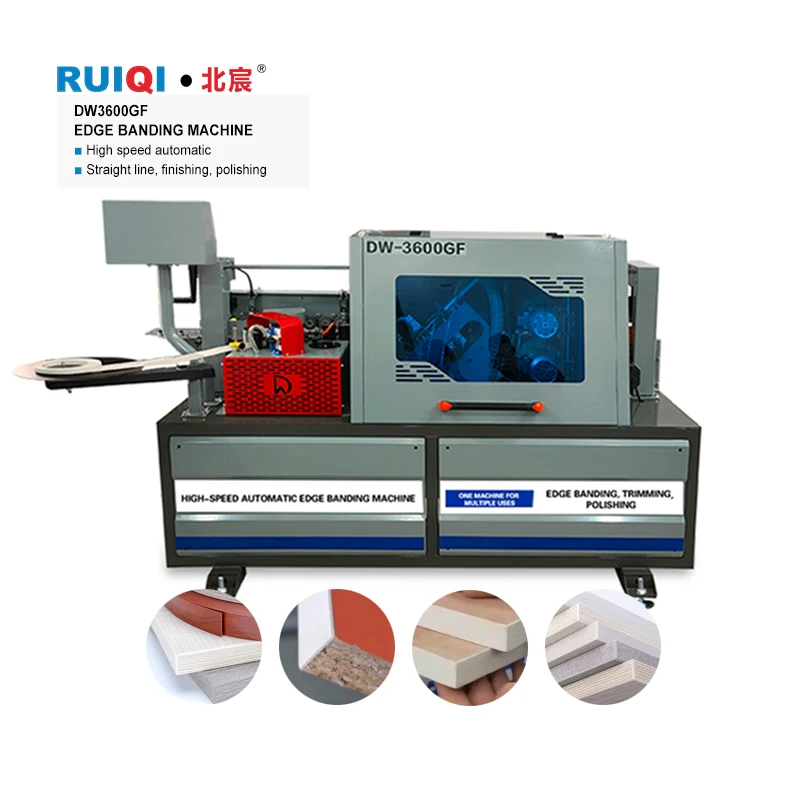
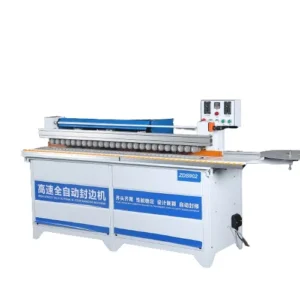
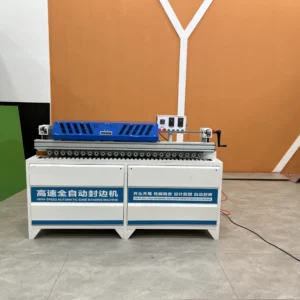
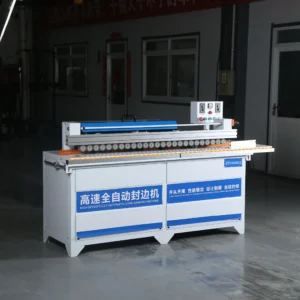
Precision tolerance verification — DW-3600GF edge banding machine specifications mapped against actual panel dimensions and feed parameters so technical buyers can confirm fit before committing.
Technical Specifications
| Parameter |
Value |
| Model |
DW-3600GF |
| Product Type |
Automatic Edge Banding Machine |
| Voltage & Frequency |
380V, Three-Phase Four-Wire |
| Total Power |
4.9 kW |
| Overall Dimensions (L×W×H) |
2200 × 650 × 1250 mm |
| Net Weight |
320 kg |
| Edge Banding Type |
Straight Edge Banding |
| Edge Band Height Range |
0–50 mm |
| Edge Band Thickness Range |
0.3–3 mm |
| Minimum Panel Length |
200 mm |
| Feed Speed |
0–14 m/min |
| Gluing Power |
160 W |
| Transmission Power |
180 W |
| Trimming Power |
800 W × 2, 24000 r/min |
| Polishing Power |
400 W × 2 |
| Air Supply Requirement |
0.4–0.6 MPa |
| Standard Functions |
Gluing, Trimming, Front and Rear Trimming, Scraping, Polishing, Vacuuming |
| Language Options |
Chinese and English standard; other languages customizable |
| Certification |
CE, ISO 9001 |
Application Suitability
| Application |
Material or Output |
| Cabinet door edge finishing |
MDF and plywood with PVC or ABS banding |
| Custom furniture panel processing |
Particleboard with melamine edge bands |
| Small-batch workshop production |
Solid wood panels with veneer edge banding |
| Shelving and carcass edge treatment |
Laminated board stock up to 50 mm band height |
| Joinery component finishing |
Mixed substrate runs switching between MDF and plywood |
Why the Voltage Question Should Come Before the Edge Banding Machine Specifications
Confirm your local three-phase supply configuration before reviewing any other parameter on the sheet.
I have seen workshops receive equipment that matched every production requirement except electrical compatibility. The machine sat on the floor for weeks while transformers were sourced, or worse, the wrong frequency was overlooked entirely and motors burned through their bearings within the first production run. [NEED_CITE: voltage and frequency standards by export market] When you are evaluating edge banding machine specifications, the voltage and phase requirement is the one variable that cannot be adjusted after the machine leaves the factory floor. The DW-3600GF is configured for 380V three-phase four-wire supply as standard, but frequency confirmation for your specific grid — 50 Hz or 60 Hz — must be locked in before production begins.
Matching Feed Speed to Your Daily Panel Volume
The 0–14 m/min feed speed range on the DW-3600GF gives operators room to adjust based on substrate behavior and edge band material. Running PVC at the upper end of the range works well on stable MDF, but recycled particleboard with inconsistent density often requires slowing down to maintain glue adhesion and trimming quality. The separate gluing motor at 160 W and transmission motor at 180 W allow independent control, so the feed rate does not force a compromise between glue application and panel transport.
How Band Thickness Coverage Affects Your Material Options
With a 0.3–3 mm edge band thickness range, this automatic edge banding machine handles thin decorative veneers on one end and standard PVC profiles on the other. Workshops that run a narrow band of materials may not need this full range, but those switching between melamine, ABS, and wood veneer across different jobs will find the coverage reduces the need for secondary finishing. The dual trimming stations running at 800 W each and 24000 r/min are sized to cut cleanly across that material spread without requiring separate tooling changes for each band type.

Reading the Numbers That Actually Affect Downstream Assembly
The 2200 × 650 × 1250 mm footprint matters less than what it implies about internal station spacing. On a machine this size, the distance between the gluing station and the trimming heads determines how well the adhesive sets before cutting begins. The 0.4–0.6 MPa air supply requirement is compatible with standard workshop compressors, but pressure stability across the scraping and polishing stations directly influences edge smoothness. The 200 mm minimum panel length sets a hard floor on workpiece size — anything shorter will not engage the feed mechanism properly, which affects small component production for drawer parts or narrow shelving. [NEED_CITE: edge banding tolerance impact on furniture assembly fit]
What Happens When Specifications Are Assumed Rather Than Confirmed
I once configured a line for a cabinet maker who assumed every edge bander in this class would accept his standard 18 mm particleboard. The machine arrived, and the panel thickness range did not accommodate his stock. The glue pot clearance was wrong, the feed rollers could not grip properly, and every panel came through with visible chatter marks on the trimmed edge. The downtime cost him an entire production week while a replacement was arranged. Edge banding machine specifications exist to prevent exactly this scenario, yet buyers still skip the verification step when the machine looks right in photographs.
Why Specification-Led Procurement Works Here
Every DW-3600GF leaves the factory with a test record showing actual performance on the buyer's specified substrate and banding material — not a generic demonstration on ideal stock. The electrical schematic is confirmed against the destination market's three-phase supply before the machine enters final assembly. An operation and maintenance manual in the agreed language ships with the unit so the operator can read the control panel from day one. The four-stage quality check covers incoming components through pre-shipment verification, catching tolerance drift before it reaches the workshop floor.
Documentation & Verification
- Machine specification sheet with confirmed voltage and frequency for your grid
- Factory test record showing feed speed and trim quality on your actual substrate
- Electrical schematic matching your three-phase supply configuration
- Operation and maintenance manual in the language your operators read
- Spare parts list with part numbers for consumables and wear items
- Packing photographs and customs documentation for import clearance
Installation, Commissioning & Support
- Floor space allocation based on the 2200 × 650 mm footprint plus operator clearance
- Dedicated circuit rated for 4.9 kW total draw with correct phase rotation verified
- Air line connection at 0.4–0.6 MPa with regulator and moisture trap installed upstream
- First-run parameter setting covering feed speed, glue temperature, and trimming depth
- Operator training on the six standard functions with emphasis on band thickness changeover
- Scheduled maintenance intervals for trimming heads, polishing wheels, and glue pot cleaning
What to Include in Your Inquiry
To match the DW-3600GF to your production environment, share the substrate types and panel thickness range you process most often, along with the edge band materials and thicknesses in your current product mix. Specify your local voltage and frequency so the electrical configuration is confirmed before production scheduling. If your panels fall near the 200 mm minimum length or the 50 mm band height boundary, flag this early so feed mechanism compatibility is verified against your actual workpiece dimensions.
Frequently Asked Questions
Q: How do I verify the 0–14 m/min feed speed against my daily panel throughput?
A: Calculate your required linear meters per shift based on average panel perimeter and daily volume. Then run a sample batch at the feed speed that produces acceptable edge quality on your specific substrate. The independently controlled gluing and transmission motors allow you to find the speed where glue adhesion and trimming finish both hold, rather than forcing maximum feed rate at the cost of edge defects.
Q: Which voltage and plug configurations are available for different regional markets?
A: The standard configuration is 380V three-phase four-wire, but the machine can be built to match voltage and frequency requirements across different export markets. Confirm your local supply specifications — including whether your grid runs 50 Hz or 60 Hz — during the inquiry stage so the correct motor windings and control components are installed before assembly.
Q: How do the six standard functions map to my edge quality requirements?
A: Gluing and trimming handle the primary band application and excess removal. Front and rear trimming clean the panel ends. Scraping removes adhesive residue and smooths the band edge. Polishing produces the final surface finish. If your product requires only basic edge coverage, you may not use every station on every run, but having all six available means you can adjust output quality without adding secondary operations.
Q: What minimum and maximum panel dimensions does this model accept?
A: The minimum panel length is 200 mm, and the edge band height range covers 0–50 mm with band thickness from 0.3 to 3 mm. Panel thickness and width ranges should be confirmed against your specific production mix during the configuration stage, as these dimensions determine feed roller engagement and glue pot clearance for your standard workpieces.
Q: Can I request a sample processing test on my specific substrate before ordering?
A: Yes. Send representative samples of your MDF, particleboard, or plywood along with the edge banding material you use most frequently. The factory will run these through the DW-3600GF at various feed speeds and document the trimming quality, glue line appearance, and edge finish so you can evaluate results on your actual production materials rather than generic test stock.