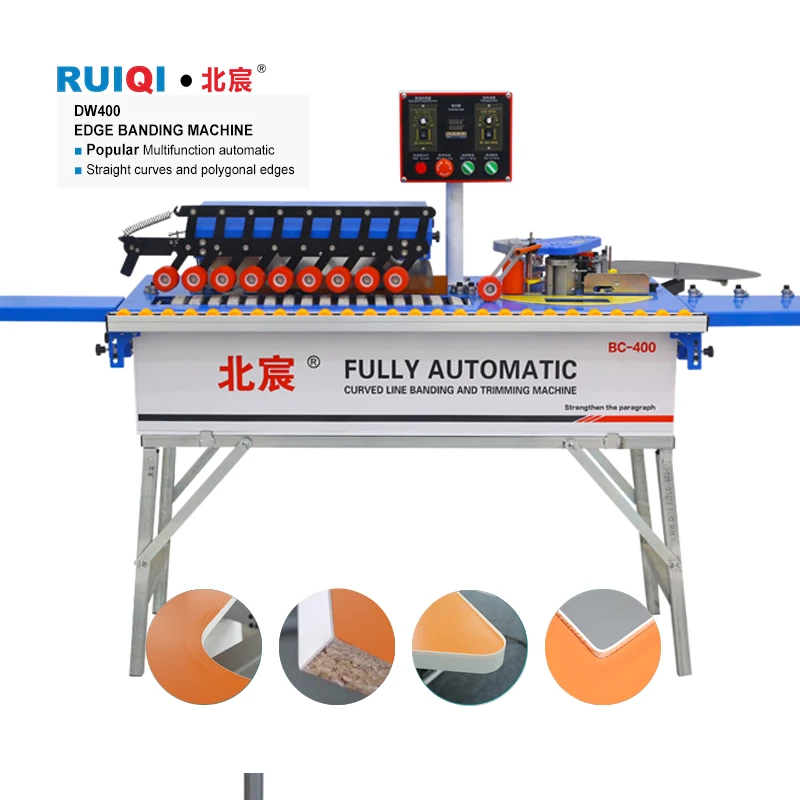
Verified Tolerance, Custom Voltage, Full Specification Confirmation — every DW400 ships with a factory test record on your panel stock and electrical schematic matched to your workshop supply before dispatch.
Technical Specifications
| Parameter |
Value |
| Model |
DW400 |
| Product Type |
Manual Straight and Curved Edge Banding Machine |
| Total Power |
3800W |
| Trimming Power |
650W × 2 |
| Polishing Power |
180W × 2 |
| Vacuum Power |
1200W |
| Transmission Power |
60W |
| Edge Power |
20W |
| Voltage |
220V / 380V / customization available |
| Glue Pot Capacity |
1000 ml |
| Edge Banding Height |
0–50 mm |
| Edge Banding Thickness |
0.3–3 mm |
| Minimum Sheet Length |
250 mm |
| Minimum Sheet Width |
100 mm |
| Air Source Pressure |
0.5–0.8 MPa |
| Machine Dimensions |
1160 × 470 × 690 mm |
| Machine Weight |
70 kg |
| Key Features |
Straight edge banding, trimming, polishing, curved edge capability |
Application Suitability
| Application |
Material or Output |
| Cabinet door and carcass edge finishing |
MDF and particleboard with PVC or melamine banding |
| Plywood furniture panel edging |
Plywood panels with veneer or ABS edge strips |
| Custom joinery small-batch production |
Blockboard and solid wood panels up to 50 mm thickness |
| Polymer door component trimming |
Polymer composite sheets requiring curved edge profiling |
| Workshop upgrade from hand banding |
Mixed panel stock at moderate daily volumes |
Why the Voltage Question Must Come Before Any Edge Banding Machine Specifications Discussion
Confirming your workshop supply voltage and frequency before configuration is the single step that prevents a three-week production stop.
I once watched a three-phase 415V supply destroy a control board on a machine wired for a different standard. The replacement parts took weeks to arrive, and the installer stood in the workshop with nothing to show for the trip. Edge banding machine specifications mean very little when the machine cannot be powered on [NEED_CITE: voltage and frequency standards by export market]. The DW400 is configurable for 220V, 380V, or site-specific requirements, but that flexibility only matters if the buyer provides the actual supply data before production begins. Asking for a photo of the workshop distribution board is not excessive — it is the baseline check that separates a working installation from a dead machine sitting in a crate.

Matching Trimming Power to Your Edge Banding Thickness Range
The DW400 carries dual 650W trimming motors, which places it in a range suited for PVC, ABS, and thin veneer edge materials within the 0.3–3 mm thickness window. When trimming motors are undersized for the banding material, the result is chipped edges and visible score lines that show up under finish. Edge banding machine specifications around trimming power should always be evaluated against the specific banding stock you run most often, not just the maximum thickness the machine claims to handle.
Glue Pot Capacity and Continuous Run Duration
A 1000 ml glue pot means fewer refill interruptions during a batch run, but the practical impact depends on your panel volume and the glue consumption rate per linear meter of edge. For a joinery workshop running mixed cabinet components in batches, this capacity typically covers a full morning session without stopping. For higher-volume furniture production, refill frequency becomes a scheduling factor that affects overall output consistency [NEED_CITE: adhesive consumption rates for edge banding on particleboard]. The DW400 sits at a capacity that suits small-to-medium workshops transitioning from manual application.
How Panel Thickness Range and Air Pressure Shape Downstream Assembly
The 0–50 mm edge banding height range covers most standard cabinet and furniture panel thicknesses, from thin 9 mm MDF shelving up to thick blockboard worktops. The specified air source pressure of 0.5–0.8 MPa drives the pressure roller contact and trimming station actuation. Insufficient or unstable air pressure causes inconsistent roller contact, which translates into uneven glue spread and banding adhesion failures that only appear during assembly when panels are joined under load. Edge banding machine specifications on air requirements are not optional guidelines — they are the threshold below which edge quality becomes unpredictable. Polishing power at 180W × 2 is adequate for removing residual adhesive and producing a clean edge finish on standard PVC and veneer materials, though higher-density ABS may require slower feed rates for acceptable results.
The Hidden Cost of Skipping Specification Verification
When a workshop orders an edge bander without confirming the minimum sheet dimensions against their actual cut list, the machine arrives unable to process small offcuts that make up a significant portion of daily work. The DW400 requires a minimum sheet length of 250 mm and width of 100 mm — panels below these dimensions cannot be fed through the machine safely. Similarly, specifying a machine without verifying that the control panel language matches the operator's reading ability stalls commissioning entirely [NEED_CITE: operator interface language requirements for exported machinery]. These are not theoretical risks. They are recurring patterns observed across installation sites where specification confirmation was treated as a formality rather than a prerequisite.
Why Technical Buyers Source This Model Here
In-house manufacturing with patented cutting mechanisms means tolerance claims on the DW400 are backed by verifiable factory test records, not brochure numbers. The full product family from entry-level to full-function allows a workshop to add capacity later without switching suppliers or retraining operators on a different control interface. Voltage, language, and specification customization is treated as standard configuration, not a premium add-on, so the machine arrives matched to the installation site. The four-stage quality control process with pre-shipment verification catches electrical and mechanical faults before the crate is sealed. Engineer-led configuration recommendation with a formal quotation within 24 hours means the technical discussion happens before the purchase order, not after the machine fails to start [NEED_CITE: ISO 9001 quality management requirements for machinery manufacturers].
Documentation & Verification
- Machine specification sheet confirming your selected voltage, frequency, and control language
- Electrical schematic cross-referenced to your workshop distribution board before dispatch
- Factory test record showing trimming and polishing results on your actual panel material
- Operation and maintenance manual delivered in the operator's working language
- Packing photographs documenting machine condition at point of shipment
- CE declaration of conformity for market entry documentation
Installation, Commissioning & Support
- Dedicated circuit required matching confirmed voltage, 3800W total draw plus startup surge margin
- Air compressor supply verified at 0.5–0.8 MPa stable pressure before first run
- Machine footprint of 1160 × 470 mm requires level floor with clearance for sheet infeed and outfeed
- Glue pot first-fill procedure and temperature calibration performed with operator present
- Trimming station alignment checked on your panel stock thickness range during commissioning
- Spare wearing parts list provided covering trimming blades, polishing wheels, and pressure rollers
What to Include in Your Specification Inquiry
Provide the panel materials and thickness range you process most frequently, the edge banding material type and thickness you intend to run, and a photo or specification of your workshop electrical supply including voltage and frequency. If you are integrating the DW400 into an existing line, note the upstream cutting equipment output dimensions and any downstream assembly tolerance requirements. Specify the preferred control panel language at inquiry stage to avoid delays during commissioning.
Frequently Asked Questions
Q: How do I verify the DW400 trimming tolerance against my panel assembly requirements?
A: Request a factory test record produced on your specific panel material and edge banding stock. This document shows actual trimming results including edge finish quality and dimensional consistency. Compare these results against your assembly joint tolerances before confirming the order. The test is conducted at the factory before shipment, giving you verifiable data rather than generic specification claims.
Q: What voltage and frequency information do I need to provide before ordering?
A: Provide a photo of your workshop electrical distribution board along with the confirmed supply voltage, phase configuration, and frequency in Hz. The DW400 is configurable for 220V or 380V, but local supply conditions vary. This verification step prevents motor damage and control board failure at first power-on, which are the most common commissioning failures on exported woodworking machinery.
Q: Can the control panel and manual be supplied in my operator's language?
A: Yes, multilingual control panels and operation manuals are available and should be specified at the inquiry stage. State the required language clearly in your initial configuration request so the control interface and documentation are prepared before production. This avoids commissioning delays caused by operators unable to read error codes or setup instructions on the machine display.
Q: How do I match glue pot capacity and trimming power to my substrate?
A: Share your primary panel material, edge banding type, and typical batch size during the inquiry. The 1000 ml glue pot and dual 650W trimming motors on the DW400 suit moderate-volume workshops running PVC, ABS, or veneer on MDF and particleboard. An engineer reviews these details to confirm whether the standard configuration meets your requirements or if adjustments are needed.
Q: Can I request a sample processing test on my own panel stock before ordering?
A: Yes, send a sample of your panel material and preferred edge banding stock to the factory for a processing trial. The test evaluates glue adhesion, trimming quality, and polishing finish under controlled conditions. Results are documented and shared with you before any purchase commitment, allowing you to verify output quality against your production standards.