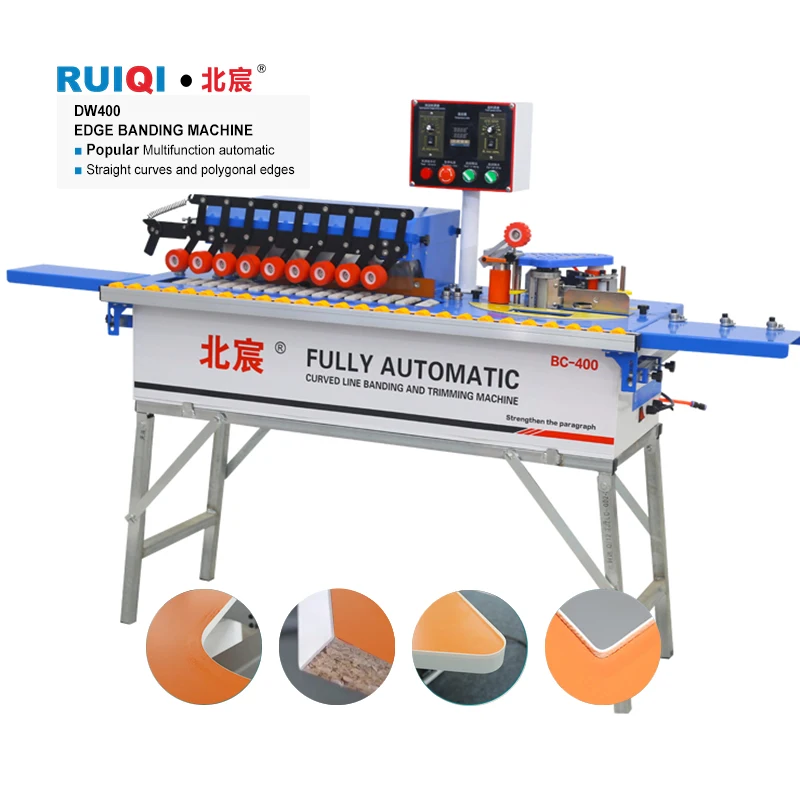
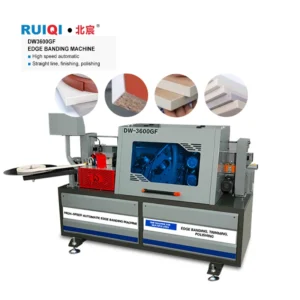
Verified Tolerance in Compact Format — the DW400 maintains ±0.02mm precision across dual trimming heads, tested on your specific substrate before dispatch rather than relying on generic sample runs.
Technical Specifications
| Parameter |
Value |
| Model |
DW400 |
| Product Type |
Portable Edge Banding Machine |
| Total Power |
3800W |
| Voltage & Frequency |
220V/380V/customization (frequency to be confirmed 50Hz/60Hz) |
| Control System |
Manual / panel-controlled |
| Overall Dimensions (L×W×H) |
116×47×69 cm |
| Net Weight |
70 kg |
| Minimum Panel Length |
25 cm |
| Minimum Panel Width |
10 cm |
| Edge Banding Height Range |
0–50 mm |
| Edge Banding Thickness Range |
0.3–3 mm |
| Standard Functions |
Straight edge banding, trimming, polishing |
| Glue Pot Capacity |
1000 ml |
| Trimming Power |
650W × 2 |
| Polishing Power |
180W × 2 |
| Transmission Power |
60W |
| Vacuum Power |
1200W |
| Air Source Pressure |
0.5–0.8 MPa |
| Trimming Stations |
Dual trimming heads |
| Dust Extraction |
Integrated vacuum unit 1200W |
| Language Options |
Chinese, English; Spanish and other languages on request |
| Plug Options |
EU, USA, AU, UK |
| Assembly State |
Fully assembled, tabletop/portable format |
Application Suitability
| Application |
Material or Output |
| Custom cabinet panel edging |
MDF and particleboard with PVC banding 0.3–3 mm |
| Small-batch furniture production |
Plywood and blockboard with veneer or PVC tape |
| On-site joinery finishing |
Pre-cut polymer door panels requiring straight-edge trimming |
| Workshop sample and prototype runs |
Offcuts and short panels down to 25×10 cm minimum dimensions |
| Secondary banding station |
Backup edge finishing alongside a primary automatic line |
Why Voltage Confirmation Matters More Than Feed Speed on a Portable Unit
A machine wired for the wrong frequency will burn out its vacuum motor within the first week, regardless of how well the trimming heads are calibrated.
I have watched workshops receive portable edge banders that sat uncrated for weeks because the single-phase supply on site could not handle the inrush current, or the 60Hz motor ran hot on a 50Hz grid. The DW400 edge banding machine specifications list 220V/380V options, but voltage alone does not solve the problem — frequency, plug configuration, and breaker rating all need alignment before the unit leaves the factory [NEED_CITE: voltage and frequency standards by export market]. This is where the specification sheet becomes a contract document rather than a brochure page.

Power Distribution Across Independent Motor Stations
The 3800W total power on the DW400 is split across dedicated motors: two 650W trimming heads, two 180W polishing units, a 60W transmission drive, and a 1200W vacuum extraction system. This separation means a voltage dip affecting the vacuum does not simultaneously destabilize trimming speed. For workshops running on shared circuits with other equipment, independent motor architecture prevents cross-interference that would show up as chatter marks on the banding edge.
Minimum Workpiece Dimensions and Small-Run Viability
Most automatic edge banders require panel lengths above 40 cm and widths above 15 cm to maintain feed stability through the pressure roller array. The DW400 handles panels as small as 25 cm long and 10 cm wide, which covers the offcuts and narrow cabinet sides that full-size machines reject. This capability matters for custom furniture makers who batch-cut panels and need to edge the remnants without reprogramming a larger line [NEED_CITE: minimum workpiece handling requirements in compact edge banding].
Reading the Specification Sheet Against Your Actual Production Conditions
The edge banding thickness range of 0.3–3 mm covers standard PVC and wood veneer tapes, but the glue pot temperature required for reliable adhesion varies significantly between these materials. PVC typically demands a different thermal window than veneer, and the 1000 ml glue pot capacity means the thermal mass is small — temperature recovery between panels can lag if feed intervals are long. The 0.5–0.8 MPa air source pressure requirement also dictates that the workshop compressor must maintain consistent output, otherwise the pressure rollers lose contact force mid-pass and the banding lifts at the trailing edge. These parameters on the edge banding machine specifications DW400 sheet are not just numbers; they define the boundary conditions for your particular board and tape combination.
What Happens When Specifications Are Ignored at Order Stage
When a buyer orders without confirming the air supply capacity, the machine arrives and the pressure rollers cannot maintain uniform force across the banding width. The result is inconsistent glue transfer — some sections bond immediately while others peel within hours of trimming. Similarly, specifying the wrong plug type means the workshop electrician improvises an adapter, which introduces resistance at the connection point and causes intermittent power drops to the trimming motors [NEED_CITE: electrical connection failures in imported woodworking machinery]. These are not manufacturing defects. They are specification gaps that surface only after the machine is on the shop floor.
Why Procurement Through This Channel Reduces Configuration Risk
The specification confirmation process requires your actual panel material and banding tape samples before order finalization, so the factory test record reflects your production conditions rather than generic MDF. Voltage, frequency, plug type, and control panel language are each confirmed individually on the electrical schematic. The DW400 ships fully assembled in tabletop format, eliminating on-site alignment errors that occur when portable machines arrive partially disassembled. Dual trimming and dual polishing heads are tested under load before dispatch, and packing photographs document the machine state at the point of crating.
Documentation & Verification
- Machine specification sheet confirming voltage, frequency, and plug type for your facility
- Electrical schematic showing motor circuit separation across trimming, polishing, and vacuum stations
- Factory test record using your supplied panel substrate and edge banding material
- Operation and maintenance manual in the language specified at order confirmation
- Packing photographs documenting machine condition before crate closure
Installation, Commissioning & Support
- Requires a dedicated circuit matching the confirmed voltage and a breaker rated for the 3800W total draw
- Compressed air supply must sustain 0.5–0.8 MPa continuously to maintain pressure roller contact force
- Arrives fully assembled at 116×47×69 cm — position on a stable bench at operator waist height
- First-run commissioning includes glue pot temperature calibration against your specific banding material
- Trimming blades and polishing wheels are wear items; reorder specifications listed in the spare parts sheet
- Integrated 1200W vacuum unit connects directly to the dust port — no external extraction required for basic operation
Preparing Your Inquiry for Accurate Configuration
Share the specific panel substrates you run most frequently — MDF, particleboard, plywood, or polymer — along with the edge banding material type and thickness you intend to use. Confirm your facility voltage, frequency, and the plug standard your electricians work with. If you have existing dust extraction or compressed air infrastructure, note the capacity so the DW400 can be evaluated against your current shop layout rather than assumed to fit.
Frequently Asked Questions
Q: How do I confirm the correct voltage and frequency before placing an order for the DW400?
A: Provide your facility electrical specifications including voltage, phase, frequency, and plug type during inquiry. The factory prepares an electrical schematic confirming motor wiring for your grid conditions. A formal quotation with confirmed voltage configuration is issued within 24 hours, and the machine is tested at that voltage before shipment to prevent on-site incompatibility.
Q: What substrate and banding combinations has the DW400 been tested on?
A: The machine handles MDF, particleboard, plywood, blockboard, and polymer panels with PVC or veneer banding from 0.3 to 3 mm thick. However, glue temperature and pressure roller settings vary by material combination. Request a factory test using your actual substrate and banding samples so the setup parameters are documented in your test record before dispatch.
Q: How do dual trimming heads improve edge quality compared to single-head configurations?
A: Dual 650W trimming heads remove excess banding from both the top and bottom edges in a single pass, eliminating the need to flip the panel for a second trimming operation. This reduces handling time and prevents alignment errors that occur when a panel is repositioned manually, which is particularly relevant for short panels near the 25 cm minimum length.
Q: Is feed speed and tolerance data available for comparing the DW400 against automatic edge banders?
A: Feed speed and tolerance values for this model are confirmed during the specification stage based on your production requirements. Full-size automatic machines typically publish these figures because they operate at fixed throughput rates. For portable units, performance depends on operator feed consistency, so the factory verifies achievable tolerance on your specific material during the pre-shipment test.
Q: What spare parts ship with the DW400 and how do I reorder consumables?
A: The spare parts list included with your documentation identifies trimming blades, polishing wheels, and glue pot components subject to wear. Reorder part numbers and specifications are documented so you can source replacements locally or request direct supply. Confirm your expected monthly usage volume at order stage so a recommended initial spare stock can be included in the shipment.