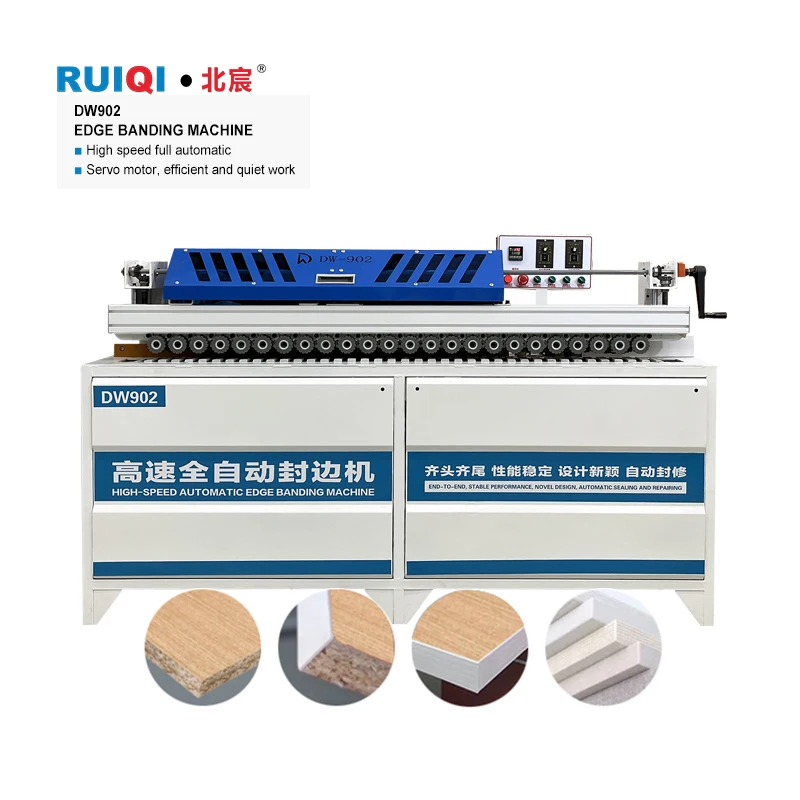
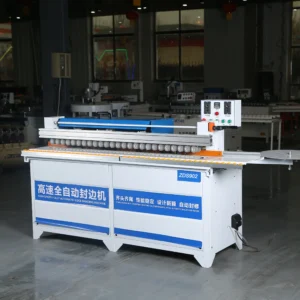
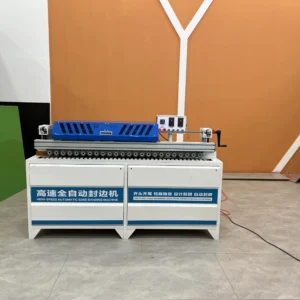
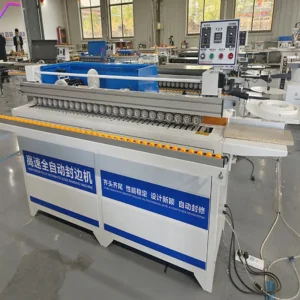
Verified Tolerance Claims — The DW902 ships with a factory test record documenting actual trimming output on your specified substrate before it leaves the facility.
Technical Specifications
| Parameter |
Value |
| Model |
DW902 |
| Product Type |
Automatic Edge Banding Machine |
| Total Power |
4000W |
| Voltage |
220V / 380V / customization available |
| Edge Power |
140W |
| Transmission Power |
140W |
| Trimming Station |
Dual 800W motors at 24,000 r/min |
| Polishing Station |
Dual 380W motors |
| Vacuum Power |
550W |
| Air Source Pressure |
0.5–0.8 MPa |
| Glue Pot Capacity |
4000 ml |
| Minimum Sheet Dimensions |
25 cm length × 10 cm width |
| Edge Banding Height |
5 cm |
| Edge Banding Thickness |
0.3–3 mm |
| Edge Type |
45° bevel and straight dual-purpose |
| Pressing Mechanism |
Double row pressing wheels, 4 groups of oblique pressure wheels, auxiliary slide plate |
| Thermal System |
Double hot air design |
| Overall Dimensions (L×W×H) |
175 × 87 × 112 cm |
| Net Weight |
240 kg |
| Plug Options |
EU, USA, AU, UK |
| Language Options |
Chinese and English standard; Spanish or other languages by customization |
Application Suitability
| Application |
Material or Output |
| Cabinet door edge finishing |
MDF and particleboard with PVC or melamine paper banding |
| Custom furniture panel processing |
Plywood, blockboard, and ecological board substrates |
| Solid wood panel trimming |
Solid wood boards requiring bevel or straight edge profiles |
| Workshop-scale production runs |
Medium-density fiberboard panels up to 5 cm edge height |
Why the Voltage Question Should Come Before the Quotation
A machine that cannot match your facility's electrical supply becomes dead weight the moment it arrives.
I have seen factories take delivery of woodworking equipment only to discover the motor was wired for a 50 Hz grid when their shop runs on 60 Hz. The result is burned windings, stalled commissioning, and weeks of back-and-forth with the supplier while production deadlines pass. This automatic edge banding machine specification sheet forces that conversation before the order is placed — not after. When buyers skip confirming local voltage and frequency, the machine may physically plug in but operate outside its designed torque curve, leading to inconsistent feed rates and premature motor failure [NEED_CITE: voltage and frequency standards by export market].

Mapping Electrical Configuration to Your Workshop
The DW902 supports voltage options from 220V to 380V with customization beyond that range, and plug configurations are selectable across EU, USA, AU, and UK standards. This matters because a technical buyer sourcing across borders must match the machine's automatic edge banding machine specifications to the facility's actual grid conditions. A 380V three-phase setup delivers stable torque for the dual 800W trimming motors, while a 220V single-phase arrangement suits smaller workshops with limited electrical infrastructure.
The Language Barrier at Commissioning
Control panel language is a detail that rarely surfaces in initial quotations but can stall a production line for days. When an operator cannot read the interface, parameter adjustments become guesswork. The DW902 ships with Chinese and English interfaces as standard, with Spanish or other languages available through customization. Confirming the operator's preferred language during the configuration stage avoids the situation where a machine sits idle waiting for a translated manual.
How Trimming Speed and Glue Temperature Affect Edge Quality
The dual trimming motors run at 24,000 r/min, which is the rotational speed that determines how cleanly the excess banding material is removed from the panel edge. On MDF and particleboard, this speed produces a flush finish without chipping the substrate surface. The double hot air design maintains consistent glue temperature across the banding path, which is critical when switching between PVC strips and thinner melamine paper — a scenario where insufficient thermal capacity causes adhesion failure mid-run. The 4000 ml glue pot provides sufficient capacity for continuous runs without frequent refills, and the 0.3–3 mm banding thickness range covers most standard furniture edge profiles. Feed speed and panel thickness range values are available upon request with test records on your specified substrate [NEED_CITE: CE machinery directive requirements for industrial equipment].
The Cost of Skipping Substrate Verification
I once configured an edge bander for a cabinet maker who tested with PVC banding and signed off on the machine. When production started, they switched to melamine paper banding — a material that demands higher glue temperature and different pressing pressure. The banding lifted along every panel edge, and two weeks of parameter adjustment followed before output met quality standards. Requesting a factory test on your actual board and banding material before shipment eliminates this category of failure entirely. Mismatched pressing mechanisms and glue temperatures account for a significant share of edge banding complaints that surface only under production conditions [NEED_CITE: common edge banding failure modes in panel furniture manufacturing].
What This Manufacturer Actually Builds In-House
The DW902's pressing mechanism — double row pressing wheels with four groups of oblique pressure wheels and an auxiliary slide plate — is a proprietary configuration developed for consistent contact across bevel and straight edge profiles. In-house manufacturing extends to the cutting mechanisms, which carry patents for tolerance consistency. Four-stage quality control covers incoming material, in-process assembly, finished product, and pre-shipment verification, so the machine you receive has been run against documented test parameters rather than pulled from a warehouse floor. Configuration recommendations are engineer-led, with formal quotations typically provided within 24 hours of receiving complete specifications. Factory visits are welcomed for buyers who want to witness the assembly and testing process directly [NEED_CITE: quality management standards for woodworking machinery exports].
Documentation & Verification
- CE declaration of conformity specific to the DW902 model configuration
- Machine specification sheet with all confirmed parameters for your voltage and plug type
- Electrical schematic with voltage and frequency match documented before production
- Factory test record showing trimming and polishing results on your specified panel material
- Operation and maintenance manual in the agreed language with spare parts list included
- Packing photographs and customs documentation support for your import procedure
Installation, Commissioning & Support
- Floor space of approximately 175 × 87 cm with clearance for panel infeed and outfeed paths
- Dedicated circuit matching confirmed voltage with appropriate breaker rating for 4000W total draw
- Air supply connection at 0.5–0.8 MPa for pressing wheel actuation and vacuum system
- First-run parameter calibration on your panel stock with technician guidance provided
- Trimming blade and polishing wheel replacement intervals documented in the manual
- Spare parts list shipped with the machine identifying all wear components and part numbers
Before You Request a Quotation
Provide the board material you actually run — MDF, particleboard, plywood, or solid wood — along with the specific banding type and thickness you use in production. Include your facility's voltage, phase, and frequency so the electrical configuration is locked in before manufacturing begins. If your operators require a specific control panel language or if your workshop has ceiling height or footprint constraints, note those upfront so the configuration proposal accounts for them.
Frequently Asked Questions
Q: How is edge banding tolerance verified on different substrates before the machine ships?
A: The factory runs a test on your specified panel material and banding type before dispatch. A test record documenting the measured results accompanies the shipment. This is the only way to confirm tolerance claims — generic specifications without substrate-specific test data do not account for how different board densities and banding materials behave under the pressing mechanism and trimming stations.
Q: How do I confirm the voltage and frequency will match my facility before ordering?
A: During the configuration stage, you provide your facility's electrical specifications — voltage, phase, and frequency. The manufacturer produces an electrical schematic confirming the match, which is reviewed before production begins. This prevents the situation where a machine arrives wired for a different grid standard and requires rewinding or transformer installation.
Q: What control panel language options are available for operators?
A: Chinese and English are standard interfaces on the DW902. Spanish and other languages are available through customization. The language requirement should be specified during the quotation stage so the control panel and operation manual are prepared in the correct language before shipment, avoiding commissioning delays.
Q: How does feed speed affect throughput matching with my existing panel saw?
A: Feed speed determines how many panels per hour the machine can process, which must align with your upstream cutting equipment to avoid bottlenecks. The specific feed rate for the DW902 is confirmed during the configuration proposal based on your panel dimensions and production targets, documented in the formal quotation and specification sheet.