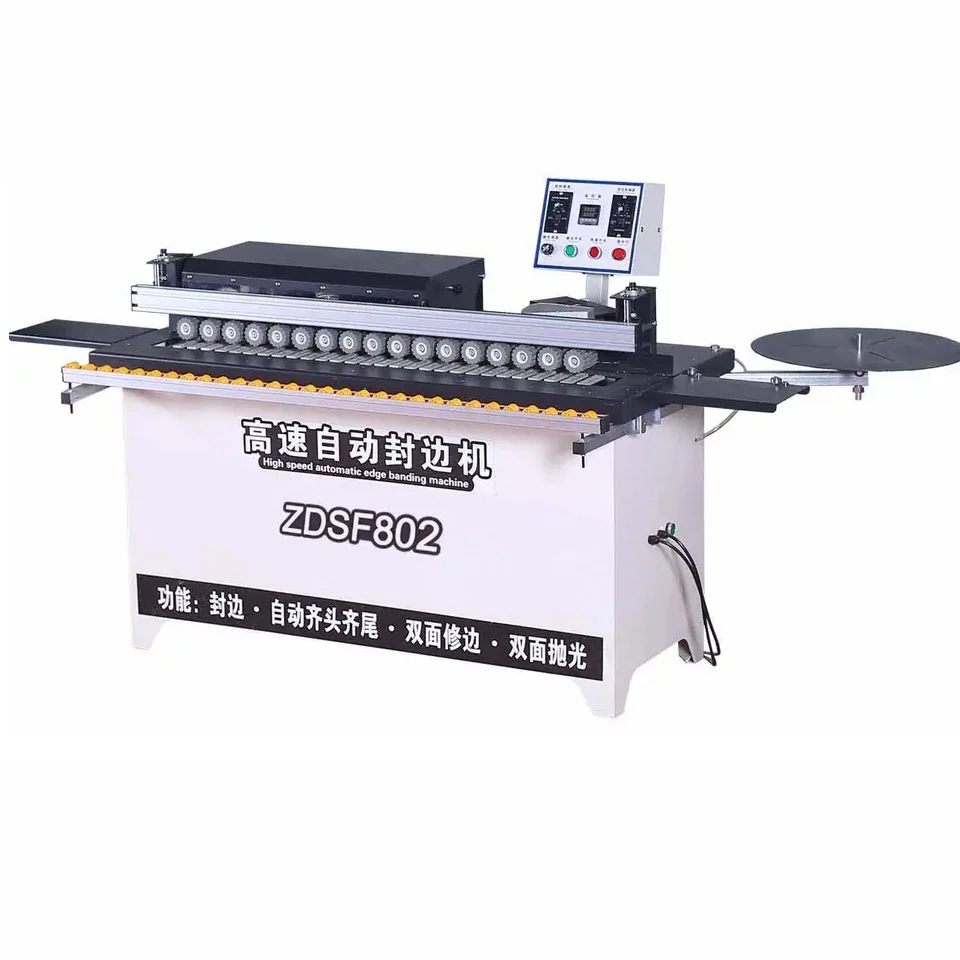
Voltage verified at the drawing board, not the dock — every electrical parameter on the ZDSF802 automatic edge banding machine specifications sheet is cross-checked against your local supply before production begins, eliminating the three-week rewiring standstill I once watched shut down an entire panel line in Chile.
Technical Specifications
| Parameter |
Value |
| Model |
ZDSF802 |
| Product Type |
Automatic Edge Banding Machine |
| Rated Power |
4 kW |
| Voltage & Frequency |
220 V (frequency to be confirmed per market) |
| Control System |
Digital display control panel with independent switches |
| Overall Dimensions (L×W×H) |
130 × 65 × 75 cm |
| Net Weight |
150 kg |
| Panel Thickness Range |
10–50 mm |
| Edge Strip Thickness Range |
0.5–2.5 mm |
| Edge Type |
Straight line |
| Feed Speed |
0–10 m/min |
| Conveyor Belt Speed |
0–10 m/min |
| Trimming Power |
800 W × 2 |
| Polishing Power |
180 W × 2 |
| Suction Power |
1200 W |
| Heating Power |
1000 W (heat-up time 5–10 min) |
| Glue Pot Capacity |
4000 ml |
| Rated Air Pressure |
0.4–0.6 MPa |
| Functions |
Automatic plate feeding, end cutting, upper and lower polishing, automatic head and tail trimming, dust collection |
| Dust Extraction |
Integrated vacuum cleaner (1200 W) |
| Pressure System |
Integrated pressure beam, double rows of pressure wheels |
| Conveyor Belt Material |
Silicone |
| Belt Breaking Method |
Pneumatically controlled |
| Assembly State |
Partially assembled (some assembly required on site) |
| Key Features |
Straight-line edge processing, digital control, pneumatic end cutting, integrated dust extraction |
Application Suitability
| Application |
Material or Output |
| Custom furniture panel edge banding |
MDF, particleboard, plywood with PVC or veneer strips |
| Cabinet door and carcass finishing |
Solid wood panels and melamine-faced chipboard |
| Small-batch joinery production |
Straight-line components requiring 0.5–2.5 mm edge strips |
| Workshop transitioning from manual to automatic |
Panels 10–50 mm thick at feed speeds up to 10 m/min |
Why the Voltage Question Must Come Before the Quotation
A machine that cannot run on your local supply is not a machine — it is a 150 kg floor anchor.
I spent three weeks on a jobsite outside Santiago watching a panel line sit idle because a single edge bander arrived wired for a voltage the workshop did not have. The rest of the factory was running, CNC routers cutting, sliding saws dimensioning, but nothing could be edged and nothing could ship. That bottleneck cost more in missed delivery penalties than the machine itself [NEED_CITE: voltage and frequency standards by export market]. When reviewing automatic edge banding machine specifications, confirming whether 220 V matches your facility and whether the local frequency aligns with the motor rating is the first step, not an afterthought during commissioning.
Matching Feed Speed to Your Daily Panel Output
The ZDSF802 runs at 0–10 m/min, and the conveyor belt speed is synchronized to the same range. For a small-to-medium custom furniture workshop processing a mix of cabinet sides, shelving, and door panels, this feed rate covers typical batch volumes without forcing operators to rush loading or risk panel drift. The silicone conveyor belt grips coated and uncoated substrates without leaving marks, which matters when you are feeding pre-finished melamine boards that cannot tolerate surface scoring. Selecting the correct automatic edge banding machine specifications means calculating whether this speed range aligns with your upstream saw output and downstream boring capacity so no single station becomes the constraint.
Glue Pot Volume and Continuous Run Discipline
A 4000 ml glue pot allows the ZDSF802 to run longer between refills, which reduces the number of thermal cycles the adhesive goes through during a shift. Every time a pot is opened and replenished, the temperature drops and the viscosity curve shifts, potentially affecting bond consistency on the next batch of panels. With a 1000 W heating element and a documented heat-up window of 5–10 minutes, the recovery time after a refill is manageable, but fewer refills still mean fewer opportunities for variation [NEED_CITE: hot-melt adhesive thermal stability in edge banding applications]. Production managers reviewing automatic edge banding machine specifications should map the glue pot capacity directly against their average daily linear meters of edging to determine whether refill interruptions will fall inside or outside a normal shift rhythm.
How Panel Range and Motor Configuration Affect Edge Quality
The 10–50 mm panel thickness range covers the majority of substrates used in cabinet and furniture manufacturing, from thin 10 mm drawer bottoms to 50 mm solid-wood worktops. Dual 800 W trimming motors handle upper and lower edge trimming in a single pass, while dual 180 W polishing motors follow immediately to blend the trimmed edge flush with the panel surface. If the trimming motors are underpowered for a given substrate density, the cutter leaves chatter marks that polishing cannot correct. Conversely, running hardwood panels at the upper end of the thickness range demands confirming that the feed speed is reduced proportionally so the trimming cutters engage the material at a controlled rate. The pneumatically controlled belt breaking method ensures that end cuts on each panel are consistent, removing the operator judgment variable that causes uneven end-trim results on manually fed machines.

The Hidden Cost of Specifying Without Verification
When tolerance is claimed on a quotation but never verified against actual test panels, the problem surfaces only during assembly. A cabinet carcase that is half a millimeter out on edge thickness will not seat properly in a dado joint, and a run of twenty mismatched sides means twenty rejected units rather than one [NEED_CITE: downstream assembly tolerance stacking in panel furniture]. I have walked into workshops where the edge bander was running, panels were moving, but the assembly bench was backed up with parts that would not fit together. The root cause was not the operator and not the material — it was a machine whose actual output tolerance had never been checked against the factory's own assembly requirements before the first production run.
Why This Configuration Stands Up to Inspection
The ZDSF802 sits within a product family that scales from entry-level to full-function pre-milling models, meaning a workshop can add capacity later without switching suppliers or retraining operators on a different control interface. Voltage customization from 110 V to 440 V is available as standard, so the 220 V baseline can be adjusted to match your local supply before the machine leaves the factory. A four-stage quality control process covers incoming material, in-process assembly, finished product testing, and pre-shipment verification, ensuring each unit is documented before crating. Multilingual control panel options address the commissioning delays that occur when operators cannot read the interface language. Engineer-led configuration recommendations ensure that the machine you receive matches your substrate mix and production volume rather than a generic catalog default.
Documentation & Verification
- CE declaration of conformity matching the ZDSF802 model designation
- Electrical schematic with confirmed voltage and frequency for your market
- Factory test record run on your specified panel thickness and strip material
- Operation and maintenance manual provided in your agreed language
- Spare parts list identifying consumables and recommended replacement intervals
- Pre-shipment packing photographs for condition verification before dispatch
Installation, Commissioning & Support
- Allocate floor space for the 130 × 65 × 75 cm footprint plus operator clearance on the feed side
- Confirm a dedicated 220 V circuit rated for the 4 kW total draw plus start-up surge
- Plan for partial on-site assembly of pressure beam and dust extraction connections
- Schedule first-run calibration using your actual panel stock and edge strip material
- Train operators on digital display controls and independent switch functions before production starts
- Stock replacement trimming cutters and polishing wheels from the included spare parts list
Preparing Your Inquiry
To move from catalog review to a confirmed configuration, share your primary panel materials and thickness range, your target daily linear meters of edge banding, and your workshop's confirmed voltage and frequency. Include any existing upstream or downstream equipment so feed heights and throughput rates can be matched. If you require a sample processing test on your own substrate before committing, specify the panel and strip combination so the test can be arranged in advance.
Frequently Asked Questions
Q: How do I verify the ZDSF802 feed speed against my daily panel output requirement?
A: Calculate your total daily linear meters of edging and divide by available production hours to find the minimum sustained feed speed. Compare that figure against the 0–10 m/min range, factoring in loading time between panels. If your requirement sits near the upper limit, consider whether a higher-tier model in the same product family would provide more headroom.
Q: Is the 220 V rating compatible with my local supply, and can it be customized?
A: The baseline rating is 220 V, but voltage configuration from 110 V to 440 V is available. Confirm your local voltage and frequency before ordering so the motor, heating element, and control system are wound and calibrated correctly. The electrical schematic is provided with the machine for your electrician's verification on arrival.
Q: What panel and edge strip thickness combinations does this machine actually accept?
A: The ZDSF802 accepts panels from 10 to 50 mm thick and edge strips from 0.5 to 2.5 mm, handling PVC and veneer materials on straight-line edges. Confirm that your heaviest substrate and thickest strip fall within these boundaries, and request a factory test on your specific material combination before shipment.
Q: How is the glue pot temperature controlled and what is the heat-up cycle?
A: A 1000 W heating element brings the 4000 ml glue pot to working temperature within 5–10 minutes, controlled through the digital display panel. Independent switches allow the operator to manage heating separately from feed and trimming functions, reducing adhesive degradation during idle periods between batches.
Q: Which spare parts are included and what is the recommended replacement schedule?
A: A spare parts list is supplied with each machine, identifying consumable items such as trimming cutters, polishing wheels, and feed belt components. Replacement intervals depend on your substrate abrasiveness and daily run volume, so request the schedule matched to your specific material mix during the inquiry stage.