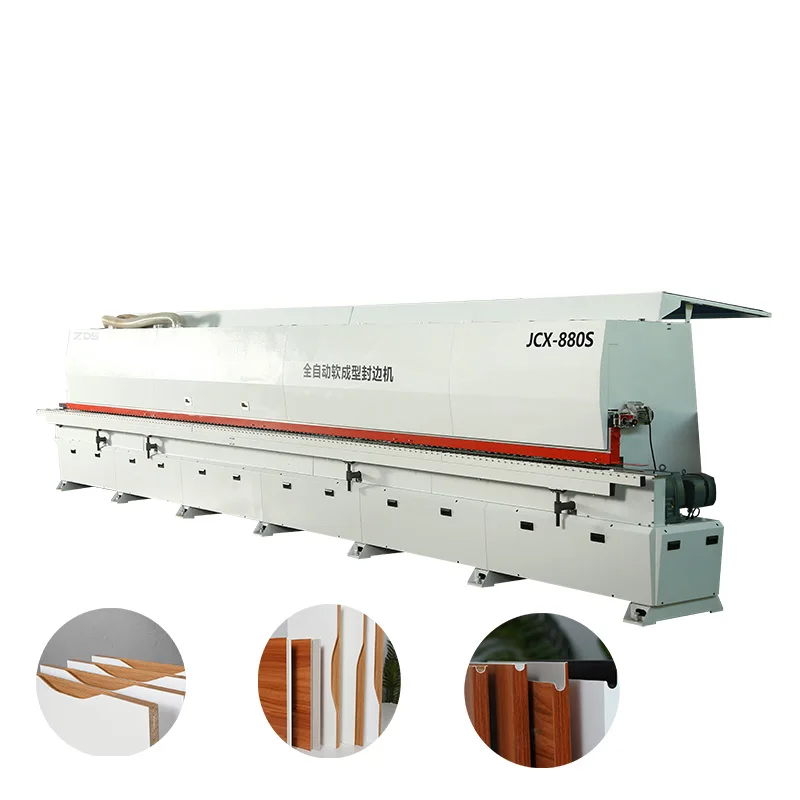
Engineer-Led Configuration — Every ZDSJCX-880S proposal begins with a formal review of your factory voltage, panel stock, and feed throughput before production is scheduled, ensuring the machine arrives ready to run on day one.
Technical Specifications
| Parameter |
Value |
| Model |
ZDSJCX-880S |
| Product Type |
Automatic Edge Banding Machine with Pre-milling |
| Overall Dimensions (L×W×H) |
8.82×1.07×1.85 m |
| Net Weight |
3200 kg |
| Total Power |
47.1 kW |
| Voltage |
380V (frequency to be confirmed: 50Hz or 60Hz) |
| Air Supply Requirement |
0.6–0.8 MPa |
| Vacuum Opening Size |
Ф100×6 |
| Panel Thickness Range |
18–22 mm |
| Edge Banding Thickness Range |
0.5–0.8 mm |
| Edge Banding Width |
58 mm |
| Minimum Sheet Width |
150 mm |
| Minimum Sheet Length |
300 mm |
| Conveying Speed |
6–8 m/min |
| Machining Shape Capability |
J type, C type, oblique straight, left/right semi-pass, water drop, rhombus, triangle — 15+ types |
| Warranty |
1 year |
Application Suitability
| Application |
Material or Output |
| Custom cabinet door and carcass edge finishing |
MDF and particleboard with PVC edge banding |
| Panel furniture contour edge profiling |
Plywood panels with shaped edges (J, C, water drop, rhombus) |
| Small-batch workshop production runs |
Boards within 18–22 mm thickness, minimum 150×300 mm |
| Straight and shaped edge treatments in one pass |
PVC banding 0.5–0.8 mm thick, up to 58 mm wide |
Why the Voltage Question Must Come Before the Order
A machine wired for the wrong frequency will not start, regardless of how well it was built.
I once watched a furniture factory in the Middle East lose two full weeks of production because an edge bander arrived configured for 440V/60Hz while the local grid delivered 380V/50Hz. The motors could not reach rated speed, the PLC threw fault codes, and a transformer had to be air-freighted from overseas. That kind of failure has nothing to do with build quality — it is a documentation gap that surfaces only after the crate is opened [NEED_CITE: voltage and frequency standards by export market]. Before any ZDSJCX-880S leaves the factory, the electrical schematic and nameplate data must match the buyer's confirmed supply, eliminating the single most common commissioning blocker for imported woodworking machinery.

Matching Feed Speed to Your Batch Profile
The conveying speed of 6–8 m/min positions the ZDSJCX-880S in the mid-range throughput bracket, which aligns with workshops processing several hundred panels per shift rather than continuous high-volume lines. When your batch sizes fluctuate between custom cabinet orders and small furniture runs, this feed rate gives operators enough control to manage loading without bottlenecking upstream saws or downstream assembly stations. Evaluating automatic edge banding machine specifications at this speed range helps a production manager decide whether a single pass covers both straight and contoured edges without re-routing panels to a secondary station.
Profile Versatility Without Retooling
With 15+ machining shape profiles available — including J type, C type, oblique straight, semi-pass, water drop, rhombus, and triangle — the ZDSJCX-880S handles contour edge work that would otherwise require a separate shaping machine or manual routing. This matters most for custom furniture factories where a single project may call for three or four different edge profiles across cabinet doors, drawer fronts, and shelving. Switching between profiles is a tooling and parameter change rather than a machine swap, keeping downtime measured in minutes rather than hours [NEED_CITE: CE machinery directive requirements for industrial equipment].
Reading the Numbers That Actually Affect Output
The 18–22 mm panel thickness range tells you immediately whether this machine fits your board stock; if your workshop regularly processes 12 mm backs or 25 mm worktops, those panels fall outside the envelope and will need an alternate station. The 0.5–0.8 mm edge banding thickness and 58 mm width define the PVC strip specification you should procure — ordering 1 mm ABS banding, for example, would exceed the stated capacity. At 47.1 kW total power, the ZDSJCX-880S demands a dedicated electrical circuit sized for continuous industrial load, and the six Ф100 vacuum openings require a dust extraction system capable of maintaining adequate suction across all ports simultaneously. The 0.6–0.8 MPa air supply requirement means your compressor must deliver clean, dry air at stable pressure; fluctuating air pressure is a frequent cause of inconsistent glue application and uneven trimming results on automatic edge banding machine specifications sheets that never get verified before installation.
The Hidden Cost of Skipping Specification Verification
When edge banding thickness compatibility is assumed rather than confirmed, the first sign of trouble appears as visible glue lines on finished panels — by which point the batch is already in the customer's hands. Ordering a machine without confirming local frequency means motors and variable-frequency drives arrive mismatched to the grid, and the resulting commissioning delay cascades into delivery promises made to end clients [NEED_CITE: typical causes of edge banding machine commissioning delays]. A control panel labeled in a language the operator cannot read turns a straightforward setup into a multi-day troubleshooting exercise, and none of these problems reflect machine quality — they reflect gaps in the pre-order specification process.
Why Source This Machine Through This Channel
In-house manufacturing with patented cutting mechanisms means tolerance claims on the ZDSJCX-880S can be verified through factory test records rather than relying on catalog assertions alone. Voltage, language, and specification customization are treated as standard configuration steps, not special requests, so a 380V/50Hz machine with an Arabic control interface is processed through the same workflow as a 440V/60Hz unit. The four-stage QC protocol — covering incoming material, in-process inspection, finished product review, and pre-shipment verification — applies to every unit before crating. Engineer-led configuration review ensures that the automatic edge banding machine specifications you receive in the formal quotation match your actual factory conditions, not just a generic template. Factory visits are welcomed so you can witness the machine running your panel material before it ships.
Documentation & Verification
- CE declaration of conformity covering the ZDSJCX-880S edge banding unit
- Electrical schematic confirming 380V supply and exact frequency for your grid
- Factory test record measured on your specified panel thickness and banding material
- Operation and maintenance manual produced in the agreed operator language
- Spare parts list with part numbers matching the as-built configuration
Installation, Commissioning & Support
- Floor space planning based on the 8.82 m machine length plus operator clearance zones
- Dedicated circuit sizing for 47.1 kW continuous load with correct phase and frequency
- Machine ships fully assembled; confirm forklift capacity for 3200 kg net weight on arrival
- First-run parameter setting for your specific 0.5–0.8 mm PVC banding and panel thickness
- Compressed air line installation meeting 0.6–0.8 MPa with dryer and filtration fitted
- Dust extraction ducting routed to six Ф100 vacuum ports before production start
Starting Your Technical Evaluation
To move from catalog review to a workable quotation, share your primary panel material and thickness range, the edge banding type and dimensions you intend to use, and your confirmed local voltage and frequency. Include your typical batch profile — whether you run mostly straight edges or need frequent contour profile changes — so the configuration proposal accounts for the correct tooling stations. If you require a sample processing test on your own board stock, state this early so material can be staged before the build cycle begins.
Frequently Asked Questions
Q: How do I verify whether the 6–8 m/min feed speed matches my production volume?
A: Calculate your average panels per shift and the linear edge meters per panel. Multiply total linear meters by your target shift hours, then compare against the 6–8 m/min range accounting for loading and unloading time. This gives a realistic throughput envelope rather than a theoretical maximum.
Q: Is the 380V supply compatible with my factory electrical system?
A: The ZDSJCX-880S is listed at 380V, but frequency (50Hz or 60Hz) must be confirmed before production. Request the electrical schematic showing motor ratings and PLC specifications matched to your local grid. Shipping a machine with the wrong frequency configuration causes motor and drive failures that delay commissioning by weeks.
Q: What edge banding materials does the 0.5–0.8 mm range actually cover?
A: The stated thickness range aligns with standard PVC edge banding used in cabinet and furniture production. Before ordering, confirm whether you also need ABS, wood veneer, or melamine banding, as each material behaves differently in the glue pot and trimming stations and may require parameter adjustments.
Q: How does the 18–22 mm panel thickness range limit my board choices?
A: This range suits standard cabinet and furniture carcass boards. If your production includes thinner backs (12 mm) or thicker worktops (25 mm+), those panels fall outside the machine envelope and require a separate edge banding station or a different model configured for a wider thickness window.
Q: Can I request a sample processing test before the machine ships?
A: Yes. Send your actual panel material and preferred edge banding stock to the factory for a test run. The resulting sample and test record let you verify edge quality, glue line visibility, and trimming accuracy on your own substrates before committing to shipment.