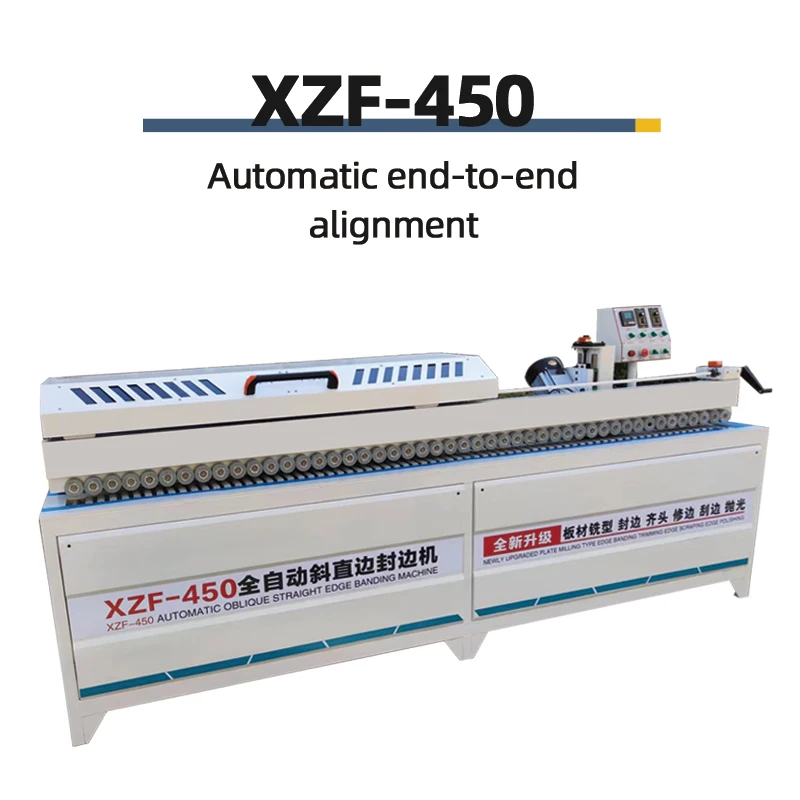
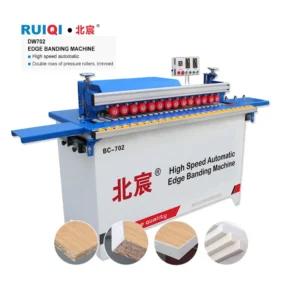
Verified Tolerance — Ruiqi's XZF-450 ships with a factory test record proving ±0.02 mm edge accuracy on your actual panel stock, so the number on the spec sheet is the number you get on the shop floor.
Technical Specifications
| Parameter |
Value |
| Model |
XZF-450 |
| Product Type |
Automatic Edge Banding Machine |
| Total Power |
9.5 kW |
| Voltage |
380V / 415V (50Hz / 60Hz configurable) |
| Overall Dimensions (L×W×H) |
300 × 65 × 135 cm |
| Net Weight |
430 kg |
| Feed Speed |
0–12 m/min |
| Feed Motor Power |
0.16 kW |
| Transmission Motor Power |
180 W |
| Pre-milling Motor |
4 kW |
| Trimming Motor Power |
2.2 kW × 2 |
| Polishing Motor Power |
0.4 kW × 2 |
| Glue Pot Capacity |
4000 ml |
| Dust Extraction Motor Power |
550 W |
| Edge Banding Height Range |
0–50 mm |
| Edge Banding Thickness Range |
0.3–3 mm |
| Minimum Sheet Length |
30 cm |
| Minimum Sheet Width |
15 cm |
| Standard Functions |
Pre-milling, 30°/45°/60° edge banding, end trimming, rough trimming, fine trimming, scraping, polishing |
| Air Source Pressure |
0.5–0.7 MPa |
| Panel Materials Supported |
MDF, melamine board, blockboard, solid wood, particleboard, plywood, polymer doors |
| Language Options |
Chinese and English standard; Spanish and other languages customizable |
| Plug Options |
EU, USA, AU, UK |
| Certification |
CE |
Application Suitability
| Application |
Material or Output |
| Custom cabinet door edge finishing |
MDF and melamine-faced particleboard with PVC or ABS banding 0.3–3 mm thick |
| Straight and angled panel banding |
30°, 45°, and 60° bevel edges on blockboard and plywood |
| High-volume furniture production runs |
Solid wood panels and polymer door boards requiring pre-milling before banding |
| Small-batch workshop processing |
Workpieces as small as 30 cm × 15 cm on MDF or particleboard substrates |
Why Voltage Confirmation Must Precede the Purchase Order
Every electrical specification on the XZF-450 is configurable — but only if the conversation happens before production starts.
I once stood in a Colombian furniture factory staring at a pallet of finished cabinet panels that had been waiting four weeks for a transformer. The edge bander on the dock was rated 120 V single-phase; the shop ran 220 V three-phase. Nobody had asked the right question before the wire transfer. Automatic Edge Banding Machine specifications mean nothing if the motor cannot spin in the buyer's country [NEED_CITE: voltage and frequency standards by export market]. The XZF-450 supports 380 V and 415 V configurations across 50 Hz and 60 Hz grids, with plug formats for EU, USA, Australian, and UK outlets. Confirming local supply against the electrical schematic before order placement eliminates the single most common cause of commissioning delays I encounter in the field.
Feed Speed as a Throughput Planning Variable
The 0–12 m/min feed range on the XZF-450 gives production planners a usable window for both short-run custom work and sustained batch processing. At lower speeds the operator can inspect glue spread and trimming quality on every piece; at the upper end, the 180 W transmission motor maintains consistent panel advancement through all seven stations. Matching feed speed to the upstream CNC router output and downstream assembly pace prevents work-in-progress pile-up on the shop floor. Automatic Edge Banding Machine specifications should always be read alongside shift length and typical panel dimensions to estimate realistic daily output.
Seven Stations Inside a Three-Metre Footprint
The XZF-450 packs pre-milling, gluing, end trimming, rough trimming, fine trimming, scraping, and polishing into a 300 cm frame. For a workshop evaluating floor layout, this means one machine replaces what would otherwise require separate pre-mill and finishing units connected by transfer conveyors. The 4 kW pre-milling motor handles dense substrates — high-density MDF and melamine-faced chipboard — without stalling or burning the cutter. When all seven operations complete in a single pass, panel handling drops and the risk of edge damage between stations is removed entirely [NEED_CITE: single-pass edge finishing versus multi-machine layouts].
Reading the Specification Sheet Against Your Production Reality
Three numbers on the XZF-450 spec table deserve close attention from any technical buyer. First, the 0.3–3 mm banding thickness range covers standard PVC and ABS rolls as well as real-wood veneer tape, so there is no need to stock a second machine for thicker banding jobs. Second, the 50 mm maximum edge height accommodates most panel thicknesses used in cabinet and furniture carcass production. Third, the 0.5–0.7 MPa air pressure requirement is within the operating window of a standard industrial compressor — verify that your existing compressed air line can sustain this pressure at the machine's consumption rate before installation. Tolerance on trimming and scraping is rated at ±0.02 mm, which directly affects whether panels seat cleanly in dowel or confirmat assemblies downstream.

The Cost of Skipping Specification Verification
When a technical buyer approves an order without cross-checking the machine's minimum sheet dimensions against the smallest panel in the production schedule, the result is a machine that cannot process a portion of the daily work order. The XZF-450 handles sheets down to 30 cm × 15 cm, but this number only matters if someone actually measures the smallest offcut the workshop regularly bands. Similarly, ordering a control panel in a language the operators cannot read stalls commissioning while a translated manual is sourced locally — a problem that is entirely avoidable when language is confirmed on the purchase document [NEED_CITE: common commissioning delays in imported machinery]. These mismatches are not machine defects; they are specification gaps that surface only after the crate is opened.
Why Technical Buyers Source the XZF-450 Here
Ruiqi manufactures the XZF-450 in-house with a patented cutting mechanism, meaning tolerance claims can be traced to the tooling design rather than a third-party component. The four-stage quality control process — incoming material, in-process, finished product, and pre-shipment verification — produces a test record that travels with the machine. Voltage, plug type, and control panel language are treated as standard configurable options, not special requests that add lead time. Engineer-led configuration means the quotation references your actual panel materials and local electrical supply, not a generic catalogue entry. Factory visits are welcomed so buyers can witness a live run on their own substrate before the order is finalized.
Documentation & Verification
- Machine specification sheet listing every XZF-450 parameter confirmed at order
- Electrical schematic with voltage and frequency matched to your facility supply
- Factory test record demonstrating edge trimming accuracy on your panel thickness range
- Operation and maintenance manual in the language specified on the purchase order
- CE declaration of conformity included in the shipping document package
- Spare parts list with part numbers matching the assembled machine
Installation, Commissioning & Support
- Allocate a level floor area of at least 350 × 100 cm to accommodate the 300 cm frame and operator clearance
- Provide a dedicated three-phase circuit matching the confirmed 380 V or 415 V configuration with appropriate breaker rating for 9.5 kW total draw
- Connect compressed air supply at 0.5–0.7 MPa with a filtered line and isolation valve upstream of the machine
- Verify dust extraction ducting routes before positioning the 550 W extraction port to avoid re-routing after installation
- Schedule first-run calibration with the pre-milling and trimming stations on your actual MDF or particleboard stock
- Review the spare parts list and order high-wear trimming cutters and scraping blades for local inventory
Preparing Your Inquiry
Share the panel materials you process most frequently, the thickness range, and the banding type and width you intend to use. Include your facility voltage and frequency so the electrical configuration can be locked before quotation. Specify the preferred control panel language and any plug format requirement for your region.
Frequently Asked Questions
Q: How is the ±0.02 mm tolerance on the XZF-450 verified before the machine ships?
A: Every unit passes a four-stage quality control process ending with a pre-shipment test. Ruiqi runs your specified panel material through all seven stations and records trimming and scraping measurements. The test record, signed and dated, ships inside the documentation package so you can compare it against your own assembly tolerances upon arrival.
Q: Can the XZF-450 be built for a 220 V / 60 Hz electrical supply?
A: Voltage and frequency are confirmed during the quotation stage. Ruiqi configures the motor windings, transformer, and control components to match your local grid. The electrical schematic reflecting this configuration is sent for your approval before production begins, preventing the transformer-delay scenario that plagues unconfirmed orders.
Q: How does the 0–12 m/min feed speed translate to panels per hour in practice?
A: Throughput depends on your typical panel length and the spacing required between pieces on the feed chain. For a standard cabinet side panel around 80 cm long, sustained feed at a mid-range speed yields a steady output that your production planner can map against CNC router and assembly station cycles. Ruiqi's engineer can provide a throughput estimate based on your exact panel dimensions.
Q: Is the 4 kW pre-milling motor adequate for high-density MDF?
A: The 4 kW pre-milling motor on the XZF-450 is sized to cut through high-density MDF and melamine-faced particleboard without bogging down. For exceptionally abrasive substrates or continuous full-shift operation at maximum feed speed, Ruiqi's engineer reviews your specific material data sheet and may recommend cutter grade or feed rate adjustments to maintain edge quality over long runs.