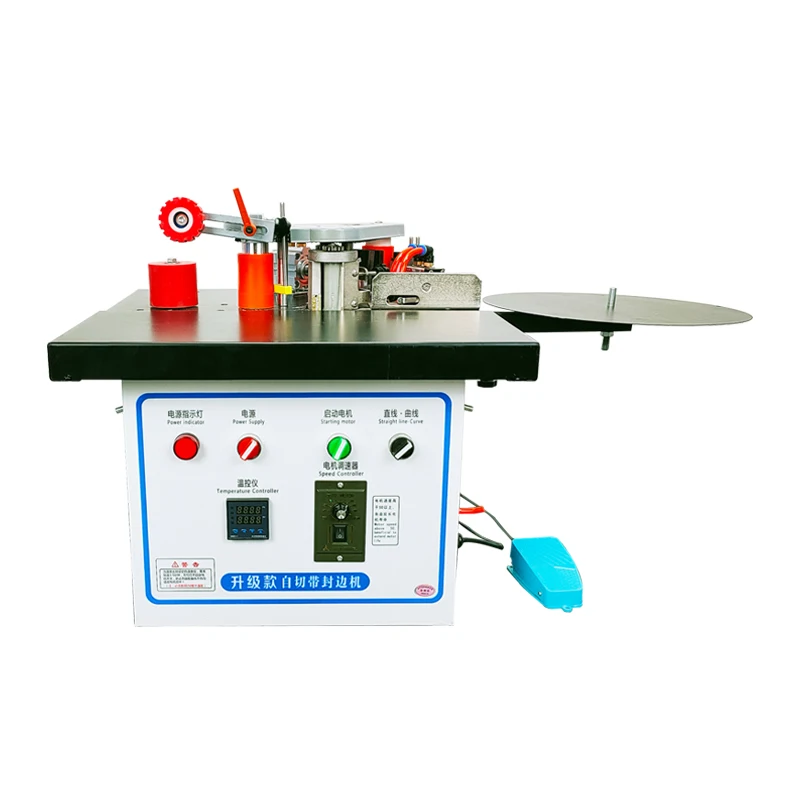
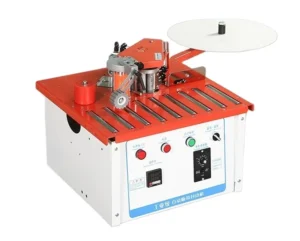
Compact Footprint Configuration — a 22kg manual edge banding unit that fits where full automatic lines cannot, while covering curved and straight profiles within a single workstation.
Technical Specifications
| Parameter |
Value |
| Model |
ST-50 |
| Product Type |
Manual Edge Banding Machine |
| Total Power |
1000W |
| Voltage |
220V / 380V / customizable |
| Edge Banding Thickness |
0.3–3mm |
| Edge Banding Height |
0–50mm |
| Minimum Sheet Length |
25cm |
| Minimum Sheet Width |
3cm |
| Glue Pot Capacity |
1000ml |
| Air Source Pressure |
0.5–0.8MPa |
| Edge Power |
20W |
| Product Size |
50 × 50 × 47cm |
| Net Weight |
22kg |
| Key Features |
Curved and straight edge banding, multilingual control panel options (Chinese, English, Spanish, or other languages) |
Application Suitability
| Application |
Material or Output |
| Small joinery workshop edge sealing |
MDF, particleboard, plywood panels |
| Custom furniture curved-edge banding |
Shaped cabinet doors, contoured shelving, solid wood profiles |
| Home-decoration on-site production |
Ecological board, veneer and PVC edge banding |
| Transition from hand-banding to mechanized sealing |
Small-batch panels requiring both straight and curved coverage |
Why Voltage Confirmation Must Precede Every Edge Banding Machine Order
Confirming electrical compatibility before shipment prevents machines from sitting idle at the dock.
When edge banding machine specifications how to choose comes up in conversation, most buyers jump straight to banding thickness and feed speed. The voltage question gets buried until the container is opened and the electrician discovers the motor will not run on the local grid [NEED_CITE: voltage and frequency standards by export market]. I have watched three units of this class sit in a Lagos port warehouse for nearly a month while the customer sourced a step-down transformer. A manual edge bander drawing only 1000W is simple to reconfigure at the factory, but only if the correct voltage is locked in before production starts.
Banding Envelope: What 0.3–3mm Actually Covers
The 0.3–3mm edge banding thickness range and 0–50mm height envelope define the substrate and edge material combination this machine can handle. Thin PVC at 0.3mm suits laminated particleboard where a visible glue line is unacceptable, while 3mm solid wood or ABS strip covers the heavier wear edges on worktops and shelving. Buyers evaluating edge banding machine specifications how to choose should cross-reference their most common panel thickness against the 50mm maximum banding height to confirm full coverage.
Dual Curved-and-Straight Capability in a 22kg Unit
Most workshops that process both flat cabinet sides and shaped door fronts buy two separate machines. The ST-50 handles curved and straight profiles from a single workstation, trading automated feed speed for functional breadth. This matters when floor space is limited and batch sizes do not justify dedicated curved-edge stations [NEED_CITE: small workshop machinery consolidation strategies]. The 50 × 50 × 47cm footprint allows placement beside a sliding table saw without disrupting material flow through the shop.
Reading the Numbers That Matter on the Shop Floor
Glue pot capacity at 1000ml determines how many linear meters of banding can be applied before a refill is needed — in a manual-feed environment, frequent glue replenishment interrupts operator rhythm and risks temperature drop in the pot. The 0.5–0.8MPa air supply requirement is modest; most small workshop compressors can sustain it, but the line must be filtered and regulated to protect the glue feed mechanism from moisture contamination. Total power at 1000W means the unit can run on a standard single-phase circuit in most markets, simplifying installation compared with multi-kilowatt automatic banders that demand dedicated three-phase drops. Understanding these edge banding machine specifications how to choose parameters prevents utility-side surprises once the crate is opened.
The Real Cost of Skipping Electrical Verification
Arriving-unusable is not a shipping delay — it is a cash-flow problem. A machine parked at the port accrues demurrage daily while the buyer hunts for transformers or rewinds motors [NEED_CITE: CE machinery directive requirements for industrial equipment]. Beyond the direct cost, operators sit idle and installation schedules slip downstream. When the ST-50 is ordered with confirmed voltage and frequency, the motor and control transformer leave the factory matched to the destination grid, and commissioning becomes a same-day task rather than a multi-week project.
Manufacturing Depth Behind a Compact Unit
The ST-50 benefits from the same four-stage quality control protocol applied across the full machine range — incoming material inspection, in-process checks, finished-product testing, and pre-shipment verification. Voltage and plug configuration are confirmed against the buyer's electrical schematic before the unit enters final assembly. Factory test records are generated on the specific substrate and banding material the buyer will run, so tolerance claims are measurable rather than theoretical. The patented cutting mechanism design philosophy that governs the larger automatic models also informs the trimming components on this manual unit, keeping edge finish consistent across the thickness range.
Documentation & Verification
- Machine specification sheet confirming voltage, frequency, and plug type for your destination market
- Factory test record run on your actual MDF or plywood substrate and banding material
- Electrical schematic showing internal wiring matched to confirmed supply voltage
- Operation and maintenance manual in the agreed operator language before shipment
- CE declaration of conformity documentation for customs clearance
Installation, Commissioning & Support
- Requires a stable 0.5–0.8MPa filtered air line with regulator for glue feed protection
- 1000W draw fits a standard single-phase circuit; confirm local plug type before dispatch
- 50 × 50 × 47cm footprint needs a level bench surface with 10cm rear clearance for air hose routing
- 1000ml glue pot should be purged after each shift to prevent residue buildup in small-batch use
- Multilingual control panel configured to operator language before crating, eliminating commissioning delays
Preparing Your Inquiry
Share the panel materials you run most often — MDF, particleboard, solid wood, or plywood — along with typical thickness and the banding material you intend to use. Confirm your workshop voltage and frequency so the electrical configuration can be finalized before production begins. If curved profiles are part of your output, specify the minimum bend radius so compatibility can be verified against the machine's banding envelope.
Frequently Asked Questions
Q: How can I verify edge banding quality on my substrate before committing to an order?
A: Request a factory test record using your exact panel material and banding thickness. The test runs your substrate through the ST-50 at production settings, and the results document glue adhesion, edge trim quality, and visible glue line presence. For higher confidence, arrange a sample processing test or factory visit where you can inspect finished panels in person.
Q: What voltage and frequency options exist, and how do I confirm the right one?
A: The ST-50 ships in 220V or 380V configurations with full customization for other voltages. Provide your facility's supply voltage, frequency, and plug type during inquiry. The electrical schematic is confirmed before production so the motor, control transformer, and wiring arrive matched to your grid — no aftermarket rewinding required.
Q: How does the 25cm × 3cm minimum sheet size affect small-part processing?
A: Panels smaller than 25cm in length or 3cm in width cannot be reliably fed through the banding station. For custom furniture makers producing narrow drawer fronts or small accent pieces, verify that your smallest common part exceeds these dimensions. Parts near the minimum benefit from operator jigs to maintain consistent feed pressure.
Q: What infrastructure does the ST-50 need on day one of installation?
A: You need a single-phase power outlet matching the confirmed voltage, a compressed air supply delivering 0.5–0.8MPa through a filtered and regulated line, and a level bench with clearance for the 50 × 50 × 47cm footprint. Total power draw is 1000W, so a dedicated circuit is recommended but not mandatory in most workshop panels.