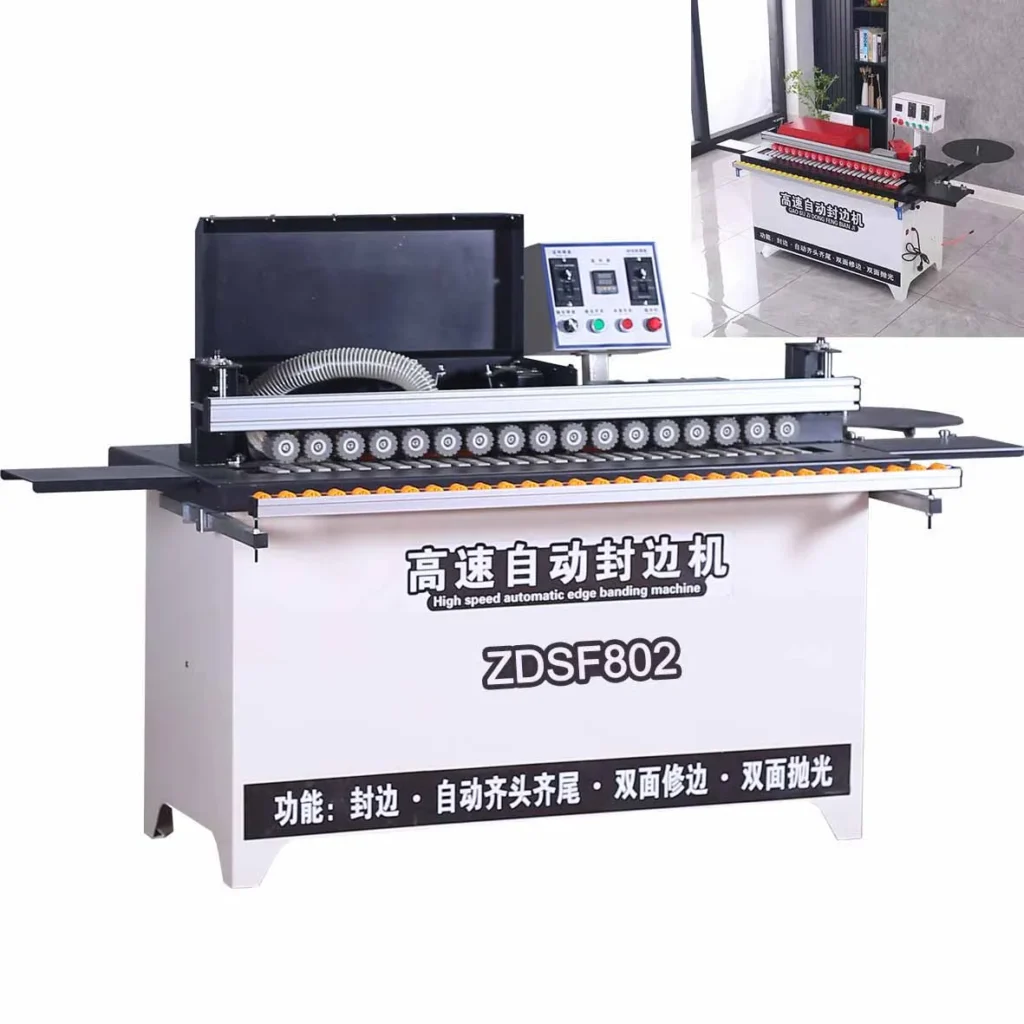
Voltage-Flex Configuration — Every 802 unit ships with a confirmed electrical schematic matching your workshop's local phase and frequency, eliminating dead-on-arrival surprises.
Technical Specifications
| Parameter |
Value |
| Model |
802 |
| Product Type |
Automatic Edge Banding Machine |
| Rated Voltage |
220V |
| Rated Power |
4 kW |
| Feed Speed |
0–10 m/min |
| Conveyor Belt Speed |
0–10 m/min |
| Sheet Thickness Range |
10–50 mm |
| Strip Thickness Range |
0.5–2.5 mm |
| Edge Type |
Straight line |
| Trimming Power |
800 W × 2 |
| Polishing Power |
180 W × 2 |
| Suction Power |
1200 W |
| Glue Pot Capacity |
4000 ml |
| Heating Power |
1000 W (5–10 min heat-up) |
| Rated Air Pressure |
0.4–0.6 MPa |
| Pressure Beam |
One-piece integrated, double rows of pressure wheels |
| Conveyor Belt Material |
Silicone |
| Belt Breaking Method |
Pneumatically controlled |
| Control Panel |
Digital display of glue pot temperature, independent switch |
| Overall Dimensions |
130 × 65 × 75 cm |
| Machine Weight |
150 kg |
| Key Features |
Automatic plate feeding, end cutting, upper and lower trimming, head and tail trimming, polishing, integrated dust collector |
Application Suitability
| Application |
Material or Output |
| Custom cabinet panel edging |
MDF and particleboard with PVC strips (0.5–2.5 mm) |
| Plywood shelving edge finishing |
Plywood panels 10–50 mm thick with veneer banding |
| Small-batch furniture components |
Solid wood composite boards requiring straight-line sealing |
| Workshop-scale joinery production |
Melamine-faced chipboard for carcass and door panels |
Why the Voltage Question Must Precede the Quotation
Confirming local phase and frequency before you evaluate any Automatic Edge Banding Machine specifications prevents a machine from sitting idle on your floor.
I once saw a workshop receive a unit wired for a supply it simply did not have. The distributor had quoted based on price and availability, never asking whether the facility ran single-phase or three-phase, or at what frequency. That machine needed an expensive transformer before it could even heat the glue pot. The cost of the transformer nearly matched the machine itself [NEED_CITE: voltage and frequency standards by export market]. When buyers review Automatic Edge Banding Machine specifications, the voltage rating deserves the same scrutiny as feed speed or trimming power.
Feed Speed and Panel Thickness: Finding the Operating Window
The 0–10 m/min variable feed speed on the 802 pairs with a 10–50 mm sheet thickness range to cover most panel stock a small cabinet shop handles. Thicker panels at the upper end of that range tend to require a slower feed rate so the trimming motors can engage cleanly without chipping the substrate edge. Operators dialing in a new board type should start at the lower end of the speed range, check the trimmed edge under light, and step up gradually until the finish holds within tolerance.
Glue Pot Capacity and Continuous Run Behavior
A 4000 ml glue pot fed by a 1000 W heating element means the 802 reaches working temperature within roughly five to ten minutes and sustains it across multiple panels before needing a refill. For shops running batch sizes of thirty to fifty cabinet sides in a session, that capacity reduces the number of mid-run pauses. The digital temperature display lets the operator verify that the adhesive stays within the range required by the specific PVC or veneer strip loaded, which matters because different banding materials demand different melt points for a clean glue line [NEED_CITE: adhesive melt temperature ranges for PVC and wood veneer edge banding].
Trimming, Polishing, and the Integrated Dust Path
Two 800 W trimming motors handle upper and lower edges in a single pass, followed by 180 W polishing motors that smooth any residual adhesive. The integrated dust collector, rated at 1200 W suction, captures offcuts and sanding dust at the source. This sequence matters because any trimming debris left on the conveyor belt can score the face of the next panel. Shops working melamine-faced chipboard know how easily a stray chip embedded in the silicone belt leaves a visible mark on subsequent boards.

The Hidden Cost of Skipping a Sample Processing Test
Tolerance on paper means little until you run your actual panel stock through the machine. I have watched buyers commit to an order based on a published spec sheet, only to discover during commissioning that the edge finish on their particular grade of particleboard left a visible glue line on the lighter melamine face. A sample processing test using your own substrate and banding material reveals whether the trimming motors and pressure wheel configuration produce an edge your assembly crew can work with immediately [NEED_CITE: edge banding adhesion and finish standards for panel furniture].
Why Source This Configuration Here
The 802 sits within a full product family that scales from compact workshop units to multi-station lines, so your supplier relationship does not need to restart when you outgrow this model. Voltage confirmation and electrical schematics ship with every unit, addressing the most common mismatch I see in cross-border machinery orders. Custom control panel language ensures your operators can read the digital display and independent switches without guessing. A four-stage quality check — incoming material, in-process, finished product, and pre-shipment verification — catches assembly issues before the crate is sealed. Engineer-led configuration recommendations arrive within 24 hours of your inquiry, backed by a formal quotation rather than a rough estimate.
Documentation & Verification
- Electrical schematic confirming 220V rating and compatible frequency for your facility
- Factory test record run on your specified panel thickness before dispatch
- Machine specification sheet covering all trimming, polishing, and suction power values
- Operation and maintenance manual written in your agreed language
- Packing photographs showing crate condition and accessory placement before shipment
Installation, Commissioning & Support
- Allocate floor space for the 130 × 65 × 75 cm footprint plus operator clearance on the infeed side
- Provide a dedicated circuit matching the 4 kW rated power and confirmed voltage
- Verify pneumatic supply delivers 0.4–0.6 MPa to support the belt breaking mechanism
- Run initial calibration at low feed speed using scrap panels from your own stock
- Schedule glue pot temperature profiling for each banding material in your inventory
- Stock replacement silicone belt segments and trimming cutters as first-order spares
Before You Send an Inquiry
Share your primary panel material, typical board thickness, and the edge banding type you run most often. Include your workshop's supply voltage, phase, and frequency so the quotation arrives with a matching electrical configuration. If you have an existing panel saw or boring station upstream, note its output rate so feed speed compatibility can be assessed.
Frequently Asked Questions
Q: How do I verify trimming accuracy with my own panel material before committing?
A: Request a sample processing test using your actual substrate and edge banding strip. Send a few panels to the factory or ask your regional representative to arrange a local demonstration. Inspect the trimmed edge under direct light for glue line visibility and surface smoothness. This step confirms whether the 802 trimming motors produce a finish your assembly process requires.
Q: Is the 220V rating single-phase or three-phase, and what frequency range is supported?
A: The 220V specification must be confirmed against your local supply before order placement. Frequency compatibility depends on your market, typically 50 Hz or 60 Hz. Request a voltage confirmation document as part of your shipment documentation to ensure the unit arrives ready to connect without additional transformers or converters.
Q: How does the 4 kW rated power distribute across trimming, polishing, suction, and heating?
A: The rated power covers all stations running simultaneously: 800 W per trimming motor, 180 W per polishing motor, 1200 W for dust suction, and 1000 W for the glue pot heater. This breakdown helps you verify that your workshop circuit can handle the full load during continuous operation without tripping upstream breakers.
Q: How should I match this feed rate with my panel saw output?
A: At the maximum 10 m/min feed speed, calculate how many panels per hour your saw produces and compare that to the banding station throughput. If your saw cuts faster than the 802 can edge, you will need a buffer rack between stations. Balancing these rates prevents bottlenecks on either side of the workflow.