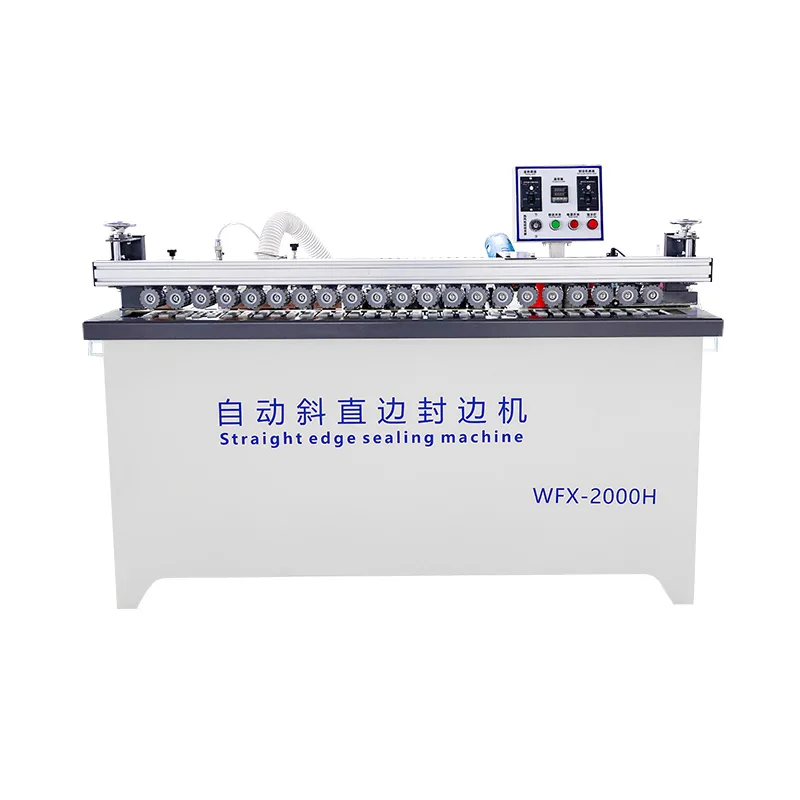
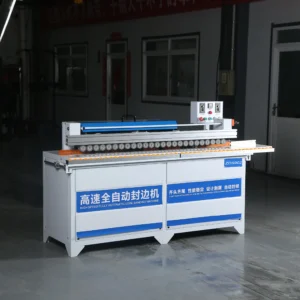
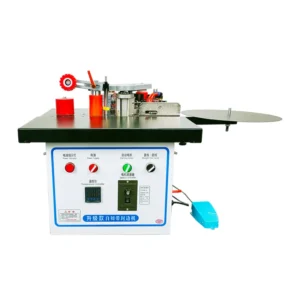
Compact Footprint, Verified Voltage — the ZDSF-2000H ships with a confirmed 220V rating and full electrical schematic so you can validate site compatibility before the machine leaves the factory.
Technical Specifications
| Parameter |
Value |
| Model |
ZDSF-2000H |
| Product Type |
Bevel-Straight Automatic Edge Banding Machine |
| Overall Dimensions (L×W×H) |
2100×600×1100 mm |
| Net Weight |
149 kg |
| Panel Thickness Range |
18–25 mm |
| Edge Strip Thickness |
Up to 1.2 mm |
| Rated Voltage |
220 V |
| Rated Power |
6.17 kW |
| Rated Air Pressure |
0.4–0.6 MPa |
| Feed Speed |
0–14 m/min |
| Plate Feeding |
Automatic |
| Gluing Method |
Hot air heating |
| Trimming |
Elastic profiling trimming |
| Pressing Section |
8 pressing rollers |
| Pressure Beam |
Aluminum alloy, manually adjustable |
| Vacuum Device |
Self-contained |
| Functions |
Edge banding, slotting, automatic belt breaking, trimming, polishing |
Application Suitability
| Application |
Material or Output |
| Bevel-edge cabinet door fronts |
MDF and plywood with PVC or veneer strips up to 1.2 mm |
| Straight-edge shelving and carcass panels |
Particleboard and MDF with PVC edge banding |
| Custom furniture panel processing |
Solid wood panels with veneer edge strips |
| Small-to-medium workshop production runs |
Mixed bevel and straight profiles on board stock 18–25 mm thick |
Why the Voltage Question Should Come Before the Bevel Straight Edge BANDING Machine Specifications
A machine that cannot run on your plant supply is a crate of expensive steel, no matter how well it trims.
I watched a workshop in Southeast Asia lose three weeks of production because an edge bander arrived wired for a voltage the local grid could not deliver. The main motor stalled under load, the control board threw fault codes, and the operator had no schematic to trace the issue. The distributor had assumed 220V meant 220V/60Hz without asking, and the frequency mismatch was the real problem. When you compare bevel straight edge banding machine specifications, the electrical data should be the first row you check, not an afterthought buried in a footnote [NEED_CITE: voltage and frequency standards by export market].

Dual-Profile Capability in a Single Pass
The ZDSF-2000H handles both oblique and straight edge profiles without requiring a second machine or a tooling swap mid-shift. For workshops producing bevel-edge door fronts alongside straight-edge cabinet sides, this dual capability collapses two stations into one footprint measuring just 2100×600 mm. The feed system runs at up to 14 m/min, which suits batch sizes typical of custom furniture operations rather than high-volume panel plants.
Hot Air Gluing Across Substrate Densities
The hot air heating system warms the glue and the panel edge simultaneously before the strip meets the substrate. This matters when you alternate between MDF, which absorbs heat differently, and denser particleboard. Consistent thermal transfer means the adhesive bonds evenly across varying board densities, reducing the chance of edge lift on the finished panel [NEED_CITE: adhesive bonding performance on engineered wood substrates].
Reading the Numbers That Matter for Edge Quality
The 18–25 mm panel thickness range covers standard board stock for cabinet and furniture manufacturing. The eight pressing rollers distribute contact force across the strip width, which is critical when applying 1.2 mm PVC to a bevel profile where pressure must follow the angle rather than press flat. Elastic profiling trimming follows the panel contour without gouging the surface, and the self-contained vacuum device captures trim waste at the source. The 6.17 kW power draw stays within single-circuit limits for most small workshops, but you still need to confirm that your supply can sustain this load alongside other running equipment. The aluminum alloy pressure beam is manually adjustable, giving the operator direct control over clamping force for different board thicknesses within the specified range.
What Happens When the Configuration Is Wrong
Ordering an edge bander without matching the air supply to the rated 0.4–0.6 MPa range leads to inconsistent pressing force and visible glue lines on finished panels. Operators who run the feed speed at maximum on bevel profiles often see strip slippage because the angled surface reduces contact time with the pressing rollers. A machine set up for one strip thickness struggles when the shop switches to a heavier veneer without recalibrating the trimming station. These are not defects in the machine — they are mismatches between the specification sheet and the actual production conditions [NEED_CITE: common edge banding defects caused by feed and pressure settings].
Why Technical Buyers Source This Model Here
In-house manufacturing means the cutting mechanism and pressing assembly are built and inspected under one roof, not assembled from third-party sub-contracts. Voltage customization from 110V to 440V is available as a standard configuration option, not a special request, which eliminates the assumption trap I described earlier. Every unit passes a four-stage quality check covering incoming material, in-process assembly, finished product, and pre-shipment verification. Engineer-led configuration recommendations arrive within 24 hours of an inquiry, so you get a formal quotation with the electrical data you need to validate site readiness. Factory visits are welcomed if you want to see the machine run your actual board stock before committing to an order.
Documentation & Verification
- Machine specification sheet listing all ZDSF-2000H parameters including confirmed voltage and frequency
- Electrical schematic with voltage confirmation matched to your plant supply before dispatch
- Factory test record run on your specified panel thickness and edge strip material
- Operation and maintenance manual provided in your agreed operator language
- CE declaration of conformity and ISO 9001 certificate included with shipping documents
- Packing photographs and customs documentation support for smooth import clearance
Installation, Commissioning & Support
- Confirm a dedicated 220V circuit rated for at least 6.17 kW before the ZDSF-2000H arrives on site
- Allow floor space of at least 2100×600 mm plus operator clearance on the feed and exit sides
- Connect compressed air supply within the 0.4–0.6 MPa range to ensure full pressing roller force
- First-run commissioning includes feed speed calibration and trimming station alignment for your strip thickness
- Operator training covers manual pressure beam adjustment across the 18–25 mm panel thickness range
- Spare parts list identifies wear items including trimming blades and pressing roller surfaces
What to Include in Your Inquiry
Send your panel material type, board thickness range, and edge strip specification so the engineer can confirm the ZDSF-2000H configuration matches your production. State your local voltage and frequency — not what you assume, but what your utility actually delivers. If you run upstream saws or downstream boring machines, share their feed rates so the line throughput can be balanced around the 0–14 m/min range of this edge bander.
Frequently Asked Questions
Q: Can the ZDSF-2000H be configured for voltages other than 220V and for 60Hz frequency?
A: Voltage customization from 110V to 440V is available as a standard option. Frequency must be confirmed before production so the motor and control components match your local grid. The electrical schematic and voltage confirmation document are provided with every order to prevent on-site compatibility failures.
Q: Does the 18–25 mm panel thickness range allow adjustment for thinner boards?
A: The specified range covers standard furniture board stock. Thinner panels or strips exceeding 1.2 mm may require mechanical adjustment or a different configuration. Request a test run on your actual material before ordering to verify compatibility.
Q: At what feed speed does bevel-edge quality remain consistent on MDF versus particleboard?
A: The 0–14 m/min range gives the operator flexibility, but bevel profiles typically require a slower feed than straight edges to maintain glue contact time. MDF and particleboard respond differently to heat and pressure, so the optimal speed depends on your specific substrate and strip combination.
Q: What bevel angles does the ZDSF-2000H support, and how is the angle set?
A: The machine handles oblique edge profiles alongside straight edges in a single pass. The specific angle range and whether adjustment is mechanical or via the control panel should be confirmed during the configuration stage. Include your required angle in your inquiry so the engineer can validate the setup.
Q: How does this machine integrate with existing saws and boring machines in a workshop line?
A: The 2100×600 mm footprint and 0–14 m/min feed rate suit small-to-medium workshop layouts. Share the throughput of your upstream sliding table saw and downstream boring stations so the line can be balanced without creating a bottleneck at the edge banding station.