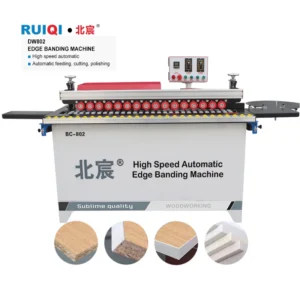
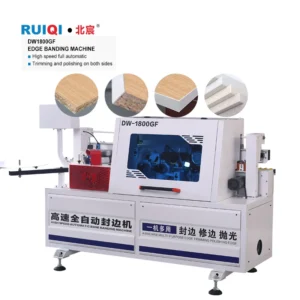
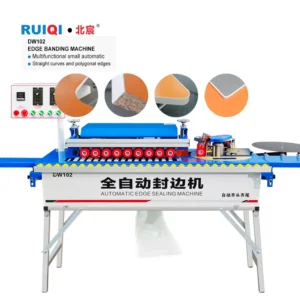
Precision-ground components — The DW902 automatic edge banding machine delivers trimming spindle speeds of 24,000 r/min with verifiable motor ratings at every station, letting technical buyers compare line by line before committing.
Technical Specifications
| Parameter |
Value |
| Model |
DW902 |
| Product Type |
Automatic Edge Banding Machine |
| Total Power |
4000 W |
| Voltage & Frequency |
220 V / 380 V / customization |
| Edge Motor Power |
140 W |
| Transmission Motor Power |
140 W |
| Trimming Motor Power |
800 W × 2 |
| Trimming Spindle Speed |
24,000 r/min |
| Polishing Motor Power |
380 W × 2 |
| Vacuum Motor Power |
550 W |
| Glue Pot Capacity |
4000 ml |
| Air Source Pressure |
0.5–0.8 MPa |
| Minimum Sheet Length |
250 mm |
| Minimum Sheet Width |
100 mm |
| Edge Banding Height |
50 mm |
| Edge Banding Thickness |
0.3–3 mm |
| Machine Features |
Oblique and straight dual-purpose banding; double hot air design; feeding auxiliary slide plate; 4 groups of oblique pressure wheels; double row pressing wheels; chamfering function |
| Overall Dimensions (L×W×H) |
175 × 87 × 112 cm |
| Net Weight |
240 kg |
| Control Panel Languages |
Chinese and English standard; Spanish or other languages customizable |
| Plug Options |
EU / USA / AU / UK |
| Certifications |
CE, ISO 9001 |
Application Suitability
| Application |
Material or Output |
| Cabinet door edge banding |
MDF and particleboard with PVC edge banding |
| Custom furniture panel finishing |
Plywood and ecological board with 0.3–3 mm banding |
| Joinery workshop production runs |
Solid wood board for 90-degree edge profiles |
| Small-batch home decoration components |
Short panels down to 250 mm length |
Why Edge Banding Machine Specifications Decide Assembly Quality Downstream
A machine that trims clean at 24,000 r/min today may leave visible glue lines tomorrow if the substrate and glue temperature were never matched.
Technical buyers often receive quotation sheets listing feed speed and motor power but omitting how those numbers behave on the actual panel stock running through the shop. I once configured a line for a Vietnamese cabinet factory where the edge bander performed perfectly on standard MDF during the factory test, yet the same unit produced widespread banding lift-off once the customer switched to high-moisture particleboard in their own facility. The trimming motors kept pace, but the glue pot thermal recovery could not maintain bonding temperature under continuous load. That mismatch only surfaced because we asked about the real substrate before shipping [NEED_CITE: substrate moisture content effect on hot-melt adhesive bonding]. Reviewing edge banding machine specifications on paper is only the first gate; the second gate is confirming those specifications against your actual material flow.

Trimming Power and Spindle Speed Under Load
The DW902 stations two 800 W trimming motors running at 24,000 r/min. At this spindle speed, PVC banding up to 3 mm thick typically shears cleanly without chipping the substrate edge. For workshops alternating between thin veneer and thicker PVC profiles, the dual-motor arrangement means rough trimming and finish trimming can share the workload, reducing heat buildup on each cutter. When evaluating any edge banding machine specifications sheet, verify whether the stated motor wattage is per spindle or combined — the DW902 lists 800 W per spindle, which matters when dense particleboard demands sustained cutting force.
Glue Pot Thermal Recovery and Double Hot Air Design
A 4,000 ml glue pot capacity supports continuous runs on standard panel widths, but capacity alone does not guarantee thermal stability. The double hot air design on this unit pre-heats both the panel edge and the banding strip before they meet the glue roller. In humid environments, moisture on the substrate surface absorbs heat rapidly, so the double hot air arrangement compensates by raising the surface temperature of both mating materials. Production managers running ecological board or moisture-rich particleboard should request a thermal recovery test at their target feed rate to confirm the pot holds bonding temperature across consecutive panels [NEED_CITE: hot-melt adhesive open time and temperature drop in humid conditions].
Reading the Motor Map Against Your Product Mix
Every station on the DW902 carries its own motor rating: 140 W for the banding feed, 550 W for vacuum extraction, 380 W per polishing spindle. This station-by-station breakdown lets a technical buyer compare the DW902 edge banding machine specifications directly against competing models without needing to decode bundled power figures. The vacuum motor at 550 W handles trimming dust and offcut removal, which becomes critical when running MDF that generates fine particulate. If your shop processes predominantly plywood, the vacuum demand drops, but the polishing stage gains importance — two 380 W polishing motors must smooth the trimmed edge without burning the banding face.
The Hidden Cost of Skipping Voltage Confirmation
Ordering a 380 V machine into a facility running 220 V single-phase is more common than most importers admit. The resulting symptoms range from motors that start but stall under load to control boards that fail within weeks. The DW902 offers voltage customization across 220 V and 380 V with plug options for EU, USA, AU, and UK markets, yet the exact frequency must also match — 50 Hz and 60 Hz grids change motor speed proportionally, which shifts trimming spindle output away from the rated 24,000 r/min. Buyers in regions with mixed grid standards should confirm both voltage and frequency on the electrical schematic before the machine enters production [NEED_CITE: voltage and frequency standards by export market]. A unit rated for one grid but operated on another will void warranty claims and leave the workshop searching for transformer solutions that introduce their own efficiency losses.
Why Source the DW902 From This Manufacturer
The factory operates in-house manufacturing with patented cutting mechanisms, meaning the trimming spindles and pressure wheel assemblies on the DW902 are built and inspected under one roof rather than sourced from third-party integrators. A four-stage QC process covers incoming material inspection, in-process checks, finished product verification, and pre-shipment testing — each DW902 receives a factory test record documenting edge quality on the agreed substrate before crating. Voltage, language, and specification customization are handled as standard options, not special orders, so a buyer requesting Spanish-language controls and 220 V/60 Hz configuration receives the same lead time as a standard domestic unit. Engineer-led configuration recommendations arrive within a formal quotation cycle, giving technical buyers documented parameters to file alongside competing bids. Factory visits are welcomed, letting buyers witness the DW902 running their own panel stock on the assembly floor before committing to a purchase order.
Documentation & Verification
- CE declaration of conformity covering the DW902 trimming and polishing stations
- Machine specification sheet listing every station motor rating and dimensional tolerance
- Electrical schematic confirming voltage, frequency, and plug type for your facility
- Factory test record demonstrating edge banding quality on your specified substrate and banding thickness
- Operation and maintenance manual delivered in the agreed control panel language
- Spare parts list identifying consumable cutters and replacement pressure wheels
Installation, Commissioning & Support
- Verify floor space for the 175 × 87 cm footprint plus operator clearance on the infeed side
- Confirm a dedicated circuit matching the ordered voltage and the 4000 W total power draw
- Inspect the 240 kg unit upon arrival for transit damage before positioning and leveling
- Set air supply to the required 0.5–0.8 MPa range using a regulated line with moisture trap
- Run first-article panels in your actual material to calibrate trimming depth and glue temperature
- Stock replacement trimming cutters and polishing pads from the supplied spare parts list
Preparing Your Inquiry for Accurate Configuration
To receive a configuration proposal that matches your production reality, share the panel materials you run most frequently, the edge banding thickness range in your product mix, and the voltage and frequency standard at your facility. If your shop processes short panels near the 250 mm minimum, note that dimension explicitly so the engineer can confirm feed stability on small workpieces. Specify the control panel language your operators need and whether you plan to run a sample test using your own stock before final order.
Frequently Asked Questions
Q: What feed speed and panel thickness range does the DW902 support?
A: The published edge banding machine specifications for the DW902 list minimum sheet dimensions of 250 mm by 100 mm and a banding thickness range of 0.3–3 mm. Feed speed and maximum panel thickness are not stated in the current source documentation and must be confirmed with the manufacturer during the quotation stage to ensure the unit matches your target daily throughput.
Q: How does voltage customization affect motor and control components?
A: Voltage customization between 220 V and 380 V involves matching motor winding configuration and control transformer ratings to your local supply. Frequency also matters — a 60 Hz grid will shift the trimming spindle speed above the rated 24,000 r/min at 50 Hz. The manufacturer provides an electrical schematic confirming all component ratings for the ordered voltage and frequency combination.
Q: What edge banding tolerance can be verified before shipment?
A: The manufacturer states a general precision capability associated with their proprietary cutting mechanisms. For the DW902 specifically, buyers should request a factory test record showing measured edge deviation on their chosen substrate and banding material. This test is conducted during pre-shipment verification and documents actual finished-edge measurements.
Q: Which components are classified as consumable spare parts?
A: Trimming cutters, polishing pads, and pressure wheel surfaces experience normal wear during operation. The spare parts list supplied with each DW902 identifies these consumable items along with part numbers. Buyers should confirm replenishment lead times for their region at the ordering stage to avoid unplanned downtime.
Q: Can we run a sample test with our own panel material before ordering?
A: Yes, the manufacturer welcomes sample processing tests using the buyer's own substrate and edge banding stock. This test verifies glue adhesion, trimming cleanliness, and polishing finish under real material conditions. Results are documented in the factory test record provided before shipment.