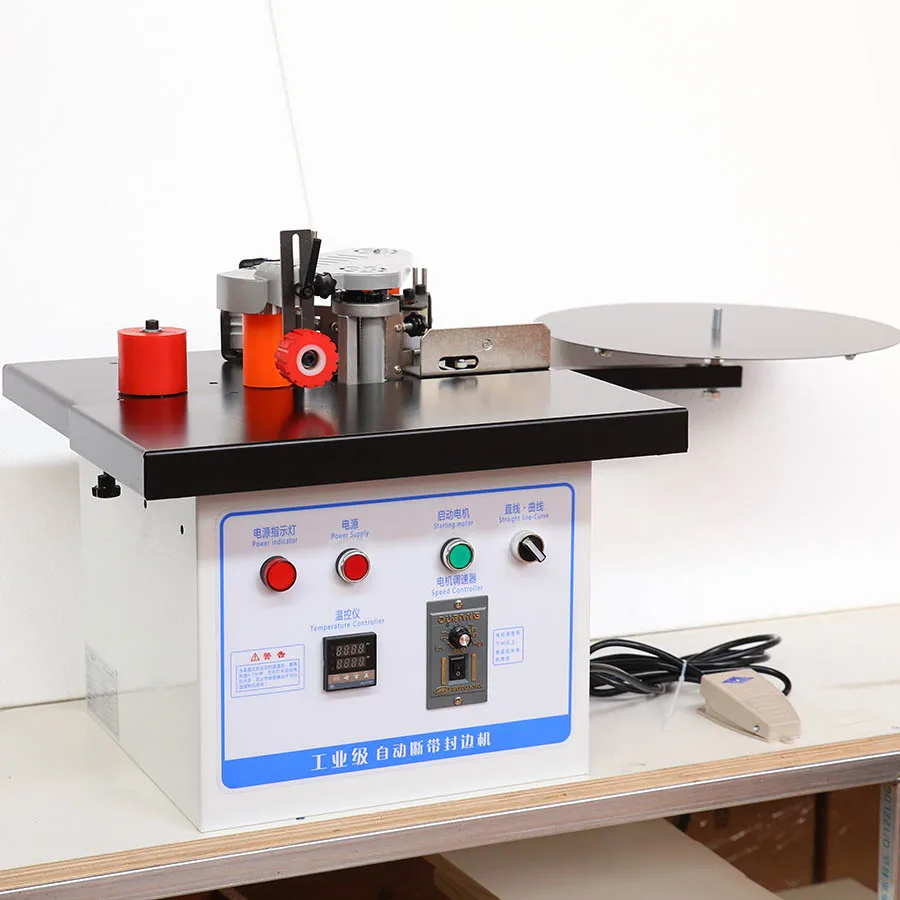
Utility-Matched Specification Data — every electrical and dimensional figure on this sheet is tied to real workshop conditions, drawn from the ZDSF-50mini portable edge bander test records so technical buyers can verify compatibility before committing.
Technical Specifications
| Parameter |
Value |
| Model |
ZDSF-50mini |
| Product Type |
Portable Automatic Edge Banding Machine |
| Rated Voltage |
220V |
| Heating Power |
800W |
| Heating System |
4 heating tubes |
| Heat-Up Time |
5-8 minutes |
| Rated Air Pressure |
0.4-0.6 MPa |
| Edge Banding Speed |
0-6 m/min |
| Strip Thickness Range |
0.5-2 mm |
| Max Sheet Thickness |
50 mm |
| Glue Pot Capacity |
1000 ml |
| Gluing Method |
Double-sided gluing via glue-coated rollers |
| Edge Shape Supported |
Straight edge, curved edge, shaped edge |
| Pressure Roller |
Adjustable, rubber material |
| Edge Strip Transport |
Adjustable bayonet per edge strip height |
| Belt Breaking — Curved |
Pneumatically controlled, foot switch operation |
| Belt Breaking — Straight |
Travel switch for automatic operation |
| Overall Dimensions (L×W×H) |
54×54×56 cm |
| Machine Weight |
26 kg |
| Key Features |
Light and portable frame, automatic tape breaking, double-sided gluing |
Application Suitability
| Application |
Material or Output |
| Small-batch cabinet door edge finishing |
MDF and plywood panels with 0.5-2 mm PVC edge banding |
| On-site curved edge work for custom furniture |
Particleboard and solid wood panels with veneer or PVC strips |
| Prototype and sample edge banding before full-line commitment |
MDF, plywood and particleboard up to 50 mm thick |
| Secondary workshop shaped-edge production |
Solid wood panels with shaped or contoured profiles |
| Repair and re-banding of existing furniture components |
PVC and veneer strips on straight and curved edges |
Why the Voltage Question Must Come Before Everything Else
Confirming 220V single-phase compatibility with your local supply is the single most important pre-order step for a Portable Automatic Edge Banding Machine specifications review.
I spent years running commissioning visits across African and South Asian workshops, and the pattern is the same every time: a machine arrives, gets plugged in, and the motor burns out because nobody checked whether the factory runs 220V, 380V, or something in between. In one Kenyan cabinet shop, a compact edge bander rated for 220V was connected to a 380V line. The motor failed on the first cycle, and the workshop stood idle for two full weeks waiting for a replacement shipped from overseas [NEED_CITE: voltage and frequency standards by export market]. These are not rare incidents. They happen because the voltage question gets buried in paperwork while everyone focuses on throughput and price.
Matching Feed Speed to Small-Shop Production Reality
The 0-6 m/min edge banding speed range on the ZDSF-50mini is designed for workshops where batch sizes are measured in single digits or low double digits, not production lines running hundreds of panels per shift. At the lower end of that range, an operator can carefully guide curved and shaped edges through the feed path without sacrificing adhesive contact time. For straight-edge runs on standard MDF panels, moving toward the upper end of the Portable Automatic Edge Banding Machine specifications envelope keeps the work moving without rushing the glue bond.
Understanding the Panel Thickness Envelope
The 50 mm maximum sheet thickness defines the upper boundary of what this unit can physically accept. Most MDF, plywood and particleboard used in cabinet and furniture work falls well within that limit, but it matters when you process thicker solid wood panels or laminated boards. The adjustable bayonet for edge strip transport and the adjustable rubber pressure roller work together to maintain consistent contact across that full thickness range, which directly affects whether the bonded edge holds through downstream handling and assembly [NEED_CITE: edge adhesion requirements across panel thickness ranges].
Reading the Specs That Actually Affect Output Quality

What the Glue Pot and Heating System Mean for Daily Operation
The 1000 ml glue pot capacity paired with four heating tubes and an 800W heating element gives a heat-up window of 5 to 8 minutes. For a small workshop that runs two or three edge banding sessions per day rather than continuous production, this means the operator can power up the glue system, prepare the first panels, and start feeding strips before the adhesive reaches working temperature. The double-sided gluing method through glue-coated rollers ensures adhesive contacts both the panel edge and the strip back simultaneously, which is the mechanism that determines whether you get a clean bond line or a visible gap once the panel is assembled into a carcass.
Pneumatic Belt Breaking and Operator Workflow
The ZDSF-50mini uses two different belt-breaking methods depending on the edge geometry. For curved edges, a pneumatically controlled device operated by a foot switch gives the operator hands-free control of the cut point — essential when both hands are guiding an irregular panel contour through the feed. For straight-line work, a travel switch handles automatic belt breaking at the panel end. The 0.4-0.6 MPa air pressure requirement is modest enough that a small workshop compressor can supply it, but the air line must be plumbed and regulated before first use. Skipping that step risks inconsistent cuts on the strip material.
The Cost of Skipping Specification Verification
When a buyer orders a portable edge bander without confirming that the voltage matches the local supply, the failure is immediate and total — not a gradual degradation that can be worked around. When strip thickness range and panel thickness are not checked against the actual materials in the workshop, the pressure roller cannot maintain proper contact and edges lift within days of assembly. When air pressure is below the rated 0.4 MPa minimum, the pneumatic belt-breaking device misfires or fails to cut cleanly, leaving excess strip material that must be trimmed by hand [NEED_CITE: pneumatic system failure modes in small workshop compressors]. Every one of these problems is preventable by spending thirty minutes with the specification sheet before placing the order.
What Distinguishes This Procurement Path
The ZDSF-50mini is built around an in-house manufacturing process with precision-ground components and multi-stage inspection, which matters because portable edge banders live in environments where vibration and movement are constant. A four-stage quality control process covering incoming material through pre-shipment verification is applied to every unit, not just sampled from a batch. Voltage and specification customization is available as a standard option, meaning a workshop running 110V or other local standards can have the electrical system configured before the machine leaves the factory. Engineer-led configuration recommendations are provided with a formal quotation within 24 hours of inquiry, so the Portable Automatic Edge Banding Machine specifications you evaluate are matched to your actual panel materials and local utilities. Factory visits are accepted for buyers who want to inspect build quality in person before committing.
Documentation & Verification
- Electrical schematic confirming 220V rating and local frequency compatibility before dispatch
- Machine specification sheet listing all dimensional and performance parameters for your records
- Factory test record on your panel thickness range and edge strip material before shipment
- Operation and maintenance manual in the operator's working language
- Spare parts list identifying wear items and recommended replacement intervals
- Packing photographs documenting machine condition prior to crate closure
Installation, Commissioning & Support
- Requires a dedicated 220V circuit with appropriate amperage for the 800W heating load plus feed motor draw
- Air supply must deliver 0.4-0.6 MPa through a filtered and regulated line to the pneumatic belt-breaking system
- Weighs 26 kg with a 54×54×56 cm footprint, placeable on a standard workbench without foundation work
- First commissioning includes setting pressure roller tension and adjusting the bayonet to your primary strip height
- Operator training covers foot-switch technique for curved edges and travel-switch setup for straight-line runs
- Wear parts include glue-coated rollers, rubber pressure roller, and heating tubes with documented replacement intervals
Preparing Your Specification Inquiry
To get a configuration recommendation that actually fits your workshop, share the panel materials and thicknesses you process most often, the edge strip types and gauges you stock, and your local voltage and frequency. If you run both straight and curved edge work, note the approximate split between the two. This information allows the engineer to confirm that the Portable Automatic Edge Banding Machine specifications align with your production before a quotation is issued, rather than discovering mismatches after the unit arrives on site.
Frequently Asked Questions
Q: How do I verify edge banding quality on curved and shaped edges with this portable model?
A: Request a sample processing test using your own panel material and edge strip before ordering. The ZDSF-50mini handles curved and shaped edges through the pneumatically controlled foot-switch belt breaking system, and a sample run lets you inspect the bond line and trim quality on the actual geometry you will produce in your workshop.
Q: Can the voltage be configured for markets that do not use 220V single-phase?
A: Voltage customization from 110V to 440V is available as a standard configuration option. Provide your local voltage and frequency at the inquiry stage so the electrical schematic and heating element rating are matched to your supply before the machine enters production.
Q: How do I match the feed speed and panel thickness range to my workshop volume?
A: The 0-6 m/min speed range suits small-batch and prototype work rather than high-volume production. If your daily output requires sustained feeding beyond what this range supports, an engineer can recommend whether a full-function stationary edge bander would be more appropriate for your throughput.
Q: What compressor capacity is needed to supply the pneumatic belt breaking system?
A: The unit requires 0.4-0.6 MPa air pressure delivered through a filtered line. A small workshop compressor rated for continuous duty at this pressure range is sufficient, but the regulator and filter must be installed between the compressor and the machine inlet to ensure clean, consistent air to the pneumatic device.
Q: Which spare parts should I stock locally for this portable edge bander?
A: The primary wear items are the glue-coated rollers, the adjustable rubber pressure roller, and the heating tubes. Request the spare parts list with recommended replacement intervals at the order stage so you can plan local inventory and avoid downtime waiting for shipments.