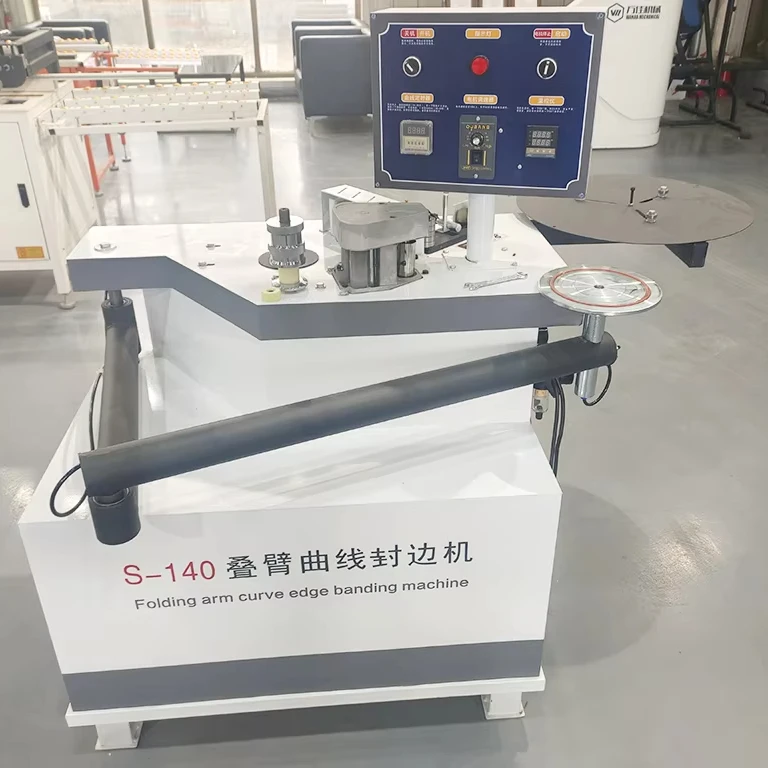
Voltage-First Configuration Protocol — Every S-140 quotation includes a signed voltage confirmation sheet before production begins, preventing the three-week transformer delay I once saw on a 440V unit shipped to a 220V workshop.
Technical Specifications
| Parameter |
Value |
| Model |
S-140 |
| Product Type |
Curve Edge Banding Machine |
| Voltage |
220V |
| Total Power |
1.4 kW |
| Air Supply Requirement |
0.5–0.8 MPa |
| Edge Banding Speed |
0–180 mm/s |
| Overall Dimensions (L×W×H) |
96×62×88 cm |
| Machine Size (L×W×H) |
105×65×120 cm |
| Net Weight |
88 kg |
| Standard Suction Cup Size |
200×26 mm |
| Edge Band Thickness Range |
0.4–2 mm |
| Edge Band Width Range |
8–50 mm |
| Breaking Method |
Automatic tape break (double cylinder controlled) |
| Glue Pot Capacity |
1000 ml |
| Gluing Method |
Double-sided gluing |
| Function Type |
Straight and curved dual purpose |
| Motor Type |
Pure copper motor |
| Control Features |
Intelligent temperature control, speed adjustment, timer |
| Hot Air Device |
Bottom-up hot air heating for improved adhesion |
| Edge Banding Wheel Adjustment |
+0.5 mm relative to edge strip width |
| Arm Design |
Folding arm device |
| Molding |
One-shot molding |
Application Suitability
| Application |
Material or Output |
| Custom cabinet door edge sealing |
MDF and particleboard with PVC edge banding |
| Wardrobe panel curved profile banding |
Plywood with veneer or PVC strips 0.4–2 mm thick |
| Office desk and study table edge finishing |
Particleboard substrates, straight and radius edges |
| Decorative wood product trimming |
Solid wood panels with thin veneer banding |
| Small-batch joinery production |
MDF, plywood, and particleboard in 8–50 mm band width |
Why the Voltage Question Should Come Before the Price on Any S-140 Curve Edge Banding Machine Specifications Sheet
Confirming local voltage and frequency compatibility before discussing pricing eliminates the single most common cause of idle-machine downtime after delivery.
I worked a case where a buyer in Southeast Asia received a curve edge bander wired for 440V three-phase. Their workshop ran on single-phase 220V. The machine sat on the floor for three weeks while they sourced and installed a step-up transformer. Production stopped, installer flyout costs doubled, and the operator forgot half the training by the time power was live. The S-140 curve edge banding machine specifications list 220V as standard, but frequency — 50 Hz or 60 Hz — determines whether the pure copper motor runs at rated thermal capacity or overheats during continuous curved runs [NEED_CITE: voltage and frequency standards by export market]. Skipping this check at quotation stage is how workshops end up with expensive floor anchors.
Matching Feed Speed to Curve Geometry
The 0–180 mm/s speed range on the S-140 folding arm curve edge bander matters most when operators transition between tight radii and long straight runs. Tighter curves demand slower feed rates so the double-sided glue application maintains full contact along the substrate edge. On straight sections, running near the upper end of the range improves throughput without sacrificing adhesion, provided the intelligent temperature control tracks the glue pot consistently. This adjustable range is what makes the S-140 curve edge banding machine specifications relevant to workshops handling mixed straight-and-curved jobs in the same shift.
Double-Sided Gluing and the 1000 ml Pot Advantage
Double-sided gluing applies adhesive to both the board edge and the banding strip simultaneously, which is particularly important on curved profiles where single-sided application tends to leave dry spots at the apex of the radius. The 1000 ml glue pot capacity means fewer mid-run refills during continuous production — a practical concern when a batch of cabinet doors requires matching edge treatment across dozens of panels. The bottom-up hot air heating device further supports adhesion by warming the substrate contact zone just before the banding wheel presses the strip into place, compensating for temperature loss on cold MDF or particleboard stock [NEED_CITE: hot air preheating effect on edge banding adhesion].
How Board Thickness, Band Width, and Air Pressure Interact
The 0.4–2 mm edge band thickness range and 8–50 mm width range define which materials the S-140 can handle, but air supply pressure at 0.5–0.8 MPa is what actually drives the double cylinder automatic tape break and the suction cup holding mechanism. If workshop air pressure drops below the lower threshold, the tape break becomes inconsistent — leaving overhang that requires manual trimming and introduces visible score lines on curved profiles. The folding arm design and the +0.5 mm wheel adjustment compensate for minor alignment shifts, but they cannot overcome insufficient pneumatic force. Buyers evaluating S-140 curve edge banding machine specifications should verify their compressor capacity before installation day.

The Hidden Cost of Specifying Without Confirming Air and Power Infrastructure
A workshop that orders a curve edge bander without verifying compressor output often discovers the problem only during the first curved panel run. The automatic tape break stutters, leaving ragged ends that operators trim by hand, introducing inconsistency across the batch. Similarly, running a 1.4 kW motor on an undersized circuit causes thermal cutouts during extended use, particularly when the hot air device and pure copper motor draw simultaneously. These failures are not machine defects — they are infrastructure mismatches that a detailed review of the S-140 curve edge banding machine specifications would have surfaced before the purchase order was signed [NEED_CITE: common edge bander commissioning failures traced to site infrastructure].
Why Buyers Source This Model Through Our Configuration Process
Our engineer-led quotation process requires signed voltage confirmation before the S-140 enters production, so the machine arrives wired for the buyer's actual supply. The four-stage QC protocol includes a pre-shipment test run using the buyer's specified band thickness and width, verifying the double cylinder tape break and glue pot temperature stability before crating. We provide the operation manual in the operator's language, preventing the commissioning stalls I have seen when control panels arrive in an unreadable script. CE declaration documentation is prepared per model, not as a blanket certificate across the product range, and factory test records ship with the unit so buyers have verifiable tolerance data before installation begins.
Documentation & Verification
- CE declaration of conformity issued specifically for the S-140 model
- Electrical schematic confirming 220V wiring and frequency rating
- Factory test record run at buyer's specified band thickness and width
- Operation and maintenance manual delivered in operator's agreed language
- Spare parts list matching the S-140 component inventory
Installation, Commissioning & Support
- Requires a dedicated 220V circuit rated for the 1.4 kW total power draw
- Air compressor must sustain 0.5–0.8 MPa at the machine inlet for reliable cylinder operation
- Compact 105×65×120 cm footprint fits standard workshop aisles without special flooring
- First-run calibration covers glue pot temperature, feed speed, and suction cup alignment
- Folding arm mechanism inspection and lubrication included in initial operator training
What to Include in Your Inquiry
Share your local voltage and frequency, the panel substrates and edge banding materials you process most frequently, and your typical curve radius range. If your workshop runs other upstream or downstream equipment, note their feed heights and throughput so we can verify compatibility. Specify the language your operators need on the control panel and in the manual.
Frequently Asked Questions
Q: How does the 0–180 mm/s feed speed range affect throughput on curved versus straight edge profiles?
A: On tight radii, operators reduce feed speed so the double-sided glue maintains full contact along the curve. Straight runs can use higher speeds within the range without losing adhesion, provided the intelligent temperature control tracks consistently. This adjustable range lets one S-140 unit handle both profile types in the same production shift.
Q: Is the 220V voltage rating compatible with both 50 Hz and 60 Hz power supplies?
A: The pure copper motor operates at 220V, but frequency affects thermal performance under continuous load. Buyers must confirm their local Hz rating at quotation stage so the motor winding and hot air device are matched to the supply. A signed voltage confirmation sheet is part of our standard order process.
Q: What substrates and band thicknesses work within the 0.4–2 mm range on curved radii?
A: MDF, particleboard, and plywood all accept PVC or veneer banding within the 0.4–2 mm thickness range. On curved profiles, thinner banding conforms more readily to tight radii, while thicker strips require slower feed speeds and verified hot air preheating for consistent adhesion.
Q: How does the folding arm design affect minimum and maximum curve radius handling?
A: The folding arm device allows the banding wheel and suction cup to pivot with the panel edge, maintaining pressure contact through direction changes. The +0.5 mm wheel adjustment prevents lateral shifting on curves. Specific radius limits depend on banding width and thickness combination selected for the job.
Q: What control panel language options are available for the S-140?
A: Multilingual control panels are available as a standard customization option. The intelligent temperature control display, speed adjustment interface, and timer can be configured in the operator's language. This is confirmed at quotation stage and documented in the order specification to avoid commissioning delays.