
Wood Saw Machines
J50 LIUHE-1 Portable Table Saw | Specifications
Portable Table Saw, EU/USA/AU/UK Plug Options, Customizable Control Panel — supports joinery...
View Details<p><strong>S-140 Folding Arm Curve Edge Banding Machine</strong>, 220V, 1.4 kW, 0–180 mm/s feed speed, 0.4–2 mm edge thickness capacity — dual-purpose unit for straight and curved panel edges with double-sided gluing and automatic tape breaking.</p> <ul> <li><strong>Intelligent temperature control</strong> with speed adjustment and timer for process repeatability across PVC, ABS, and veneer substrates</li> <li>Bottom-up hot air heating ensures consistent adhesion on curved profiles where cold-glue systems fail</li> <li>Adjustable edge banding wheel (+0.5 mm) prevents lateral shifting during application on varying strip widths</li> </ul> <p>Request factory test record with your actual panel material to verify edge banding tolerance before purchase.</p>
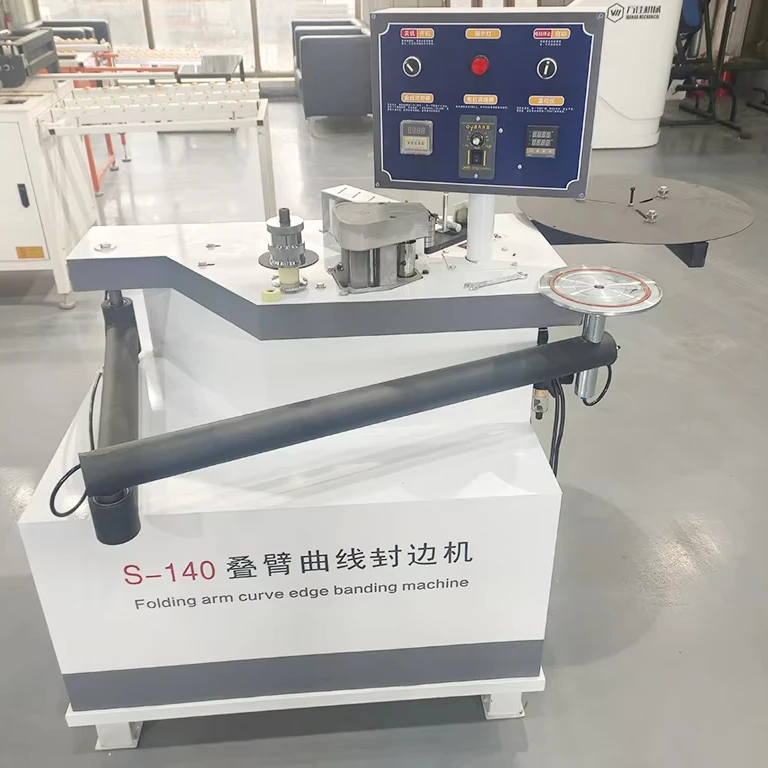
<p><strong>S-140 Folding Arm Curve Edge Banding Machine</strong>, 220V, 1.4 kW, 0–180 mm/s feed speed, 0.4–2 mm edge thickness capacity — dual-purpose unit for straight and curved panel edges with double-sided gluing and automatic tape breaking.</p> <ul> <li><strong>Intelligent temperature control</strong> with speed adjustment and timer for process repeatability across PVC, ABS, and veneer substrates</li> <li>Bottom-up hot air heating ensures consistent adhesion on curved profiles where cold-glue systems fail</li> <li>Adjustable edge banding wheel (+0.5 mm) prevents lateral shifting during application on varying strip widths</li> </ul> <p>Request factory test record with your actual panel material to verify edge banding tolerance before purchase.</p>
Quality Assured
Multi-stage QC inspection
Custom Config
Voltage, logo, language
Global Shipping
100+ countries served
After-Sales Support
Remote & spare parts
Voltage-first configuration — every S-140 folding arm curve edge banding machine ships with confirmed voltage and frequency documentation matched to the buyer's local grid before production begins.
| Parameter | Value |
|---|---|
| Model | S-140 |
| Product Type | Folding Arm Curve Edge Banding Machine |
| Total Power | 1.4 kW |
| Voltage | 220V (basis not stated in source — confirm frequency 50Hz/60Hz) |
| Edge Banding Speed | 0–180 mm/s |
| Edge Band Thickness Range | 0.4–2 mm |
| Edge Band Width Range | 8–50 mm |
| Air Source Air Pressure | 0.5–0.8 MPa |
| Glue Pot Capacity | 1000 ml |
| Gluing Type | Double-sided gluing |
| Breaking Method | Automatic tape break (double cylinder controlled) |
| Hot Air Device | Bottom-up hot air heating |
| Standard Suction Cup | 200×26 mm |
| Overall Size | 960×620×880 mm |
| Machine Size (with folding arm) | 1050×650×1200 mm |
| Net Weight | 88 kg |
| Motor Type | Pure copper motor |
| Control Panel Features | Intelligent temperature control, speed adjustment, timer |
| Function | Straight and curved dual-purpose edge banding |
| Application | Material or Output |
|---|---|
| Custom cabinet and wardrobe production | MDF, particleboard, and plywood panels with PVC or ABS edging |
| Curved-edge tabletops and countertops | Solid wood panels and veneer edge banding |
| Office furniture manufacturing | Study desks and workstation tops with melamine edging |
| Small-batch joinery and bespoke furniture | Plywood and MDF with 0.4–2 mm decorative edge strips |
| Door and window frame finishing | Solid wood substrates with veneer or PVC banding |
A machine wired for the wrong frequency will overheat the glue pot element and burn out the pure copper motor within the first production week.
I have watched buyers compare folding arm curve edge banding machine specifications across suppliers for weeks, only to plug in and discover the motor hums at the wrong pitch. The 220V rating on the S-140 nameplate does not tell you whether the internal transformer and heater element were wound for 50Hz or 60Hz grids [NEED_CITE: voltage and frequency standards by export market]. A 50Hz motor running on a 60Hz supply spins faster, which means the feed wheel pushes banding at a different rate than the speed dial indicates. The operator sees 150 mm/s on the display, but the actual feed is closer to 180 mm/s, and the glue has less time to wet the substrate before the pressure roller passes.
The S-140 applies adhesive to both the panel edge and the back of the banding strip simultaneously. The bottom-up hot air device preheats the substrate surface just ahead of the glue contact point, which matters most in workshops where ambient temperature drops below the glue's open-time threshold during early morning shifts. When processing PVC banding on particleboard, this preheating step keeps the glue tacky long enough for the roller to establish full contact across the 8–50 mm width range.
The folding arm on the S-140 extends the working envelope from 960×620 mm in its stowed position to 1050×650 mm when deployed, which affects how you arrange the feed table and offcut collection area. The arm locks into position with a manual latch rather than a pneumatic clamp, so the operator must clear the zone before folding it back. For a workshop running curved-edge tabletops in batches, I recommend leaving at least 1.2 meters of clearance on the arm side to avoid repositioning the workpiece mid-cycle. The 200×26 mm vacuum suction cup fixes the board to the table, but the cup only holds if the panel surface is flat enough to maintain seal — warped particleboard will leak vacuum and shift under feed pressure [NEED_CITE: vacuum fixation requirements for panel edge banding].
The 0.4–2 mm edge band thickness range covers most PVC, ABS, and veneer strips used in panel furniture, but the practical limit depends on the stiffness of the material. A 2 mm PVC strip on a tight inside curve will resist the pressure roller and leave a visible gap at the inner radius, so workshops processing radii below 30 mm should stay under 1 mm thickness. The 0–180 mm/s speed range is stepless, but running above 140 mm/s on a curved section means the banding has less dwell time under the roller, and the glue bond weakens proportionally. The double-cylinder automatic tape break cuts the strip cleanly at the panel end, yet the cut quality still depends on the strip being fed straight — if the edge banding wheel is not adjusted to within +0.5 mm of the strip width, lateral drift accumulates over a long edge and the break point lands off-square. The 1000 ml glue pot capacity supports roughly one full shift of intermittent use before the adhesive level drops below the pickup roller, assuming standard EVA hot melt at 180°C.
A buyer once specified the S-140 without confirming the air pressure stability in his workshop. The machine requires 0.5–0.8 MPa to actuate the double-cylinder breaker and maintain vacuum cup suction. His compressor was undersized and the pressure dipped to 0.3 MPa every time a neighboring CNC router cycled its tool changer. The tape break cylinder stalled mid-cut, leaving a ragged tail on every other panel, and the suction cup released the board during curved passes, causing edge misalignment that the operator blamed on the machine rather than the air supply [NEED_CITE: pneumatic pressure stability requirements for woodworking machinery]. The folding arm curve edge banding machine specifications list the air requirement clearly, but the consequence of ignoring it only appears once production starts and panels begin failing downstream assembly checks.
The S-140 is configured by an engineer who reviews your panel material, edge banding type, and local electrical grid before confirming the build. The factory runs a pre-shipment test using the buyer's specified edge band thickness and width to verify that the glue temperature, feed speed, and break point all align with the stated tolerance. Voltage confirmation documents and electrical schematics ship with the machine, so the installer knows which breaker size and cable gauge to pull before the crate arrives. The intelligent temperature control panel is available with multilingual labels, eliminating the commissioning delay that occurs when an operator cannot read the display prompts [NEED_CITE: machinery control panel language requirements for export equipment]. Every unit passes through a four-stage quality control sequence covering incoming component inspection, in-process assembly checks, finished product testing, and pre-shipment verification.
Send the panel material you process most often — MDF, particleboard, or plywood — along with the edge banding type and thickness range you intend to run. Include your workshop's confirmed voltage and frequency so the electrical configuration is locked before production begins. If you are running curved edges, specify the minimum radius and whether the curve is inside or outside, because that determines the maximum usable banding thickness on the S-140.
Q: How do I verify edge banding tolerance before committing to the S-140? A: The factory runs a test cycle using your actual panel material and edge banding strip before shipment. You receive a factory test record documenting glue temperature, feed speed, and break-point accuracy. Request sample panels to be shipped alongside the machine so you can inspect edge adhesion and alignment upon arrival and compare against your assembly requirements.
Q: Is the 220V supply available at both 50Hz and 60Hz for different export markets? A: The S-140 voltage is configurable, but frequency must be confirmed at the inquiry stage because the motor winding and transformer are matched to either 50Hz or 60Hz at build time. Specifying the wrong frequency causes the pure copper motor to run at an incorrect speed, affecting feed rate consistency and glue bonding quality during production.
Q: Which edge banding materials are compatible within the 0.4–2 mm thickness range? A: The S-140 handles PVC, ABS, melamine, and wood veneer strips between 0.4 mm and 2 mm thick and 8–50 mm wide. Thicker and stiffer materials like 2 mm PVC perform best on gentle outside curves, while tight inside radii require thinner, more flexible strips to maintain full contact under the pressure roller.
Q: How does the folding arm affect the machine footprint compared to a fixed-arm bander? A: With the arm stowed, the S-140 occupies 960×620×880 mm, and extends to 1050×650×1200 mm when deployed. The folding design lets you reclaim floor space between curved-edge jobs, but you need at least 1.2 meters of lateral clearance to fold and unfold the arm safely without repositioning the workpiece mid-cycle.
Q: What compressor capacity is needed to maintain 0.5–0.8 MPa at the machine inlet? A: The S-140 uses compressed air for the double-cylinder tape break and vacuum suction cup fixation. Your compressor must sustain 0.5–0.8 MPa at the machine inlet even when other pneumatic tools cycle simultaneously, otherwise the breaker stalls mid-cut and the suction cup releases the panel during curved passes, causing edge misalignment.
20+ Years Experience
Trusted by 100+ countries worldwide
Full OEM/ODM
Custom logo, voltage & panels
Lifetime After-Sales
12-month warranty + spare parts
25-45 Day Lead Time
Flexible MOQ, on-time delivery
Fill in your requirements and our team will respond with a formal quotation within 24 hours. We speak English and Spanish.
Response within 24 hours on business days
Or WhatsApp us for instant reply
Serving 100+ countries globally
Portable Table Saw, EU/USA/AU/UK Plug Options, Customizable Control Panel — supports joinery...
View DetailsProducts Disply Product Parameters ModelZDSF802 Full-line Auto Edge Banding Machine802FunctionGluing. End cutting....
View DetailsJL-1 CNC Wood Boring Machine, 1.5 kW Pure Copper Motor, 35mm +...
View DetailsAutomatic Edge Banding Machine, 220V, 0–15 m/min Conveying, 0.3–3 mm Edge Thickness...
View DetailsOur global sales team is ready to assist. Get a formal quotation, technical specs, and OEM/ODM options within 24 hours.