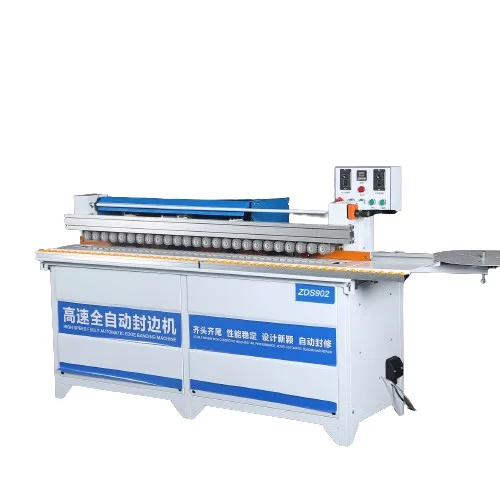
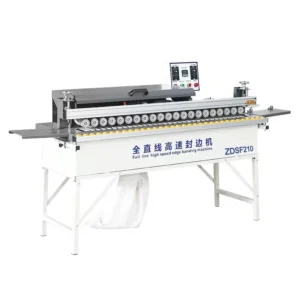
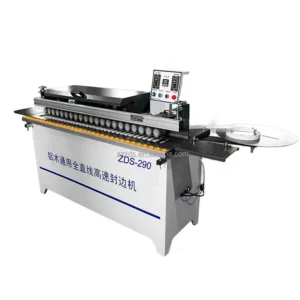
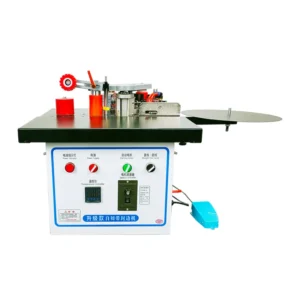
Verified Tolerance on Your Substrate — we run your actual panel material through the High-speed Fully Automatic Edge Banding Machine before quotation, so ±0.02mm precision is confirmed on MDF, particleboard, or plywood, not just promised on paper.
Technical Specifications
| Parameter |
Value |
| Product Type |
Automatic Edge Banding Machine |
| Voltage |
220V (frequency 50Hz or 60Hz to be confirmed) |
| Total Power |
4200W |
| Equipment Size |
207 × 60 × 122 cm |
| Weight |
245 kg |
| Edge Band Thickness Range |
0.5 – 2.5 mm |
| Edge Band Height Range |
0 – 35 mm |
| Glue Pot Capacity |
4000 ml |
| Glue Application |
Double-sided gluing with intelligent temperature control |
| Trimming Stations |
Up and down trimming, up and down polishing |
| Edge Strip Cutting |
Pneumatically controlled cutting device |
| Pressure System |
Integrated pressure beam with double rows of pressure wheels |
| Warranty |
One year |
Application Suitability
| Application |
Material or Output |
| Plywood edge banding for cabinet and furniture panels |
Plywood substrates with PVC or veneer banding |
| Sample making and short-run edge finishing |
MDF, particleboard, and solid wood panels |
| Small-scale workshop linear edge banding |
Wood-based panels up to 35 mm edge height |
| Prototype and custom furniture edge treatment |
Melamine, PVC, and veneer edge banding materials |
Why the Voltage Question Should Come Before the Automatic Edge Banding Machine Specifications
Confirming your facility's voltage, phase, and frequency before reviewing any automatic edge banding machine specifications prevents a machine from arriving unusable on your shop floor.
I have watched a buyer in Southeast Asia receive a 380V three-phase edge bander when their workshop only had single-phase 220V supply. The machine sat crated for weeks while they arranged a transformer. That delay cost more than the transformer itself. When you are comparing how to choose edge bander models across multiple quotes, the electrical specification is the first filter — not the last detail buried in a footnote [NEED_CITE: voltage and frequency standards by export market]. A unit rated at 220V still needs its phase and frequency confirmed for your local grid, because a 50Hz motor running on 60Hz supply will overspeed and wear prematurely.
Matching Feed Speed to Your Substrate Mix
The technical buyer's first question is always about throughput, but feed speed only matters when matched to the substrate you actually run. This machine's double high-speed trimming motors and up-and-down polishing motors are configured for the demands of linear edge banding on wood-based panels. If your workshop alternates between soft particleboard and dense MDF, the trimming motors must maintain consistent cutting force across both densities without chipping the edge band. The automatic edge banding machine specifications here reflect a configuration built for that variation at a small-workshop scale.
Glue Pot Capacity and Continuous Run Time
A 4000 ml glue pot with intelligent temperature control and double-sided gluing determines how long you can run before stopping to refill. In a small furniture factory producing cabinet doors in batch runs, a larger pot means fewer interruptions and more consistent glue viscosity across the run. The temperature control maintains adhesive flow characteristics whether you are applying PVC banding at higher temperatures or delicate veneer at lower settings [NEED_CITE: adhesive temperature requirements for PVC and veneer edge banding]. This directly affects glue line visibility on the finished panel.
Reading the Trimming and Polishing Configuration
The up-and-down trimming and up-and-down polishing stations define what edge finish you can achieve in a single pass. For PVC banding on particleboard, the trimming motors shear the excess band flush with the panel surface, while the polishing wheels remove the microscopic ridge left behind. The pneumatic edge strip cutting device ensures the band is severed cleanly at the panel's end without pulling or tearing. When you evaluate how to choose edge bander configurations, count the stations and ask what each one does — a machine with fewer stations will require secondary hand-finishing that erodes any time saved on the feed.

The Hidden Cost of Wrong Configuration Choices
Buying a machine with insufficient glue pot capacity for your daily panel volume means operators stop mid-batch to refill, and the glue temperature drops during the pause. The next panels through show uneven adhesion, and the edge band lifts within days. I have seen this exact failure on MDF cabinet doors where the glue penetration was inconsistent across the batch, forcing the entire run back through the edge bander. Similarly, a machine specified without confirming local voltage can damage its motors on first startup, voiding the warranty before production ever begins [NEED_CITE: common causes of edge bander motor failure in export markets].
Why Procurement Through This Channel Works
Every High-speed Fully Automatic Edge Banding Machine ships with a factory test record on your specific panel material and edge band combination, not just a generic spec sheet. Voltage, frequency, and control panel language are confirmed in writing before production begins, so the machine that arrives matches your facility's electrical supply and your operator's reading language. The four-stage quality control process covers incoming material inspection, in-process checks, finished product verification, and pre-shipment testing. Engineer-led configuration recommendation means the trimming and polishing station setup is matched to your substrate mix rather than sold as a default package.
Documentation & Verification
- CE declaration of conformity covering this automatic edge bander class
- ISO 9001 certificate for the manufacturing quality management system
- Machine specification sheet with verified tolerance on your panel material
- Electrical schematic confirming 220V wiring, phase, and frequency for your market
- Factory test record showing edge adhesion and trimming finish on your substrate
Installation, Commissioning & Support
- Requires on-site assembly following the included manual or video instruction for the 245 kg frame
- Dedicated 220V circuit required to support the 4200W total power draw without voltage drop
- Intelligent temperature control calibration during first startup to match your adhesive type
- Pneumatic line connection needed for the edge strip cutting device and pressure beam operation
- Trimming and polishing motor alignment verified against your panel thickness during commissioning
- Spare parts list covering trimming blades, polishing wheels, and pneumatic seals included at dispatch
What to Share With Your Inquiry
Send the exact panel material you run most often — MDF density, particleboard type, or plywood grade — along with the edge banding material and thickness you plan to use. Confirm your workshop's supply voltage, phase, and frequency so the electrical configuration is locked before production. If you have daily panel volume targets or an existing production line this machine must integrate with, include those details so the feed speed and glue pot capacity can be matched to your throughput.
Frequently Asked Questions
Q: What panel thickness range and feed speed should I specify for my workshop volume?
A: Share your most common panel thickness and daily output target. The configuration is then matched so the trimming motors and feed rate handle your substrate without chipping or bottlenecking. We confirm these values on a test run with your actual material before the order is finalized.
Q: How do I verify the tolerance this edge bander claims before it ships?
A: Request a factory test record showing measured edge band alignment and trimming finish on your specific panel material. The test uses calibrated measurement tools and documents the results before dispatch, so you have written proof of precision rather than a catalog claim.
Q: Is the 220V rating single-phase or three-phase, and how do I confirm frequency?
A: State your country and facility electrical supply details in your inquiry. The electrical schematic and voltage confirmation document will then specify phase, frequency, and wiring configuration matched to your grid, preventing compatibility issues on arrival.
Q: How does 4000 ml glue pot capacity translate to continuous run time?
A: Run time depends on your panel width, edge band thickness, and glue application rate. Share your typical panel dimensions and daily volume, and the engineer will calculate whether this pot capacity covers a full batch without refill interruptions.
Q: Which trimming stations do I need for PVC versus veneer on particleboard?
A: PVC typically requires up-and-down trimming followed by polishing for a clean edge. Veneer is thinner and more fragile, needing gentler trimming pressure. Specify your banding material mix so the station configuration and motor speeds are set accordingly.