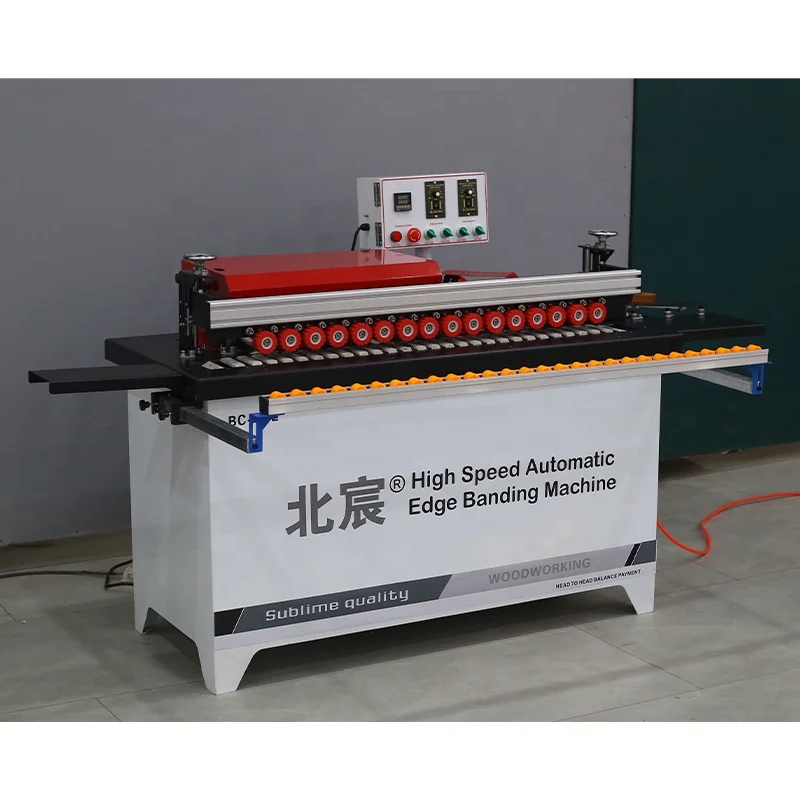
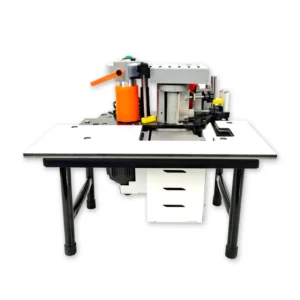
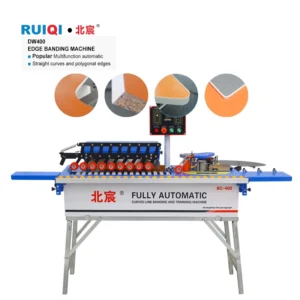
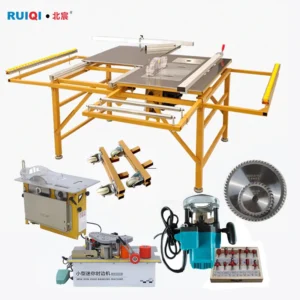
Precision-ground mechanisms — The DW802 automatic edge banding machine delivers verified tolerance through in-house manufacturing with patented cutting mechanisms and a four-stage QC protocol before dispatch.
Technical Specifications
| Parameter |
Value |
| Model |
DW802 |
| Product Type |
Automatic Edge Banding Machine |
| Total Power |
4200W |
| Voltage Options |
220V / 380V / customization available |
| Edge Banding Height |
0–50 mm |
| Edge Banding Thickness |
0.3–3 mm |
| Minimum Sheet Length |
25 cm |
| Minimum Sheet Width |
10 cm |
| Feed/Edge Power |
140W |
| Transmission Power |
140W |
| Trimming Power |
800W × 2 stations |
| Polishing Power |
180W × 2 stations |
| Vacuum Power |
1200W |
| Air Source Pressure |
0.4–0.8 MPa |
| Glue Pot Capacity |
4000 ml |
| Machine Dimensions |
130 × 60 × 95 cm |
| Machine Weight |
135 kg |
| Key Features |
Gluing, edge banding, head and tail cutting, dual trimming, dual polishing, vacuum assist, fully assembled delivery |
| Language Options |
Chinese and English standard; Spanish and other languages customizable |
| Feed Speed |
(basis to be confirmed) |
| Tolerance |
(basis to be confirmed) |
| Control System |
(basis to be confirmed) |
| Dust Extraction Port |
(basis to be confirmed) |
| Standards |
CE, ISO 9001 |
Application Suitability
| Application |
Material or Output |
| Custom cabinet door edge sealing |
MDF and particleboard panels with PVC or melamine edge banding |
| Home furniture workshop production |
Plywood and ecological board with wood veneer or ABS edging |
| Small-batch joinery runs |
Solid wood panels requiring trimming and polishing in one pass |
| Decorative shelving fabrication |
Laminated board edges needing clean flush trimming on narrow stock |
Why Voltage Confirmation Must Precede Every Other Specification Decision
An edge bander configured for the wrong voltage and frequency will not run at all — or worse, it will run and destroy its own motors within weeks.
I once watched a workshop in Lagos lose four full production days because the edge bander that arrived was wired for 380V/50Hz while their local supply fluctuated between nominal 220V and something far less stable. The glue pot could not hold temperature, the feed motor stalled on thicker MDF, and the trimming stations chattered through every edge. By the time we reconfigured the electrical cabinet and sourced a stabilizer, the delivery schedule for that client's furniture order had already slipped. With the DW802 automatic edge banding machine specifications, the voltage field shows 220V/380V/customization — but frequency in Hertz must be confirmed separately for every destination country [NEED_CITE: voltage and frequency standards by export market]. This is the single most common avoidable failure in cross-border machinery procurement.

Mapping the Station Sequence to Your Panel Mix
The DW802 runs six functional stations in a single pass: gluing, edge application, automatic head and tail cutting, dual trimming, and dual polishing. For a workshop running predominantly 18 mm MDF cabinet doors with 0.4 mm PVC edging, the dual trimming stations handle both the top and bottom flush cuts, while the polishing stations remove residual adhesive and smooth the edge transition. When your production mix shifts to plywood with real wood veneer at 2 mm thickness, the trimming power — rated at 800W per station — provides adequate torque to shear through denser veneer without tear-out. Understanding this station sequence is essential when reviewing automatic edge banding machine specifications against your actual daily material schedule.
Pneumatic and Electrical Infrastructure Before the Machine Arrives
The air source requirement of 0.4–0.8 MPa means your workshop compressor must deliver stable pressure at the upper end of that range to keep the pneumatic cylinders responsive during trimming and polishing cycles. A compressor that dips below 0.5 MPa under continuous load will cause intermittent trimming faults — the cylinder retracts slightly mid-cut, leaving a visible step on the panel edge. On the electrical side, the total power draw of 4200W requires a dedicated circuit with appropriate breaker sizing; sharing a circuit with a panel saw or dust collector invites voltage sag that affects the glue pot thermostat. These infrastructure details are the reason experienced buyers always request the electrical schematic before confirming an order [NEED_CITE: CE machinery directive requirements for industrial equipment].
Reading the Critical Specs That Determine Daily Output Quality
The edge banding height range of 0–50 mm defines the panel thickness envelope this machine accepts. If your product catalog includes 25 mm thick shelving in particleboard alongside standard 18 mm cabinet sides, the 50 mm ceiling provides headroom. However, the minimum sheet dimensions — 25 cm length and 10 cm width — mean that narrow drawer sides and small offcut pieces from nesting layouts may need to be batched differently upstream to avoid feed instability. The glue pot capacity of 4000 ml determines how long the machine can run before a refill pause; on a day with continuous production, this translates to fewer thermal cycles on the heating element, which extends its service life. The 1200W vacuum system handles the dust and PVC trimmings generated at the trimming and polishing stations, keeping the conveyor bed clear and preventing debris from scratching the panel surface during the pass. Tolerance and feed speed remain unconfirmed in the current documentation and must be verified against your specific substrate and edge material combination before the machine ships.
The Hidden Cost of Specifying an Edge Bander Without Confirming Your Actual Material
Workshops that order based on a catalog spec sheet alone often discover that the trimming stations produce clean edges on the sample MDF sent during evaluation, but tear through the cheaper particleboard they actually buy in bulk. The glue temperature that bonds perfectly to a melamine edge at 2 mm thickness may leave visible squeeze-out on 0.4 mm PVC when the ambient workshop temperature drops below the assumed range. These mismatches do not show up as machine faults — the edge bander is doing exactly what it was set up to do. The fault lies in the configuration gap between the test conditions and the real production conditions, and it typically surfaces only after the first batch of assembled furniture reveals misaligned joints caused by inconsistent edge thickness [NEED_CITE: edge banding tolerance and downstream assembly alignment].
What Verifiable Manufacturing Depth Means for This Machine
In-house manufacturing with proprietary cutting mechanism patents means the trimming and polishing stations on the DW802 are not generic bolt-on modules — they are designed as part of the integrated feed path. Precision-ground components with multi-stage inspection ensure that the conveyor bed flatness supports consistent panel tracking through each station. Voltage customization from 110V to 440V is handled at the factory level, not through a third-party transformer added after arrival. The four-stage QC protocol — incoming material, in-process, finished product, and pre-shipment verification — catches electrical and mechanical deviations before the crate is sealed. Engineer-led configuration means your specific panel material, edge type, and local voltage are documented in the quotation, not assumed from a default build.
Documentation & Verification
- CE declaration of conformity listing the DW802 automatic edge banding machine by model designation
- Electrical schematic confirming your specified voltage and frequency before production begins
- Factory test record demonstrating edge quality on your actual panel thickness and edge material
- Operation and maintenance manual in your agreed language, confirmed at order placement
- Spare parts list identifying consumable trimming blades and polishing wheels with part numbers
- ISO 9001 certificate available for review prior to order confirmation
Installation, Commissioning & Support
- Requires a level concrete floor supporting the 135 kg machine weight across its 130 × 60 cm footprint
- Dedicated electrical circuit sized for the 4200W total power draw at your confirmed voltage
- Arrives fully assembled; requires only pneumatic hose connection at 0.4–0.8 MPa and power hookup
- First-run commissioning includes glue pot temperature calibration for your specific edge banding material
- Operator training covers the adjustable edge height range from 0 to 50 mm and station sequence logic
- Replacement trimming blades and polishing wheels identified in the supplied spare parts documentation
Tell Us What Your Workshop Actually Runs
To configure the DW802 correctly for your production environment, share the specific panel materials you process most frequently, including substrate type and typical thickness range. Confirm your workshop's local voltage and frequency so the electrical cabinet is built to match. Let us know the edge banding materials — PVC, ABS, melamine, or wood veneer — and the thicknesses you use daily, so the glue pot and trimming stations can be set and tested against your actual stock before the machine leaves the factory.
Frequently Asked Questions
Q: How do I verify the edge banding tolerance before the machine ships?
A: Request a factory test record using your specific panel material and edge banding thickness. Send sample panels and edging stock to the factory so the DW802 is tested on your actual substrate. The resulting test record documents the achieved tolerance and edge finish quality, giving you verifiable data rather than a generic specification claim.
Q: What voltage and frequency details must I confirm before ordering?
A: Provide your workshop's exact supply voltage and frequency in Hertz. The DW802 supports 220V, 380V, or custom configurations, but frequency affects motor speed and glue pot heating behavior. Confirming both values ensures the electrical cabinet and motor windings are built for your local grid conditions before production begins.
Q: How do the minimum sheet dimensions affect my cutting layout upstream?
A: The DW802 requires sheets at least 25 cm long and 10 cm wide for stable feed through the stations. If your nesting software produces narrow offcuts below these dimensions, those pieces must be grouped or manually edge-banded. Plan your panel saw cutting layout to keep all routed pieces within this minimum envelope.
Q: Which control panel languages can I specify at order?
A: Chinese and English are standard on the DW802. Spanish and other languages are available as customization options. Specify your preferred language during the quotation stage so the control interface and the operation manual both match what your operators will read during daily production and troubleshooting.
Q: How do I match this machine's throughput to my panel saw and boring machine?
A: Confirm the DW802 feed speed with the factory against your specific panel thickness and edge material. Then compare that cycle time per panel to your upstream saw cut rate and downstream boring cycle. The goal is balanced station loading so no single machine creates a bottleneck in your furniture production line.