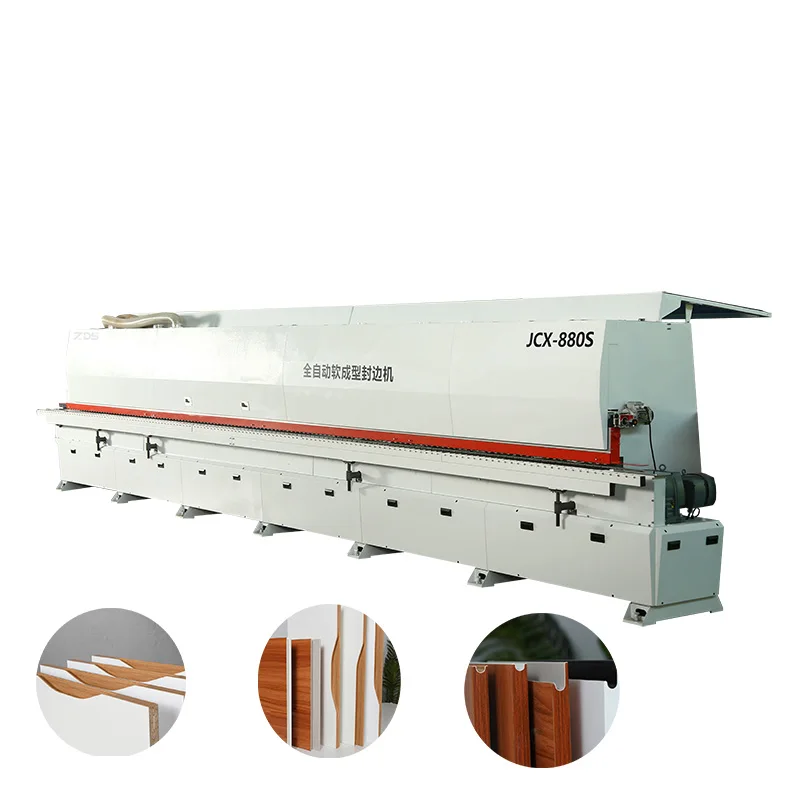
Precision-verified tolerance — every ZDSJCX-880S parameter from feed speed to panel range is documented on the factory test record before dispatch, so technical buyers can compare models on confirmed numbers rather than catalog claims.
Technical Specifications
| Parameter |
Value |
| Model |
ZDSJCX-880S |
| Product Type |
Automatic Edge Banding Machine with Pre-milling |
| Overall Dimensions (L×W×H) |
8.82 × 1.07 × 1.85 m |
| Total Weight |
3200 kg |
| Total Power |
47.1 kW |
| Voltage |
380V (frequency to be confirmed per destination market) |
| Air Pressure Requirement |
0.6–0.8 MPa |
| Vacuum Opening Size |
Ф100 × 6 |
| Panel Thickness Range |
18–22 mm (source value — verify against full adjustable range) |
| Edge Banding Thickness Range |
0.5–0.8 mm (source value — verify against full adjustable range) |
| Edge Banding Width |
58 mm |
| Minimum Sheet Width |
150 mm |
| Minimum Sheet Length |
300 mm |
| Conveying Speed |
6–8 m/min |
| Function Count |
15 functions including pre-milling, corner trimming, grooving |
| Machining Profile Types |
J type, C type, oblique straight, left/right semi-pass, water drop, rhombus, triangle — 15+ profiles |
| Warranty |
1 year |
Application Suitability
| Application |
Material or Output |
| Custom cabinet door edge finishing |
MDF and particleboard with PVC edge banding |
| Wardrobe and shelving panel processing |
Plywood panels with veneer edge banding |
| Office furniture component edging |
Melamine-faced particleboard with ABS or PVC banding |
| Kitchen cabinet carcass production |
Moisture-resistant MDF with matching PVC profiles |
| Small-batch bespoke joinery |
Solid wood panels requiring shaped edge profiles |
Why the Voltage Question Should Come Before the Automatic Edge Banding Machine Specifications
Lock your electrical parameters before any other selection criterion — a spec sheet that omits frequency is a spec sheet that cannot be trusted.
I once saw a South American facility receive a 15-function pre-milling edge bander wired for 380V when their local supply ran 440V at 60Hz. The machine tripped the breaker on first energization, and the entire production line sat idle while a transformer was sourced internationally — a delay measured in weeks, not days. The ZDSJCX-880S draws 47.1 kW total, meaning a voltage mismatch is not a minor nuisance; it is a facility-level electrical event [NEED_CITE: voltage and frequency standards by export market]. Every automatic edge banding machine specifications sheet should state phase, voltage, and frequency as a confirmed trio, not a single number left ambiguous.

Mapping Conveying Speed to Daily Panel Volume
The ZDSJCX-880S runs at 6–8 m/min, which positions it for small-to-medium custom furniture operations rather than high-volume panel processing plants. When evaluating automatic edge banding machine specifications, feed speed must be read alongside the minimum sheet dimensions — 150 mm width and 300 mm length here — because small offcuts common in custom cabinet work reduce effective throughput below the nominal linear rate. A technical buyer should calculate actual panels-per-hour based on their typical board size mix, not the belt speed alone.
Profile Versatility and Its Effect on Downstream Assembly
With 15+ edge profile types — from J and C profiles through water drop and rhombus shapes — this machine covers the variety a custom furniture line demands without requiring secondary routing stations. The pre-milling function removes saw marks before edge application, which directly affects glue-line visibility on the finished panel. When comparing models, the question is not merely how many functions are listed, but whether those functions produce a finish that passes your assembly quality standard without rework [NEED_CITE: edge banding quality standards for custom furniture production].
Reading the Numbers That Actually Matter
The 18–22 mm panel thickness range and 0.5–0.8 mm edge banding thickness range are stated values that require verification against the machine's full adjustable capability — many production environments run 10 mm drawer sides or 25 mm worktops that may fall outside this window. The 47.1 kW total power draw across all 15 stations means each workstation is independently motor-driven, which affects both electrical infrastructure planning and maintenance isolation. Six vacuum openings at Ф100 diameter require adequate dust extraction capacity; undersized extraction leads to chip buildup on the glue pot and visible contamination on light-colored PVC banding. The 0.6–0.8 MPa air pressure requirement is typical for pneumatic pressure rollers, and inconsistent supply pressure directly causes edge adhesion failures that only appear after the panel reaches the customer.
The Hidden Cost of Underspecifying Your Edge Bander
A machine selected on function count alone, without confirming that its panel thickness range and minimum sheet dimensions match your actual product mix, creates bottlenecks that no amount of operator skill can resolve. Panels that exceed the stated edge banding width of 58 mm or fall below the 150 mm minimum width requirement must be routed to a secondary station or processed manually — adding labor cost and cycle time that were never part of the production plan [NEED_CITE: common causes of edge banding rework in panel furniture manufacturing]. I have seen workshops purchase a second machine within the first year simply because the first unit could not handle their thinner stock or narrower offcuts.
Why Technical Buyers Source This Equipment Here
In-house manufacturing with proprietary cutting mechanisms means the tolerance values on the specification sheet are traceable to actual machining processes, not inherited from a third-party assembler. The full product family — from entry-level to full-function pre-milling models — allows a workshop to scale capacity without changing supplier or retraining operators on a different control interface. Voltage configuration from 110V to 440V and multilingual control panels are offered as standard customization, not as expensive add-ons discovered after the order is placed. Four-stage quality control covering incoming material through pre-shipment verification ensures the machine that arrives matches the documentation. Engineer-led configuration recommendations with formal quotation are provided within 24 hours, so technical buyers can move from inquiry to specification confirmation without prolonged back-and-forth.
Documentation & Verification
- Machine specification sheet with verified tolerance values for the ZDSJCX-880S
- Electrical schematic confirming voltage, frequency, and phase for your facility
- Factory test record processed on your submitted panel material before dispatch
- Operation and maintenance manual delivered in your agreed operator language
- Spare parts list with wear-item part numbers for local procurement cross-reference
- CE declaration of conformity and ISO 9001 certificate documentation
Installation, Commissioning & Support
- Foundation must support 3200 kg static load across the 8.82 m machine length
- Dedicated 47.1 kW circuit with confirmed voltage and frequency required before delivery
- Machine ships as a single assembly; verify workshop door clearance against 1.07 m width
- First commissioning includes parameter calibration for your specific panel thickness range
- Operator training covers all 15 functions including pre-milling and grooving setup
- Six Ф100 vacuum connections require centralized dust extraction sizing confirmation
What to Include in Your Specification Inquiry
Provide your typical panel material, thickness range, and daily volume so the configuration can be matched to your actual production requirement rather than a generic setup. Confirm your facility voltage, frequency, and available amperage to ensure the electrical specification is locked before production begins. Indicate whether your operators require a specific control panel language and whether you need sample processing on your own substrate before order confirmation.
Frequently Asked Questions
Q: How is edge banding tolerance verified on the ZDSJCX-880S before shipment?
A: The factory test record documents actual measured tolerance values from panels processed on the specific machine being shipped. Request that your own sample material — in your standard thickness and edge banding type — be run during pre-shipment testing, and require the measured results on the documentation you receive before the crate leaves the facility.
Q: Is the stated 380V compatible with my facility's electrical supply?
A: The base specification lists 380V, but frequency and phase must be confirmed for your market before the machine enters production. Voltage is configurable across a range from 110V to 440V, and the electrical schematic is adjusted accordingly. Provide your local supply details at inquiry stage so the correct configuration is built in.
Q: Does the 18–22 mm panel thickness range cover my full product mix?
A: The stated range reflects source documentation and should be verified against the machine's full adjustable capability. If your production includes thinner drawer components or thicker worktop panels, confirm the true adjustment limits with the engineering team before finalizing the specification and placing your order.
Q: How do I match conveying speed to my daily panel volume?
A: The 6–8 m/min conveying speed must be calculated against your average panel length and the gaps required between boards on the conveyor. Provide your typical panel dimensions and target daily output so the configuration can be evaluated against your actual throughput requirement rather than the nominal belt speed alone.
Q: What does the spare parts list include for ongoing maintenance?
A: The spare parts list covers wear items specific to the 15-function configuration, including trimming blades, pressure roller surfaces, and scraper elements. Cross-reference these part numbers against your maintenance schedule to ensure replacement intervals align with your production calendar and local procurement lead times.