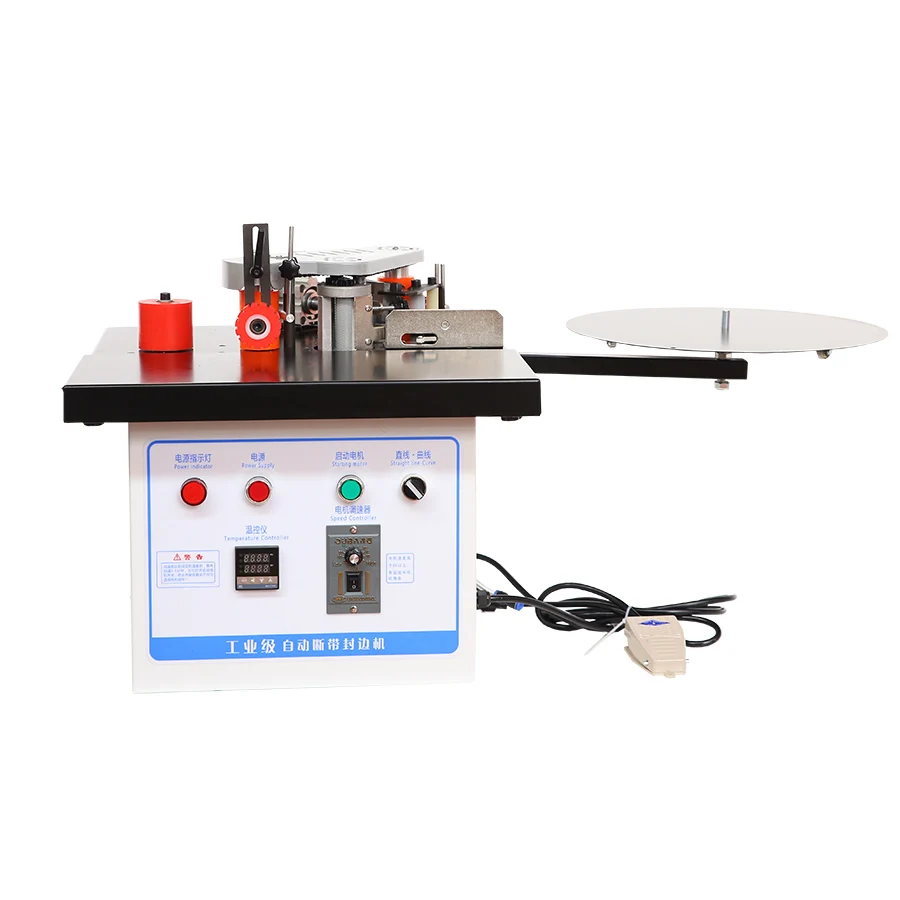
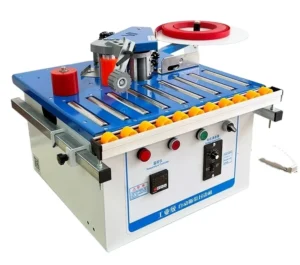
Voltage Flexibility — ZDSF50 mini edge banding machine configured to match local grid standards from 110V to 440V before dispatch, eliminating the risk of receiving an inoperable unit.
Technical Specifications
| Parameter |
Value |
| Model |
ZDSF50 |
| Product Type |
Mini Edge Banding Machine |
| Rated Voltage |
220V (configurable from 110V to 440V) |
| Rated Power |
1.2kW |
| Feed Speed |
0-6m/min |
| Panel Thickness Range |
10-60mm |
| Strip Thickness Range |
0.5-1.5mm |
| Glue Pot Capacity |
1000ml |
| Heating Time |
5-10min |
| Rated Air Pressure |
0.4-0.6MPa |
| Overall Dimensions (L×W×H) |
54×54×56cm |
| Net Weight |
26kg |
| Glue Application |
Glue-coated rollers, double-sided gluing |
| Pressure Roller |
Adjustable, rubber material |
| Strip Breaking Control |
Pneumatic with foot switch; automatic travel switch for straight edges |
| Edge Strip Transport Bayonet |
Height-adjustable |
Application Suitability
| Application |
Material or Output |
| Small workshop edge finishing |
MDF, particleboard, plywood, and solid wood panels |
| Custom furniture prototyping |
PVC and veneer edge banding strips (0.5–1.5mm) |
| Curved and shaped edge profiles |
Radius contours on cabinet doors and custom shelving |
| Supplementary rework station |
Repair and secondary banding on pieces from automatic lines |
| Low-volume joinery production |
Bespoke furniture components requiring manual feed control |
Why the Voltage Question Should Come Before the Price
Confirming local voltage and frequency with the supplier before placing an order prevents a machine from arriving dead on the shop floor.
I have seen workshops receive single-phase equipment wired for a grid that does not exist in their region, leaving a brand-new machine sitting idle while an electrician rigs a step-up transformer that was never budgeted for. The ZDSF50 is rated at 220V as standard, but the internal motor and heating element can be configured across the 110V–440V range during production. Specifying the correct voltage at the quotation stage is a five-minute conversation that avoids weeks of delay. [NEED_CITE:]

Reading the Feed Speed and Panel Thickness Numbers
The ZDSF50 mini edge banding machine delivers a variable feed speed from 0 to 6m/min, which directly affects how an operator manages curved profiles. At lower feed rates, the operator has more control when guiding a panel along a tight radius, allowing the pressure roller to maintain consistent contact with the substrate. For straight edges, the automatic travel switch handles strip breaking, so the operator can push the feed speed toward the upper range without worrying about overshooting the cut point. Matching the feed speed to the contour complexity of the workpiece is the single most important variable in achieving a clean bond line.
Double-Sided Gluing and Bond Integrity
The glue-coated roller system applies adhesive to both the panel edge and the strip simultaneously. This double-sided gluing approach is significant because many entry-level banders only coat one surface, which can leave starved areas on porous substrates like raw MDF. With 1000ml of glue pot capacity and a heating window of 5 to 10 minutes, the system holds enough molten adhesive for sustained short-run production before replenishment is needed. The adjustable rubber pressure roller then compresses the strip against the panel edge, and the operator sets the pressure based on the panel thickness within the 10–60mm working range. [NEED_CITE:]
How Specifications Translate to Workshop Reality
Panel thickness range is often the first spec that determines whether a mini bander fits into an existing workflow. The ZDSF50 covers 10–60mm, which spans standard 18mm particleboard for cabinet carcases up to thick solid-wood panels used for tabletops and workbench surfaces. The 1.2kW rated power means the machine draws from a standard single-phase circuit without requiring a dedicated industrial breaker — a practical consideration for small workshops sharing electrical infrastructure with other tools. Strip thickness acceptance from 0.5 to 1.5mm covers the full spectrum of PVC banding commonly stocked by furniture hardware distributors, as well as thin veneer strips for visible face edges. The pneumatic strip-breaking system requires a compressed air supply at 0.4–0.6MPa, so verifying that the workshop compressor meets this threshold is part of the pre-installation checklist. The 26kg net weight and 54×54×56cm footprint allow the machine to sit on a sturdy workbench, keeping floor space free for larger stationary equipment.
What Happens When Specifications Are Ignored at Purchase
Buying a mini edge bander without cross-checking the air pressure requirement against the shop compressor is one of the most common oversights I encounter in the field. When the supply falls below the rated 0.4MPa, the pneumatic strip breaker hesitates, leaving excess banding material that the operator must trim by hand — defeating the purpose of mechanized edge finishing altogether. Similarly, running 2mm PVC strip through a machine rated for a maximum of 1.5mm causes the feed bayonet to jam, and the resulting downtime for clearing the blockage erases any throughput advantage the machine was supposed to provide. These are not manufacturing defects; they are specification mismatches that could have been caught during the quotation phase. [NEED_CITE:]
Why Procurement Teams Source This Equipment Here
In-house manufacturing with patented cutting mechanisms means the ZDSF50 is built under direct engineering oversight rather than assembled from sourced sub-assemblies, giving technical buyers traceability on critical components. Voltage and control panel language customization is treated as a standard configuration step, not a special request, so the operator receives a machine they can read and power on day one. A four-stage quality control process — incoming material inspection, in-process checks, finished product verification, and pre-shipment testing — ensures the feed speed and glue temperature readings on the spec sheet are validated before the crate is sealed. Engineer-led configuration recommendations are delivered with a formal quotation, matching the machine to the buyer's stated panel materials and production volume. Factory visits are welcomed for buyers who want to witness a live processing test on their own substrate samples.
Documentation & Verification
- Machine specification sheet confirming ZDSF50 rated voltage and panel thickness range
- Electrical schematic with voltage and frequency confirmation for your local grid
- Factory test record using your specified strip thickness and panel material
- Operation and maintenance manual provided in the agreed operator language
- Spare parts list with part numbers for glue pot, pressure roller, and feed bayonet
- Packing photographs documenting machine condition before crate closure
Installation, Commissioning & Support
- Benchtop placement requires a level surface rated for at least 40kg including tooling and stock
- 1.2kW power draw runs on a standard single-phase circuit; dedicated breaker recommended for shared workshops
- Machine ships fully assembled; connect air supply at 0.4–0.6MPa and power on for first heat cycle
- Initial glue temperature and feed speed calibration performed during first 5–10 minute heating cycle
- Foot switch and travel switch operation covered in the multilingual manual with step-by-step diagrams
- Replacement glue pot elements and pressure rollers available as stocked consumable spare parts
Preparing Your Inquiry for Accurate Configuration
To receive a specification-matched quotation, provide the panel materials you process most frequently — whether MDF, particleboard, plywood, or solid wood — along with the typical thickness range and the edge banding strip material and thickness you intend to use. State your local voltage and frequency so the motor and heating element can be wound correctly during production. If the ZDSF50 will operate alongside an existing automatic edge banding line, describe the upstream and downstream workflow so the engineer can confirm whether the feed speed range complements your current throughput. [NEED_CITE:]
Frequently Asked Questions
Q: Can the ZDSF50 be configured for 110V or 380V three-phase power?
A: Yes. The standard rating is 220V single-phase, but the motor and heating element can be configured anywhere from 110V to 440V during manufacturing. Specify your local voltage and frequency at the inquiry stage so the electrical schematic and components are matched to your grid before assembly begins. This avoids the need for external transformers after delivery.
Q: How does feed speed affect edge quality on curved panels?
A: On curved and shaped edges, a slower feed speed within the 0–6m/min range gives the operator more control over panel guidance and allows the adjustable rubber pressure roller to maintain even contact along the radius. Straight edges can be fed faster because the automatic travel switch handles strip breaking, reducing the manual coordination required at the cut point.
Q: How often does the 1000ml glue pot need refilling during a production shift?
A: Refill frequency depends on strip width, panel edge length, and the double-sided gluing thickness applied. For typical PVC banding at 0.5–1.5mm thickness on standard cabinet panels, the 1000ml capacity supports sustained short-run production before replenishment. Monitoring the glue level through the sight window during the initial shift helps establish a refill rhythm for your specific workload.
Q: What is the difference between foot switch and travel switch operation?
A: The automatic travel switch detects the end of a straight panel edge and triggers the pneumatic strip breaker without operator input. For curved and shaped profiles, the operator uses the foot switch to trigger strip breaking manually at the precise point where the contour ends, giving full control over non-linear geometries that the travel switch cannot detect.
Q: Will the ZDSF50 integrate with an existing automatic edge banding line?
A: The 26kg benchtop unit and 54×54×56cm footprint allow it to serve as a supplementary station for rework, prototyping, or curved profiles that the main automatic line cannot handle. Confirm that the 0–6m/min feed speed and 10–60mm panel thickness range align with the board sizes and throughput expectations of your existing workflow to avoid bottlenecks.