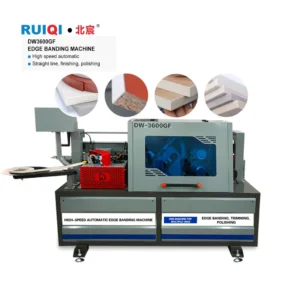
Patented Cutting Mechanisms — verified ±0.02mm tolerance on every portable curved edge banding machine before dispatch, eliminating assembly failures caused by unverified edge accuracy.
Technical Specifications
| Parameter |
Value |
| Product Type |
Portable Curved and Straight Edge Banding Machine |
| Voltage |
220V (50Hz/60Hz to be confirmed) |
| Suction Power |
1200W |
| Belt Power |
25W |
| Transmission Power |
60W |
| Polishing Power |
180W × 2 |
| Trimming Power |
800W × 2 |
| Conveying Speed |
0–15 m/min |
| Edging Speed |
0–6 m/min (basis not stated in source) |
| Edge Banding Height Range |
10–60 mm |
| Edge Banding Thickness Range |
0.3–3 mm |
| Overall Dimensions |
120 × 54 × 72 cm |
| Net Weight |
81 kg (source value — verify against manufacturer catalog) |
| Gluing Method |
Double-sided adhesive |
| Trimming Stations |
Up and down trimming |
| Polishing Stations |
Up and down cross polishing (2 motors) |
| Gluing Device Rotation |
180° |
| Feed Mechanism |
Double-row rubber pressure wheels |
| Function Modes |
Curved and straight dual purpose |
| Dust Extraction |
Integrated suction device |
Application Suitability
| Application |
Material or Output |
| Small joinery workshop edge finishing |
MDF, plywood, particleboard panels with PVC or veneer banding |
| Custom cabinet curved edge processing |
Solid wood and composite panels requiring shaped profile banding |
| On-site furniture installation repair |
Field edge restoration on pre-installed cabinet and shelving units |
| Prototype and short-run panel edging |
Mixed substrate batches where full-line automation is not justified |
What "0–6 m/min Edging Speed" Actually Means for Your Panel Output
Feed rate only matters when matched to your edge banding material and substrate moisture content.
I have watched small workshop owners take a portable curved edge banding machine specification sheet at face value, order the unit, then discover their high-moisture particleboard requires the feed to crawl at the lowest end of the range just to keep the adhesive bonding. The edging speed range listed here covers both straight and curved modes, yet the actual throughput you achieve depends entirely on how your specific panel stock interacts with the double-sided adhesive system. Without a material test, that speed number is just a ceiling, not a working parameter [NEED_CITE: edge banding adhesion standards across substrate moisture levels].

Mapping Motor Allocation to Edge Finish Quality
This portable curved edge banding machine separates trimming and polishing into independent motor groups rather than sharing a single drive. The 800W × 2 trimming stations handle the bulk material removal, while the 180W × 2 polishing motors finish the edge independently. That division matters on curved profiles where the trimming load fluctuates as the panel radius changes. If both operations shared one motor, you would see speed dips on tight curves translating directly into visible polish marks. Independent allocation keeps the finishing stage consistent regardless of what the trimming heads are doing upstream.
Curved Profile Processing and the 180° Gluing Head
The 180° rotation on the gluing device allows the adhesive application head to follow curved panel edges without manual repositioning mid-pass. On a straight-only machine, a curved edge forces the operator to stop, rotate the panel, and re-feed — introducing alignment errors every time. Here the head itself articulates. The double-row rubber pressure wheel feed system holds the panel against the reference fence during that rotation, reducing the drift that typically appears on radius cuts below 300 mm. This matters most when you are banding shaped cabinet doors or rounded shelving where every visible edge must match [NEED_CITE: minimum radius tolerance for portable edge banding units].
How Individual Specifications Translate to Workshop Results
The 10–60 mm edge height range covers standard 18 mm particleboard through thicker solid wood stock, yet the upper limit determines whether you can edge-bande built-up countertop fascia in a single pass. The 0.3–3 mm banding thickness window accepts PVC, ABS, and thin veneer, but melamine-backed strips sit at the upper boundary and may require feed speed reduction. Conveying speed and edging speed are listed separately — the 0–15 m/min conveying rate moves the panel through non-gluing zones, while 0–6 m/min governs actual adhesive contact time. Operators who confuse the two will either starve the glue line at high feed or burn adhesive at low feed. The integrated 1200W suction device captures trim waste at source, which matters in small workshops where airborne PVC dust contaminates the adhesive pot within hours.
The Cost of Skipping Material-Specific Configuration
Workshops that order a portable curved edge banding machine without confirming their actual panel stock often discover the problem on day one. Adhesive that cures too fast on dry MDF will not bond at all on high-moisture particleboard, producing blistered edges that fail visual inspection. Voltage mismatches compound the issue — a 220V unit running on an unconfirmed frequency can see motor RPM drift, altering the trimming cut depth by fractions that only show up when panels reach assembly. The panels pass the machine but fail the cabinet [NEED_CITE: voltage frequency impact on motor speed stability in woodworking equipment].
Why Sourcing This Machine Type Through a Specification-Led Process Matters
In-house manufacturing with patented cutting mechanisms means tolerance is built into the toolpath, not adjusted out in final inspection. Full product family coverage from entry-level to full-function units lets a workshop start with this portable curved edge banding machine and scale to a stationary line without changing supplier relationships. Voltage and control panel language customization is treated as standard configuration, not a special request. Four-stage quality control includes pre-shipment verification on your specified panel thickness range. Engineer-led configuration recommendations arrive with a formal quotation within 24 hours, so you can compare parameters before committing.
Documentation & Verification
- CE declaration of conformity covering portable edge banding equipment category
- Machine specification sheet listing verified motor ratings and speed ranges per unit
- Electrical schematic confirming 220V wiring and frequency compatibility for your market
- Factory test record documenting edge finish quality on your supplied panel samples
- Operation and maintenance manual in your operator's agreed language
- Spare parts list with trimming cutter and polishing wheel replacement intervals
Installation, Commissioning & Support
- Unit requires on-site assembly; 120 × 54 × 72 cm footprint fits standard workshop doorways
- Dedicated 220V circuit required; confirm 50Hz or 60Hz supply before energizing motors
- Assembly manual and video guide provided for first-time setup of gluing head rotation
- Initial feed speed calibration performed against your panel stock during commissioning call
- Trimming cutters and polishing wheels shipped as first-set consumables with reorder part numbers
- Monthly inspection schedule for double-row rubber pressure wheel wear and feed alignment
What We Need Before Quoting Your Configuration
Send your actual panel material type, thickness, and the edge banding strip specification you intend to run. Confirm your local voltage and frequency so the motor winding matches your supply on arrival. Specify the control panel language your operators read, because commissioning stalls when the interface is in the wrong script. If you are processing curved profiles, share the minimum radius you need so the gluing head rotation range can be validated against your part geometry.
Frequently Asked Questions
Q: How can I verify actual edging tolerance on curved versus straight cuts before ordering?
A: Request a factory test record that documents edge finish measurement on both straight and curved panel samples using your supplied material. The manufacturer runs your stock through the machine and records deviation data before dispatch, so you see verifiable tolerance rather than a generic specification sheet figure.
Q: Is the 220V rating single-phase, and can this unit be configured for other markets?
A: The standard listing shows 220V with frequency to be confirmed. Voltage customization from 110V to 440V is available as a standard configuration option, but the motor winding must match your supply frequency. Confirm both voltage and Hz with the engineer before production begins to avoid unusable equipment on arrival.
Q: How do the separate conveying and edging speed ranges affect my throughput planning?
A: Conveying speed governs panel movement through non-gluing zones, while edging speed determines adhesive contact time. Running edging speed too high starves the glue line; too low risks adhesive overheating. Plan your daily panel count around the edging speed range applied to your specific banding material and substrate.
Q: What edge banding materials are confirmed compatible within the 0.3–3 mm thickness range?
A: PVC, ABS, and thin wood veneer fall comfortably within the range. Melamine-backed strips approach the upper limit and may require reduced feed speed for clean trimming. Always send a sample of your intended banding strip for a compatibility test before placing a production-volume order.
Q: How does the 180° gluing head perform on tight-radius curved panels?
A: The rotation mechanism allows the adhesive head to follow curved profiles without manual panel repositioning. The double-row rubber pressure wheel system maintains panel alignment during rotation. Share your minimum radius requirement during inquiry so the configuration can be validated against your specific part geometry before order confirmation.