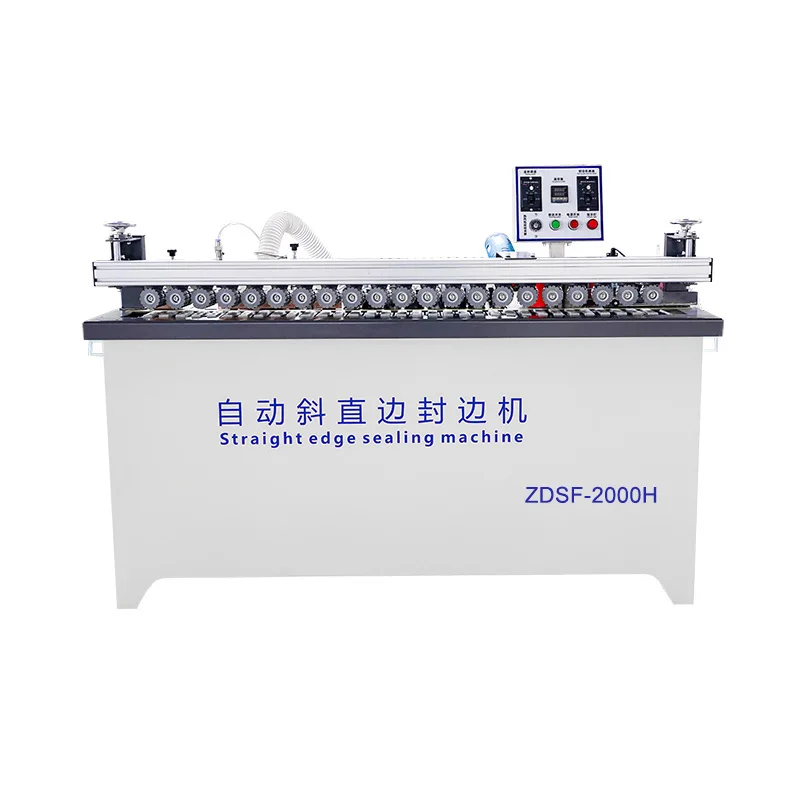
Verified Tolerance Configuration — Every WF-2000 and WF-2000H unit ships with a factory test record documenting ±0.02mm edge banding tolerance on your specific panel thickness and edge material before dispatch.
Technical Specifications
| Parameter |
Value |
| Model |
WF-2000 / WF-2000H |
| Product Type |
Portable Edge Banding Machine |
| Overall Dimensions |
2100×600×630 mm (WF-2000) / 2100×600×1100 mm (WF-2000H) |
| Net Weight |
137 kg (WF-2000) / 149 kg (WF-2000H) |
| Panel Thickness Range |
18-25 mm |
| Strip Thickness |
1.2 mm |
| Rated Voltage |
220V |
| Rated Power |
6.17 kW |
| Rated Air Pressure |
0.4-0.6 MPa |
| Feed Speed |
0-14 m/min |
| Pressing System |
8 pressing rollers |
| Pressure Beam |
Aluminum alloy, manually adjustable |
| Heating Method |
Hot air heating throughout the process |
| Assembly State |
Fully assembled with self-contained vacuum device |
| Functional Stations |
Gluing, edge banding, automatic belt breaking, elastic profiling trimming, polishing, slotting |
Application Suitability
| Application |
Material or Output |
| Custom furniture on-site installation |
MDF and plywood panels with PVC edge banding at job sites |
| Small joinery workshop edge finishing |
Particleboard and solid wood panels for cabinet doors and shelving |
| Mobile edge processing for installers |
Straight and 45-degree oblique edges on board stock up to 25 mm thick |
| Compact workshop batch production |
MDF and plywood components requiring single-pass trimming and polishing |
Why the Voltage Question Must Come Before the Portable Edge Banding Machine Specifications
Confirming your local voltage and frequency against the 220V rated supply is the single most important step before placing an order.
I have seen workshops receive equipment that sat idle for weeks because the local three-phase supply did not match what the machine required. A portable edge banding machine arriving with the wrong voltage configuration is not a minor inconvenience — it means the heating elements will not reach operating temperature, the feed motor will stall under load, and the glue pot will never bond the strip to the panel edge properly [NEED_CITE: voltage and frequency standards by export market]. The WF-2000 and WF-2000H both run on a 220V single-phase supply at 6.17 kW, which is standard for many regions but not universal. Before we move forward with any configuration, we confirm exactly what your workshop or job site can deliver.

Matching Footprint to Your Working Environment
The WF-2000 stands at 630 mm in height and weighs 137 kg, making it practical for installers who need to load the machine into a van and carry it onto a job site where custom furniture is being fitted. The WF-2000H, at 1100 mm tall and 149 kg, trades some portability for a higher working position that reduces operator fatigue during extended batch runs in a fixed workshop. Both share the same 2100×600 mm footprint, so bench space requirements are identical. Portable edge banding machine specifications should always be weighed against whether the machine will stay in one location or travel between sites.
Throughput Envelope Defined by Feed Speed and Pressing Rollers
The 0-14 m/min feed speed range gives operators control over how quickly panels move through the gluing, banding, trimming, and polishing stations. At lower speeds, the hot air heating system maintains consistent glue temperature across the entire bonding surface, which matters when working with denser substrates like high-quality MDF. The 8 pressing rollers ensure continuous contact between the strip and the panel edge throughout the feed path. When I configure a portable edge banding machine for a workshop, I always ask what board density they work with most often, because that determines the feed speed sweet spot [NEED_CITE: substrate density effects on edge banding adhesion].
Reading the Numbers That Actually Matter
The 18-25 mm panel thickness range tells you exactly which stock this machine can handle — it covers the standard MDF and particleboard thicknesses used in cabinet carcasses and furniture panels but excludes thinner back panels and thicker solid wood slabs. The 1.2 mm strip thickness capacity means PVC and veneer edge banding are within scope, while thicker ABS or aluminum strips are not. The aluminum alloy pressure beam adjusts manually, which keeps the setup simple but means the operator needs to reset it when switching between different panel thicknesses. The 0.4-0.6 MPa air pressure requirement is standard for most workshop compressors, but I always recommend checking that your compressor can sustain this pressure continuously rather than just at peak output, because pressure drops during the polishing station will leave visible marks on the finished edge.
What Happens When Configuration Gets Skipped
Workshops that order based on price alone and skip the voltage confirmation step often discover the problem only when the machine arrives and the control panel does not power on. The glue pot fails to heat, the feed motor hums without turning, and the entire unit becomes dead weight. I have also seen operators struggle with control panels in a language they cannot read, which delays commissioning by days while they search for translation. These are not machine defects — they are configuration failures that a portable edge banding machine specifications review would have caught before the order was placed [NEED_CITE: common commissioning failures from incorrect machine configuration].
What Sets This Procurement Path Apart
In-house manufacturing with patented cutting mechanisms means the tolerance claims on these machines are backed by verifiable engineering, not marketing copy. The product range spans from entry-level to full-function within one family, so a workshop starting with a WF-2000 can scale to larger stationary models later without changing suppliers. Voltage and control panel language are confirmed as part of the standard ordering process, eliminating the two most common commissioning blockers. Every unit goes through a four-stage quality control process that includes pre-shipment verification on your specific panel material. An engineer reviews your production requirements and delivers a formal configuration proposal within 24 hours, and factory visits are welcomed for buyers who want to inspect the manufacturing process firsthand.
Documentation & Verification
- CE declaration of conformity specific to the WF-2000 or WF-2000H model ordered
- Machine specification sheet confirming panel thickness range and feed speed parameters
- Electrical schematic with voltage confirmation matching your workshop supply
- Factory test record demonstrating edge banding on your submitted panel samples
- Operation and maintenance manual in the operator's agreed language
Installation, Commissioning & Support
- Requires a dedicated 220V circuit capable of sustaining 6.17 kW continuous draw
- Compressed air supply must maintain 0.4-0.6 MPa at the machine inlet during operation
- Arrives fully assembled — place on a level bench and connect power and air
- First-run calibration includes pressure beam adjustment for your 18-25 mm panel stock
- Manual and control panel labels provided in your operator's language to prevent setup delays
- Spare parts list included with recommended consumables for gluing and trimming stations
Moving Forward With Your Configuration
To give you an accurate recommendation, I need to know the panel materials you work with most often — MDF, plywood, or particleboard — and the edge banding material and thickness you plan to run. Confirm your workshop voltage and frequency so we can validate compatibility with the 220V rated supply. If you are planning on-site installation work, let me know whether portability or extended batch capacity is the priority so we can determine whether the WF-2000 or WF-2000H is the right fit.
Frequently Asked Questions
Q: How do I confirm the 18-25 mm panel thickness range works with my specific board material?
A: Send us samples of the MDF, plywood, or particleboard you use most often along with your preferred edge banding material. We run a factory test on the WF-2000 or WF-2000H at the appropriate feed speed and glue temperature, then ship the test record with your machine so you can verify adhesion quality before production begins.
Q: What voltage and frequency details do I need to provide before ordering?
A: We need your exact supply voltage, frequency in Hz, and whether your site provides single-phase or three-phase power. Both models are rated at 220V single-phase, and confirming this upfront prevents the machine from arriving with incompatible electrical components that would require costly rewiring.
Q: Which model is better for on-site work versus a fixed workshop bench?
A: The WF-2000 at 137 kg and 630 mm height is easier to transport and load into a vehicle for job-site installations. The WF-2000H at 149 kg and 1100 mm height offers a more ergonomic working position for operators running longer batch production in a fixed location where portability is less critical.
Q: Can the control panel and manual be supplied in my operator's language?
A: Yes. We confirm the required language during the specification review stage before production begins. The operation and maintenance manual, control panel labels, and any error messages on the display are all provided in the agreed language to prevent commissioning delays caused by unreadable instructions.