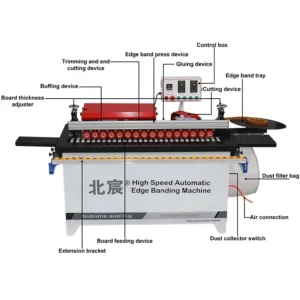
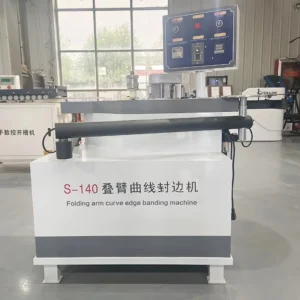
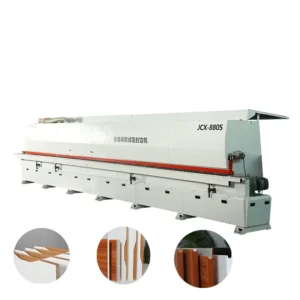
Voltage-Adaptive Configuration — Every ZDSF190 automatic curve and linear edge banding machine leaves the factory with electrical parameters verified against your local grid, eliminating the motor-reversal failures I have witnessed on Middle East job sites.
Technical Specifications
| Parameter |
Value |
| Model |
ZDSF190 |
| Product Type |
Automatic Curve and Linear Edge Banding Machine |
| Edge Type |
Both curved and straight lines |
| Feed Speed |
0–14 m/min |
| Sheet Thickness Range |
10–50 mm |
| Strip Thickness Range |
0.5–2.5 mm |
| Rated Power |
4 kW |
| Voltage & Frequency |
220V 50Hz (basis not stated in source — confirm local voltage adaptation availability) |
| Heating Power |
800 W |
| Trimming Power |
800 W × 2 |
| Polishing Power |
180 W × 2 |
| Suction Power |
1200 W |
| Belt Power |
25 W |
| Transmission Power |
120 W |
| Rated Air Pressure |
0.4–0.6 MPa |
| Glue Pot Capacity |
1000 ml |
| Gluing Method |
Double-sided gluing |
| Trimming Stations |
Upper and lower trimming with 4-blade alloy arc knife |
| Polishing Stations |
Cross polishing up and down |
| Pressure Beam |
Aluminum alloy, adjustable |
| Slide Rail |
Square slide rail for profiling; steel rod slide rails for crawler transmission |
| Dust Extraction |
Large diameter surrounding vacuum, dual dust collectors |
| Control Panel |
Multi-function button operation |
| Edge Strip Cutting |
Pneumatically controlled |
| Overall Dimensions (L×W×H) |
1900 × 560 × 1300 mm |
| Net Weight |
120 kg |
| Assembly State |
Requires assembly (user manual or video teaching provided) |
Application Suitability
| Application |
Material or Output |
| Custom cabinet fronts with curved profiles |
MDF and plywood with PVC or veneer edge banding 0.5–2.5 mm |
| Straight shelving and carcass panels |
Particleboard and MDF with melamine or PVC strip |
| Small-batch joinery producing mixed curved and linear components |
Solid wood panels with veneer banding |
| Compact workshops requiring dual-purpose edge finishing |
Board substrates 10–50 mm thick |
Why the Voltage Question Must Precede the Purchase Order for Any Automatic Curve and Linear Edge Banding Machine
Confirming voltage and frequency before production starts is the single most effective step to prevent on-site commissioning failure.
I spent weeks troubleshooting in Dubai after a cabinet factory received an edge bander wired for 380V/50Hz when their facility ran 415V/60Hz. The motor reversed on startup, the glue roller overheated, and every panel in the first batch came off the line with scorched edge banding and visible glue scarring. The cost of that single oversight exceeded the price of the machine itself. When evaluating automatic curve and linear edge banding machine specifications, electrical compatibility is the parameter that determines whether the equipment runs at all [NEED_CITE: voltage and frequency standards by export market].

Dual-Purpose Geometry on a Single Footprint
The ZDSF190 handles both curved and straight edge profiles through a 180° rotation mechanism, removing the need for two dedicated stations on the workshop floor. For a joinery operation producing curved cabinet doors alongside flat shelving, this consolidation frees up floor area and reduces material handling between machines. The feed speed range of 0–14 m/min gives operators control over throughput when switching between intricate curves that demand slower travel and longer straight runs where higher feed rates maintain productivity.
Trimming and Polishing Architecture for Clean Arc Finishes
Upper and lower trimming stations fitted with 4-blade alloy arc knives address the specific challenge of removing excess banding on radiused edges without scoring the panel surface. Cross polishing stations above and below the workpiece then smooth the trimmed edge to a finish suitable for visible cabinet faces. The square slide rail guiding the profiling and trimming assembly maintains alignment through the cutting arc, while steel rod slide rails on the crawler transmission keep the panel tracking straight during linear passes. This mechanical separation is what allows consistent edge quality across both geometries within one automatic curve and linear edge banding machine specifications sheet [NEED_CITE: edge banding tolerance verification methods for workshop acceptance].
Reading the Specification Sheet Against Your Production Reality
The 10–50 mm sheet thickness range covers the majority of furniture-grade substrates, from thin 10 mm MDF drawer bottoms to 50 mm thick particleboard worktops. If your production regularly processes boards outside this window, the pressure beam travel and glue roller gap will need verification before ordering. The double-sided gluing system with a 1000 ml glue pot applies adhesive to both the panel edge and the strip simultaneously, which improves bond consistency on porous substrates like raw particleboard compared to single-sided application. Heating power of 800 W brings the glue to working temperature, and the rate at which it recovers between panels matters when you are feeding boards in rapid succession. At the upper end of the 0–14 m/min feed speed, glue recovery time shortens, so operators running thicker strips at 2.5 mm may need to moderate feed rate to maintain adhesion quality.
The Hidden Cost of Skipping Configuration Verification
When a workshop orders an edge bander without matching the specification sheet to actual panel materials and local power infrastructure, the failures do not appear in the first hour of operation. They surface three weeks later as delaminated edge banding on curved fronts that passed initial visual inspection, or as repeated breaker trips on a circuit that was never rated for the combined motor and heating load. I have seen pneumatic systems starved of adequate air supply because the 0.4–0.6 MPa requirement was checked against compressor capacity only after arrival [NEED_CITE: compressed air supply requirements for pneumatic woodworking machinery]. These are not manufacturing defects. They are configuration gaps that a thorough pre-order specification review would have prevented.
Why Procurement Through This Channel Reduces Configuration Risk
Voltage and frequency customization from 110V to 440V is available as standard configuration, so the ZDSF190 can be built to match the exact electrical supply at your facility rather than relying on on-site transformers. A formal quotation with engineer-led configuration recommendation is issued within 24 hours of receiving your factory scale, processing requirement, and budget details, ensuring the specification sheet reflects your actual production conditions. Four-stage quality control covering incoming material, in-process inspection, finished product verification, and pre-shipment testing means the machine that arrives on your floor has been validated against its own specification before crating. The dual-purpose curve and linear capability within a single product family allows a workshop to scale edge banding capacity without introducing a second supplier into the maintenance and spare parts chain. Factory visits are welcomed so technical buyers can witness the trimming and polishing stations running on their own sample panels before committing to an order.
Documentation & Verification
- CE declaration of conformity matching the ZDSF190 model and configuration shipped
- Machine specification sheet with confirmed voltage, frequency, and control language
- Electrical schematic showing circuit layout for the exact voltage variant ordered
- Factory test record on your specified panel thickness and strip material before dispatch
- Operation and maintenance manual in the operator's agreed language
- Spare parts list with part numbers for trimming knives, glue rollers, and polishing pads
Installation, Commissioning & Support
- Requires assembly on arrival; 1900 × 560 × 1300 mm footprint fits standard workshop doorways for positioning before final placement
- Dedicated circuit rated for 4 kW total load plus startup surge, confirmed against your local supply voltage
- Pneumatic supply at 0.4–0.6 MPa must be verified at the machine inlet, not only at the compressor outlet
- Dual dust collectors connect to existing extraction ducting via the large diameter surrounding vacuum ports
- Multi-function button control panel configured in the operator's language before shipment
- Video-guided assembly and first-run parameter setting provided with the user manual
What to Include in Your Inquiry
Provide the panel substrates you process most frequently, including typical board thickness and edge strip material, so the pressure beam and glue system can be configured accordingly. Specify your local voltage and frequency along with available compressed air capacity to confirm the ZDSF190 integrates with your existing utilities. If your production includes curved profiles with tight radii, share a sample drawing or photo so the trimming station setup can be evaluated before the formal quotation is prepared.
Frequently Asked Questions
Q: How can I verify edge banding tolerance before placing an order?
A: Request a sample processing test using your actual panel material and edge strip. The factory runs the ZDSF190 on your substrates and provides a factory test record documenting trimming quality and adhesion results. This gives you physical evidence of edge finish rather than relying on published tolerance figures alone.
Q: What happens if my facility voltage differs from the standard 220V 50Hz?
A: Voltage and frequency are configurable from 110V to 440V. During the specification confirmation stage, you provide your exact supply parameters, and the machine is built to match. The electrical schematic shipped with the machine reflects the confirmed variant, preventing motor reversal and heating element damage on commissioning.
Q: Can the control panel be supplied in a language my operators understand?
A: Multilingual control panel options are available and should be confirmed before production begins. Specify the required language during the inquiry stage so button labels, error messages, and the operation manual are all aligned to the same language before the machine leaves the factory.
Q: How does the 10–50 mm sheet thickness range affect my panel selection?
A: This range covers standard furniture substrates from thin MDF to thick worktop panels. If your production includes boards below 10 mm or above 50 mm, discuss pressure beam adjustment limits during the quotation stage to confirm whether the ZDSF190 accommodates your full material mix or whether a different configuration is needed.
Q: Is the 0–14 m/min feed speed adequate for a workshop producing mixed curved and straight panels?
A: The variable feed speed allows operators to slow down for tight curved profiles and increase rate for long straight runs. For workshops processing a mix of both geometries in small to mid-size batches, this range provides sufficient flexibility to balance edge quality on curves with throughput on straight sections.