Verified Electrical Compatibility — every dust collector leaves the facility with confirmed voltage, frequency, and plug type matched to the destination grid, preventing the commissioning failures that strand equipment on workshop floors.
Technical Specifications
| Parameter |
Value |
| Product Type |
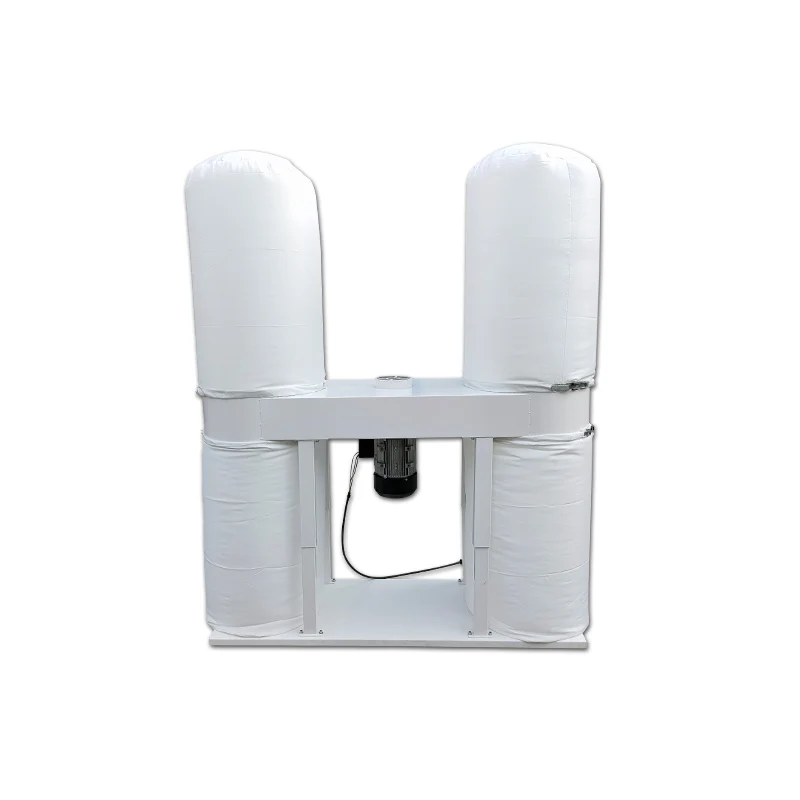
Woodworking Dust Collector |
| Operating Principle |
Bag filter with diversion device for large particle separation |
| Dust Separation Method |
Large particles fall into dust hopper via guide pipe; fine dust adsorbed on filter bag |
| Voltage & Frequency |
Configurable from 110V to 440V, 50Hz or 60Hz (basis to be confirmed per destination market) |
| Plug Options |
EU / USA / AU / UK |
| Language Options |
Chinese and English standard; other languages available on request |
| Standards |
CE |
| Filter Bag Material |
Available in polyester, felt, or cartridge type (basis to be confirmed) |
| Airflow Capacity |
Confirmed per machine model and application requirement (basis to be confirmed) |
| Dust Collection Port Size |
Matched to woodworking machine outlet diameter (basis to be confirmed) |
| Assembly State |
Confirmed prior to shipment (basis to be confirmed) |
| Color Options |
Available on request (basis to be confirmed) |
Application Suitability
| Application |
Material or Output |
| Edge banding machine dust extraction |
PVC, ABS, and wood veneer trimmings with fine adhesive residue |
| Sliding table saw and panel saw operation |
MDF, plywood, and particleboard cutting dust and offcuts |
| Boring and slotting machine environments |
Concentrated fine particulate from hinge drilling and groove cutting |
| Small-to-medium furniture factory shared extraction |
Mixed wood species and composite panel dust across multiple stations |
| Home workshop and joinery studio |
Solid wood planing shavings and sanding dust |
Why the Voltage Question Should Come Before the Price on a Woodworking Dust Collector
A dust collector wired for the wrong frequency will not develop rated suction, regardless of how well the filter media performs.
I once stood in a Dubai furniture plant watching a brand-new extraction unit refuse to start. The local supply was 415V at 60Hz, but the unit had been built for a 380V 50Hz grid. The motor drew excessive current, tripped the breaker, and sat idle while we sourced a step-up transformer and rewired the control panel — three weeks of lost extraction in a facility that could not afford airborne MDF dust. That failure had nothing to do with filtration quality and everything to do with a single unchecked line on a specification sheet. When buyers evaluate Woodworking Dust Collector specifications, the electrical confirmation must happen before production begins, not after the crate arrives [NEED_CITE: voltage and frequency standards by export market].

Filtration Architecture and Particle Separation Stages
The bag filter system in this Woodworking Dust Collector uses a diversion device that forces incoming air through a directional change before the airstream reaches the filter media. Heavier wood chips and coarse sanding residue lose momentum at the guide pipe and fall directly into the dust hopper under gravity. Only the finer particulate — the fraction that actually blinds filter media and reduces suction over time — contacts the bag surface. This two-stage separation extends the interval between bag changes and maintains more consistent airflow across a full shift. For workshops processing MDF or particleboard, where fine dust dominates the waste stream, the pre-separation stage reduces the loading rate on the filter bags and keeps static pressure within the design range of the fan.
Matching Port Diameter and Airflow to Upstream Machines
Every woodworking machine generates a specific volume of dust-laden air that must be captured at the hood or shroud before it escapes into the workshop atmosphere. A sliding table saw cutting 18mm MDF produces a different extraction demand than a multi-boring machine drilling hinge cups in solid oak. The dust collection port size on this unit is specified to match the outlet diameter of the upstream machines it serves, preventing the turbulence and velocity loss that occur when a large duct feeds into an undersized collector inlet. Workshop planners who map each machine's extraction requirement to the collector's airflow capacity avoid the common failure where a shared system pulls adequately from one station but leaves another station's hood overflowing with dust [NEED_CITE: industrial ventilation design principles for woodworking].
Reading the Specifications That Actually Matter
Airflow capacity, typically expressed in cubic meters per hour or CFM, determines whether the collector can keep pace with the machines it serves. A panel saw generating continuous fine dust during an eight-hour shift requires sustained volume, not just peak suction at the fan outlet. Filter bag material selection — polyester for general wood dust, felt for finer composite panel particulate, or cartridge type for facilities requiring higher filtration area in a compact footprint — directly affects how often the bags must be cleaned or replaced. Voltage and frequency define the motor speed and, consequently, the fan curve; a motor rated for 50Hz running on a 60Hz supply spins faster but may exceed its thermal rating without derating. The plug option ensures physical connection to the local supply without improvised adapters that compromise grounding continuity. Together, these four parameters — airflow, filter media, voltage, and plug type — form the minimum set that a technical buyer should verify before authorizing production.
The Hidden Cost of Undersized Extraction
A dust collector that cannot match the volume of its upstream machines does not fail dramatically — it fails gradually. Sawdust accumulates on machine beds, sliding surfaces wear prematurely, and edge banding adhesive picks up stray particulate that creates visible defects in the finished panel. Operators begin disconnecting duct runs to concentrate suction on the station that matters most, which leaves other machines unprotected. In environments processing MDF, airborne formaldehyde-laden dust settles on every surface and creates a respiratory hazard that no amount of manual sweeping can control. The cost of replacing a worn sliding table saw carriage or reworking a batch of edge-banded panels far exceeds the investment in correctly sized extraction from the start [NEED_CITE: occupational exposure limits for wood dust in manufacturing environments].
Why Procurement Rigor Matters Here
In-house manufacturing with verified tolerance on sheet metal fabrication ensures duct connections seal without air leaks that degrade suction at the hood. The four-stage quality control process covers incoming motor inspection, in-process assembly verification, finished product suction testing, and pre-shipment electrical validation — meaning the voltage, frequency, and rotation direction are confirmed under load before the unit is crated. Customization of voltage from 110V to 440V, plug type, and control panel language is treated as standard configuration rather than a special request, eliminating the post-delivery rewiring that delays commissioning. Engineer-led configuration recommendation matches the collector to the specific machines it will serve, with a formal quotation documenting the airflow and port sizing rationale within 24 hours. Factory test records capture actual suction performance on the buyer's specified panel material, providing verifiable evidence that the unit meets its stated duty point.
Documentation & Verification
- CE declaration of conformity covering the complete dust collector assembly
- Machine specification sheet listing confirmed airflow, filter bag material, and port diameter
- Electrical schematic with voltage, frequency, and motor full-load current verified against local supply
- Factory test record documenting suction performance and filter bag sealing under operating conditions
- Operation and maintenance manual in the agreed language, including filter replacement intervals and bag cleaning procedure
- Spare parts list with filter bag part numbers and recommended replacement stock levels
Installation, Commissioning & Support
- Dedicated electrical circuit sized to the confirmed motor full-load current with appropriate breaker rating
- Level foundation within the unit's footprint to prevent vibration transfer to connected ductwork
- Duct connections sealed with clamped flexible joints to accommodate thermal expansion without air leakage
- First-run verification of fan rotation direction against the confirmed voltage phase sequence
- Operator training on filter bag inspection, dust hopper emptying intervals, and emergency stop procedure
- Replacement filter bags and gasket seals identified in the spare parts list for local stock planning
Specifying the Right Configuration for Your Workshop
To move from a general inquiry to a confirmed quotation, the most useful details are the specific woodworking machines the collector will serve, the panel materials processed most frequently, and the local electrical supply characteristics including voltage, phase, and frequency. If the extraction system will connect to multiple machines through a shared duct network, a layout sketch showing duct run lengths and branch takeoff points helps the engineer calculate total system resistance. For facilities with noise restrictions or limited floor space, note any constraints on unit placement relative to the machines and building boundaries.
Frequently Asked Questions
Q: How do I calculate the required airflow for my woodworking machines?
A: Each machine type has a published extraction volume based on hood design and cutting width. Sum the volumes for all machines that will run simultaneously on the shared collector, then add a margin for duct friction losses across the longest branch run. The engineer configuration proposal will confirm the total system airflow and match it to the appropriate collector model before quotation.
Q: What voltage and frequency options are confirmed before shipment?
A: Voltage is configurable from 110V to 440V at either 50Hz or 60Hz, with plug type selected from EU, USA, AU, or UK standards. The electrical schematic and voltage confirmation document are issued for buyer approval before production begins, ensuring the motor winding, contactor rating, and control transformer all match the destination grid.
Q: How does the filter bag system handle fine MDF dust versus coarse solid wood chips?
A: The diversion device separates large chips into the dust hopper before they reach the filter media, so the bags only handle the fine fraction. For MDF processing where fine dust dominates, felt or cartridge-type media provides higher filtration area and longer intervals between cleaning cycles compared to standard polyester bags.
Q: What port sizes are available and how do I match them to my machines?
A: Dust collection port diameter is specified to match the outlet size of the upstream woodworking machines, from small boring machine hoods to large panel saw enclosures. Providing the machine make and model or measuring the existing outlet diameter allows the engineer to confirm the correct port configuration and duct adapter.
Q: What documentation verifies the collector's performance before delivery?
A: The factory test record captures actual suction measurements and filter bag sealing integrity under operating conditions with the confirmed voltage and frequency. The machine specification sheet, electrical schematic, and CE declaration accompany the shipment, along with the maintenance manual in the agreed language detailing bag replacement schedules.