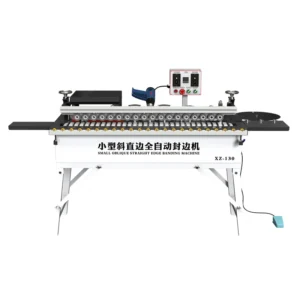
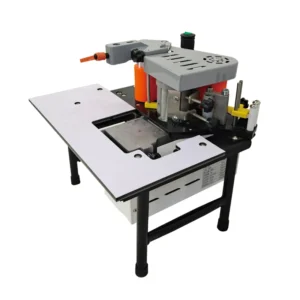
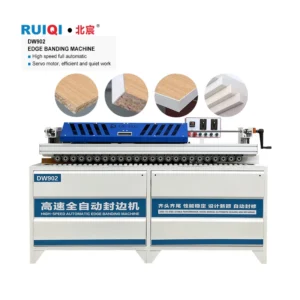
Engineer-led configuration — specification matching verified on your panel material, feed speed, and voltage before the quotation is finalized.
Technical Specifications
| Parameter |
Value |
| Model |
XZF450 |
| Product Type |
Automatic Edge Banding Machine |
| Total Power |
9.5 kW |
| Pre-milling Motor |
4 kW |
| Trimming Power |
2.2 kW × 2 |
| Polishing Power |
0.4 kW × 2 |
| Edge Power |
0.16 kW |
| Transmission Power |
180 W |
| Vacuum Power |
550 W |
| Voltage |
380V/415V (basis not stated in source — verify frequency) |
| Feed Speed |
0–12 m/min |
| Minimum Sheet Length |
300 mm |
| Minimum Sheet Width |
150 mm |
| Edge Banding Height |
0–50 mm |
| Edge Banding Thickness |
0.3–3 mm |
| Glue Pot Capacity |
4000 ml |
| Air Source Pressure |
0.5–0.7 MPa |
| Machine Dimensions |
3000 × 650 × 1350 mm |
| Machine Weight |
430 kg |
| Key Features |
Pre-milling, 30/45/60° angle banding, dual trimming, scraping, polishing, integrated dust extraction |
| Language Options |
Chinese and English standard; other languages customizable |
| Plug Options |
EU, USA, AU, UK |
Application Suitability
| Application |
Material or Output |
| Cabinet door edge finishing |
MDF and melamine-faced chipboard with PVC or ABS edge banding |
| Custom furniture panel processing |
Plywood and blockboard with veneer or melamine edge strips |
| Polymer door production |
Polymer composite panels requiring shaped or straight edge profiles |
| Wardrobe and shelving panels |
Particleboard with 0.3–3 mm thickness edge banding material |
| Office furniture components |
Medium density fiberboard with 90° or beveled edge treatment |
Why the Voltage Question Must Precede the Edge Banding Machine Specifications Review
A 380V machine shipped to a 60 Hz market without frequency confirmation will underperform on every motor-driven station.
I have seen workshops receive edge banders that powered on but ran the feed chain at the wrong speed because the motor was wound for 50 Hz while the local supply runs at 60 Hz. The trimming stations vibrate, the glue pot struggles to maintain temperature, and operators blame the machine when the real fault sits in the electrical schematic. Reviewing edge banding machine specifications means nothing if the voltage and frequency do not match what your workshop actually has at the breaker panel [NEED_CITE: voltage and frequency standards by export market].

Pre-Milling Station and Substrate Preparation
The XZF450 carries a dedicated 4 kW pre-milling motor that removes a thin layer from the panel edge before the glue roller engages. This matters when your substrate has surface irregularities — recycled particleboard or chipboard with uneven density often shows visible glue lines if the edge is not freshly cut. Pre-milling exposes a clean, square edge so the adhesive bonds uniformly. For workshops running mixed batches of MDF, plywood, and melamine board, this single station often determines whether the finished edge passes visual inspection or comes back for rework.
Multi-Angle Banding Beyond Standard Straight Edges
Most entry-level machines handle only 90-degree straight edge banding. The XZF450 supports 30, 45, and 60-degree bevel banding in addition to standard right-angle application. This capability matters for cabinet makers producing doors with chamfered profiles or furniture designers specifying angled edge treatments on shelving and display units. Switching between angles requires adjusting the banding guide and pressure roller positions, which takes time during changeover but eliminates the need for a separate profiling machine downstream [NEED_CITE: CE machinery directive requirements for industrial equipment].
Reading the Spec Sheet Against Your Actual Production Conditions
Feed speed on this model ranges from 0 to 12 m/min, adjustable through the dedicated 180 W transmission motor. The practical throughput depends on your operator loading speed, the complexity of the trimming pass, and whether you run single panels or batch sequences. The glue pot holds 4000 ml, which supports continuous runs on standard panel widths but may require mid-shift refilling if you process narrow stock at high feed rates. Edge banding thickness covers 0.3 to 3 mm — thin PVC for office furniture on the lower end, solid wood strips or thick ABS for heavy-duty shelving on the upper end. The minimum sheet dimensions of 300 mm length and 150 mm width define the smallest offcut you can process without manual assistance at the infeed.
The Cost of Skipping the Material Test Run
When a buyer orders based on brochure specifications alone and skips sending panel samples for a test run, the problems surface after installation. Recycled substrate with low surface density absorbs glue differently than virgin MDF. A machine tuned for clean melamine board may leave starved glue joints or excessive squeeze-out on porous chipboard. The scraping and polishing stations then either remove too much material or leave residue that fails the visual quality check. These are not machine defects — they are configuration gaps that a pre-shipment material test would have identified [NEED_CITE: substrate density variation and adhesive bonding behavior].
Why Procurement Through This Channel Reduces Configuration Risk
The specification matching process starts with your panel material, daily volume, and workshop electrical supply before a quotation is issued. Voltage is configurable from 110V to 440V, so the machine that ships matches your local grid rather than a generic export default. The four-stage quality control process covers incoming material inspection, in-process assembly checks, finished product testing, and pre-shipment verification with documented results. Operation and maintenance manuals are produced in the agreed language, preventing the situation where operators cannot read the control panel during commissioning. Spare parts lists and packing photographs are provided before dispatch so you can verify completeness against your order.
Documentation & Verification
- Machine specification sheet with confirmed tolerance values and motor ratings for XZF450
- Electrical schematic showing voltage and frequency configuration matching your local supply
- Factory test record processing your specific panel material and edge banding thickness
- Operation and maintenance manual in agreed language with illustrated control panel guide
- Spare parts list with part numbers for consumables and wear components on this model
Installation, Commissioning & Support
- Requires a dedicated circuit rated for 9.5 kW total draw at the confirmed voltage and frequency
- Air supply must deliver 0.5–0.7 MPa clean, dry air to the machine inlet for consistent pneumatic actuation
- Machine footprint of 3000 × 650 mm requires level floor with clearance on both sides for panel handling
- First-run commissioning includes glue temperature calibration and pressure roller adjustment for your material
- Trimming and scraping blade alignment verified on your panel samples before production handover
- Consumable spare parts identified for pre-milling cutters, trimming blades, and polishing wheels
What to Include in Your Specification Inquiry
Provide your primary panel material type, typical panel thickness range, and the edge banding material you run most often. Confirm your workshop voltage and frequency at the breaker panel, not from a general national standard. If you process beveled edges, specify the angles and the profile dimensions so the configuration accounts for guide and roller adjustments. Note the control panel language your operators require and whether you need documentation in a language beyond standard Chinese or English.
Frequently Asked Questions
Q: How do I verify the tolerance claim before committing to an order?
A: Request the factory test record that documents actual measurements from panels processed on the specific XZF450 unit allocated to your order. This record shows edge banding alignment, trimming accuracy, and scraping results on your submitted panel material. Reviewing this data before shipment confirmation is part of the pre-shipment verification stage.
Q: My workshop runs 440V at 60 Hz — can this machine be configured for that supply?
A: Voltage is configurable across a range covering 110V to 440V. You must confirm both voltage and frequency at your installation point before the electrical schematic is finalized. A machine wound for the wrong frequency will run feed and trimming motors at incorrect speeds, affecting edge quality and throughput consistency.
Q: What languages are available for the control panel and documentation?
A: Chinese and English are standard. Additional languages including Spanish are available by request at the quotation stage. The operation manual, maintenance guide, and control panel labels are all produced in the agreed language to prevent delays during operator training and commissioning.
Q: How does the 0–12 m/min feed speed translate to actual daily output?
A: Practical throughput depends on your operator loading rhythm, panel size mix, and whether you run single pieces or batch sequences. The adjustable transmission motor lets you set feed speed to match your line rhythm. Request a sample processing test with your panels to observe cycle times under realistic conditions.
Q: What documentation arrives with the machine before and after shipment?
A: Before dispatch, you receive the specification sheet, electrical schematic, factory test record, packing photographs, and spare parts list. The operation manual in your agreed language ships with the machine. CE declaration and ISO 9001 documentation are available per unit upon request.