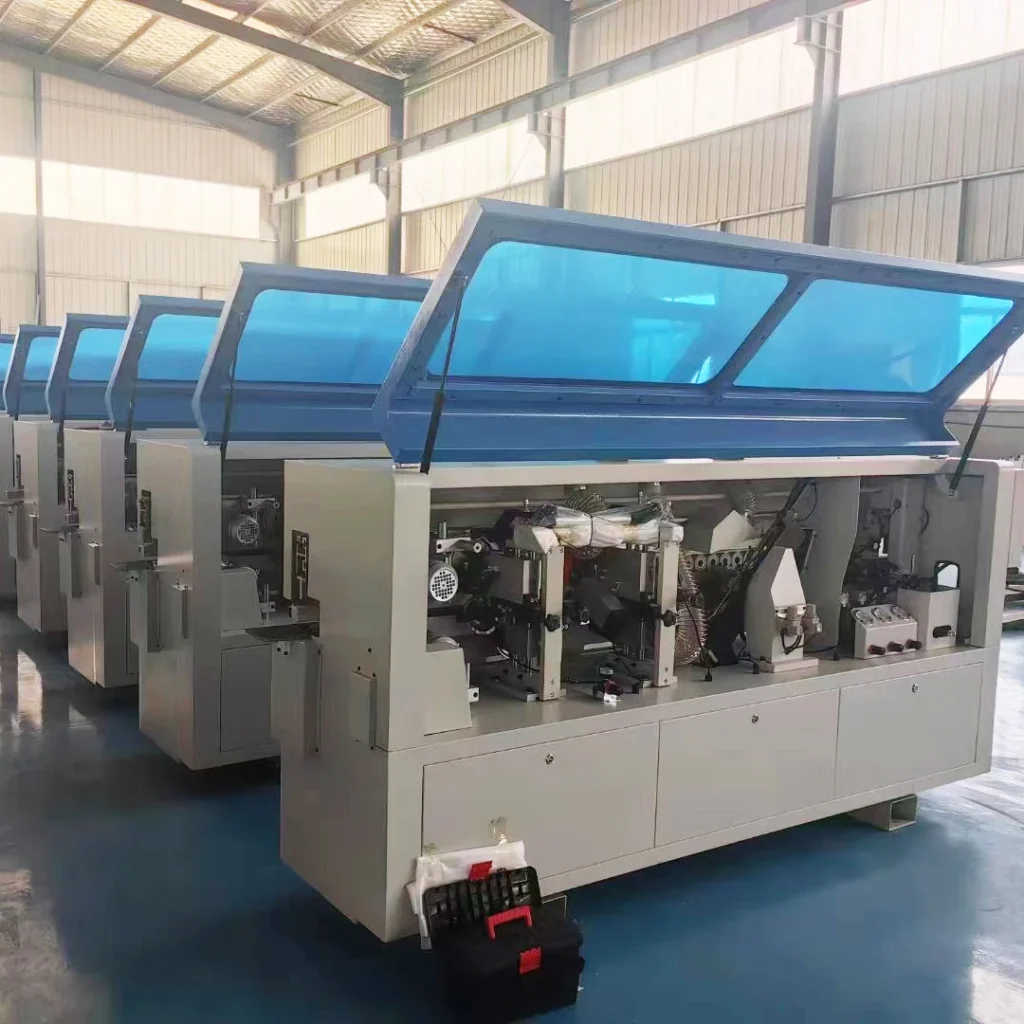
Proven Tolerance Verification — Every ZDS280B and ZDS280C unit undergoes factory testing on your actual panel substrate before dispatch, ensuring claimed ±0.02mm trimming accuracy holds true in real production conditions.
Technical Specifications
| Parameter |
Value |
| Model |
ZDS280B / ZDS280C |
| Product Type |
Automatic Straight Line Edge Bander |
| Main Functions (ZDS280B) |
Gluing, End Trimming, Fine Trimming, Buffing |
| Main Functions (ZDS280C) |
Gluing, End Trimming, Fine Trimming, Scraping, Buffing |
| Panel Thickness Range |
10–55 mm |
| Edge Thickness Range |
0.4–3 mm |
| Feed Speed |
15 m/min |
| Minimum Panel Width |
45 mm |
| Minimum Panel Length |
80 mm |
| Working Pressure |
0.6–0.8 MPa |
| Rated Power |
7.5 kW |
| Voltage & Frequency |
380V / 3HP (frequency to be confirmed: 50Hz or 60Hz) |
| Net Weight |
650 kg (ZDS280B) / 800 kg (ZDS280C) |
| Overall Dimensions (L×W×H) |
2300×700×1250 mm (ZDS280B) / 2800×700×1250 mm (ZDS280C) |
| Fuselage Material |
14 mm national standard high-strength steel plate, frame-type structure with high-temperature quenching |
| Conveyor Guide Rail |
HT260 cast iron |
| Conveying Motor |
Customized Taiwan brand with thermal protection |
| Pneumatic System |
German Festo or Taiwan AirTAC cylinders and safety valves |
| Electrical Components |
Delixi / Chint contactors; Japanese Omron travel switches |
| Warranty |
1 year |
Application Suitability
| Application |
Material or Output |
| Custom cabinet door edging |
MDF and particleboard with PVC edge banding (0.4–3 mm) |
| Wardrobe side panel finishing |
Plywood panels with veneer or melamine edge strips |
| Small-batch office furniture |
Solid wood panels up to 55 mm thickness |
| Joinery workshop production |
Mixed substrate runs requiring quick changeover between MDF and plywood |
| Visible-edge furniture components |
High-quality scraping finish (ZDS280C) for showroom-grade surfaces |
Why the Voltage Question Should Come Before the Price on Any Automatic Straight Line Edge Bander
Confirming local supply voltage and frequency before shipment prevents weeks of on-site delays that no specification sheet can recover.
I worked in the assembly shop fitting edge banders before moving into technical sales. One project stands out: a custom cabinet factory ordered a straight-line edge bander, and nobody on our side double-checked the local supply with their electrician. The machine arrived rated for 380V/50Hz, but the workshop was wired for a different configuration. The client sat idle for three weeks while the wiring was reworked, and the entire cabinet delivery schedule slipped. Since then, I personally verify voltage and frequency on every unit before it leaves the floor. A machine that cannot be powered on is not a machine — it is a very expensive placeholder taking up floor space [NEED_CITE: voltage and frequency standards by export market].

Station Configuration and Edge Finish Outcomes
The ZDS280B runs a four-station sequence: gluing, end trimming, fine trimming, and buffing. This configuration produces a clean edge suitable for interior cabinet components and shelving where the banding line is largely concealed. For a technical buyer evaluating Automatic Straight Line Edge Bander specifications, the distinction between four and five stations directly determines whether secondary hand-finishing is required downstream.
The ZDS280C adds a scraping station between fine trimming and buffing. Scraping removes the micro-ridge left by the trimming cutter, producing a smooth transition between banding and panel face. On visible furniture edges — cabinet doors, drawer fronts, open shelving — this station eliminates the need for manual scrape work and ensures consistent edge quality across long production runs.
Feed Speed and Panel Envelope Constraints
The 15 m/min conveyor speed is constant across both models, driven by a customized Taiwan-brand motor with built-in thermal protection. For a workshop processing standard cabinet panels in MDF or particleboard, this feed rate supports steady throughput on straight edges without sacrificing glue adhesion quality or trimming accuracy. The HT260 cast iron conveyor guide rail maintains alignment under continuous operation, which matters when running narrow panels down to the 45 mm minimum width.
The minimum panel length of 80 mm and minimum width of 45 mm define the working envelope. Technical buyers should cross-reference these limits against their actual cut list. Small drawer components, narrow filler strips, and plinth boards often fall below standard panel dimensions, and discovering that a batch of panels cannot physically feed through the machine after delivery creates avoidable disruption [NEED_CITE: panel dimension standards in custom furniture manufacturing].
Reading the Specification Sheet for Real Production Impact
Panel thickness coverage from 10 to 55 mm determines which substrates can run without manual adjustment beyond the standard hand-wheel setting. MDF cabinet sides typically fall in the 16–18 mm range, while solid wood worktops and shelving can push toward 40 mm and above. The 55 mm upper limit on both models provides margin for thicker stock without requiring a separate heavy-duty machine.
The 14 mm high-strength steel frame with high-temperature quenching treatment provides the structural rigidity that keeps trimming cutters aligned over extended production runs. Frame deflection under continuous load is a primary cause of gradual tolerance drift in edge banders of this class. A rigid fuselage means the fine trimming and scraping stations maintain their set position across thousands of panels.
The pneumatic system operates at 0.6–0.8 MPa, supplied by either German Festo or Taiwan AirTAC cylinders with magnetic switches. Stable air pressure is critical for consistent end-trimming force and glue roller contact. A workshop must ensure its compressor can deliver sustained airflow at the required pressure, especially when multiple pneumatic tools share the same supply line.
Electrical components from Delixi and Chint, combined with Omron travel switches, form a contactor-based control system. This architecture is straightforward to maintain: replacement contactors and switches are widely available in most export markets, reducing dependency on proprietary electronics for routine servicing.
The Hidden Cost of Specifying the Wrong Configuration
Buying a four-station ZDS280B for applications that require scraping leads to visible glue lines and micro-ridges on finished edges, particularly on PVC banding over particleboard. The downstream consequence is rework: operators hand-scraping edges to meet quality standards, slowing the entire assembly line. This problem typically surfaces only after the first production batch fails the customer's visual inspection [NEED_CITE: edge finish quality standards in cabinet manufacturing].
Conversely, specifying the five-station ZDS280C for a workshop that only produces interior carcass components means paying for scraping capacity that adds no value to hidden edges. The additional station also extends the machine footprint by 500 mm, consuming floor space that a compact workshop may not have. The cost is not just in the machine price — it is in wasted floor area and slightly longer cycle exposure on panels that do not require the extra finish pass.
What This Machine Range Offers Technical Buyers
In-house manufacturing with verified ±0.02 mm trimming tolerance means you receive actual test records, not catalog claims. Each ZDS280B and ZDS280C unit is tested on the buyer's specified panel material before shipment.
Full model range within one product family allows a workshop to scale from the ZDS280B to the ZDS280C — or to add a second unit as volume grows — without changing supplier or retraining operators on a different control layout.
Voltage and frequency customization is confirmed before production, with electrical schematics provided for local electrician review. This eliminates the on-site power mismatch that causes installation delays.
Four-stage quality control — incoming material, in-process, finished product, and pre-shipment verification — catches assembly errors before the machine is crated, not after it arrives at your dock.
Engineer-led configuration means you receive a formal proposal matching your actual panel mix, feed speed requirement, and edge quality target within 24 hours of inquiry.
Documentation & Verification
- Machine specification sheet listing confirmed ZDS280B or ZDS280C station configuration
- Electrical schematic and voltage confirmation document matched to your local grid
- Factory test record on your specified panel thickness and edge banding material
- Operation and maintenance manual in your agreed language for operator commissioning
- Spare parts list covering trimming cutters, scraping blades, and buffing wheels
- Packing photographs and customs documentation support for export clearance
Installation, Commissioning & Support
- Floor space requirement of 2300×700 mm (ZDS280B) or 2800×700 mm (ZDS280C) with clearance for panel infeed
- Dedicated 380V / 3-phase circuit required for 7.5 kW rated power with confirmed frequency
- Machine ships fully assembled; position on level floor and connect compressed air at 0.6–0.8 MPa
- First-run commissioning includes station-by-station adjustment on your actual panel stock
- Trimming cutter and scraping blade replacement training included during initial setup
- HT260 conveyor guide rail requires periodic lubrication per the maintenance schedule
Requesting a Matched Configuration
Send your typical panel materials, thickness range, and edge banding type so we can recommend the correct station configuration. Confirm your workshop supply voltage and frequency — both values — so the electrical system is built to match before the machine enters production. If you have specific edge finish requirements for visible components, indicate which panels need scraping-level quality versus standard buffed finish.
Frequently Asked Questions
Q: How do I decide between the ZDS280B and ZDS280C for my workshop?
A: The decision rests on your edge visibility requirements. If most of your output is interior cabinet carcasses, shelving, and concealed components, the four-station ZDS280B with fine trimming and buffing is sufficient. If you produce cabinet doors, drawer fronts, or display furniture where edges are visible to end users, the ZDS280C scraping station removes the trimming ridge for a smooth, hand-finished appearance straight off the machine.
Q: How is the voltage and frequency confirmed before my machine ships?
A: We require your exact supply voltage and frequency in writing before production begins. Your local electrician should confirm both values at the panel where the machine will connect. We then build the electrical system to match and provide a confirmation document with the schematic. This step prevents the situation where a machine arrives incompatible with local power, which can delay installation by weeks.
Q: Can this machine handle my small drawer sides and narrow filler panels?
A: The minimum panel dimensions are 45 mm wide by 80 mm long. Review your cut list for any components below these thresholds. Narrow strips and small offcuts that fall outside the working envelope will require alternative processing. Most standard cabinet panels, shelving, and door components fall well within the machine's capacity.
Q: What compressor capacity do I need for the 0.6–0.8 MPa pneumatic system?
A: The machine requires a stable air supply at 0.6–0.8 MPa delivered through the pneumatic cylinders and safety valves. Your compressor must sustain this pressure continuously, accounting for any other pneumatic tools or machines sharing the same line. A compressor rated only at peak pressure may drop below the minimum during sustained cycling, causing inconsistent trimming and gluing pressure.
Q: Is the scraping station on the ZDS280C worth the additional floor space?
A: The ZDS280C is 500 mm longer than the ZDS280B, adding the scraping station. If your product range includes visible-edge furniture where surface quality affects customer acceptance, the scraping station eliminates manual rework and produces consistent edges across production runs. For workshops producing only concealed components, the extra station adds cost and footprint without improving the final installed product.