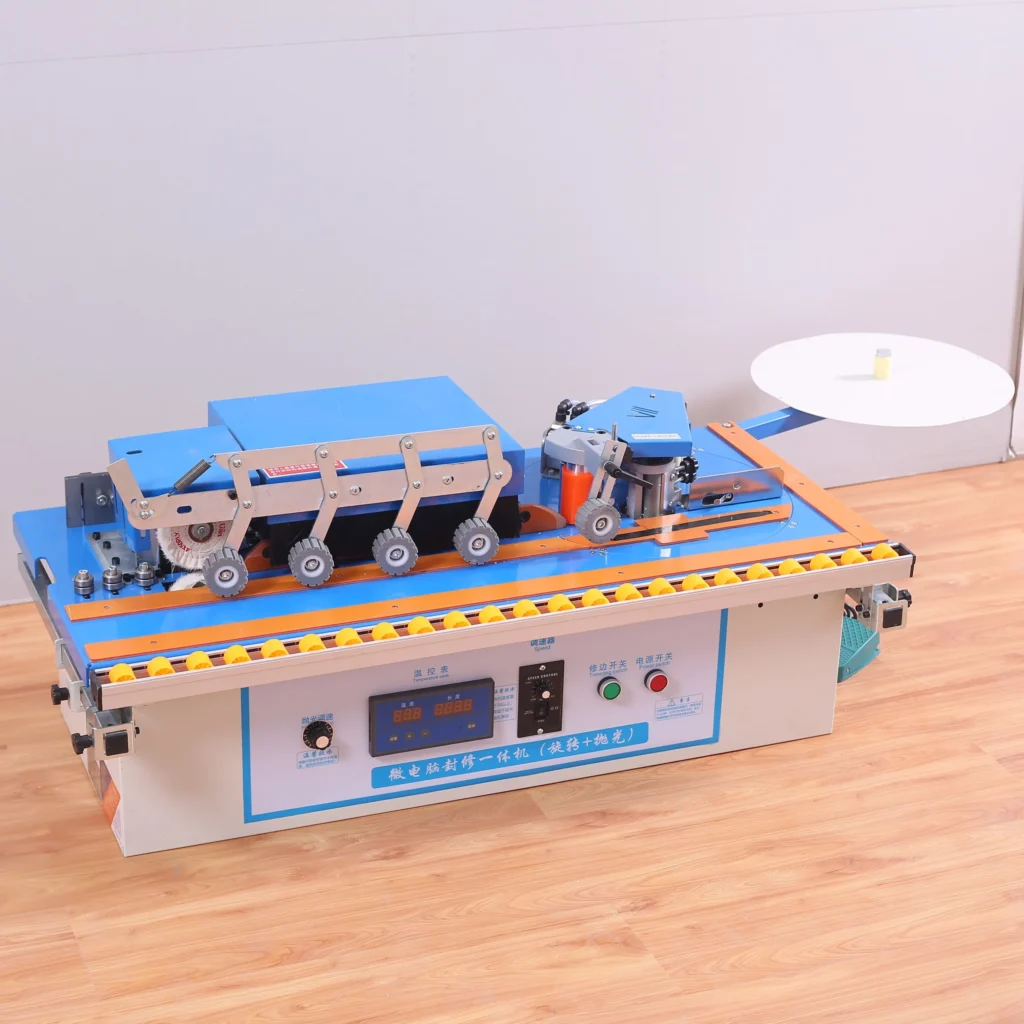
Precision-First Sizing — Every ZDSF120 edge banding machine leaves the factory with a test record matching your exact panel thickness and edge material, not just a generic datasheet.
Technical Specifications
| Parameter |
Value |
| Model |
ZDSF120 |
| Product Type |
Automatic Edge Banding Machine |
| Voltage |
220V Single-Phase |
| Rated Power |
2.8 kW |
| Glue Capacity |
1000 ml |
| Heating Time |
5–8 minutes |
| Panel Thickness Range (Cover Height) |
10–60 mm |
| Edge Thickness Range |
0.5–3 mm |
| Gluing Method |
Double-sided gluing |
| End Cutting |
Pneumatic flush head cutting |
| Trimming |
Automatic trimming and polishing |
| Operating Mode |
Straight and curved dual use |
| Overall Dimensions |
105 × 50 × 45 cm |
| Feed Speed |
(basis to be confirmed) |
| Tolerance |
(basis to be confirmed) |
| Air Supply Requirement |
(basis to be confirmed) |
Application Suitability
| Application |
Material or Output |
| Small-scale cabinet door production |
MDF and particleboard with PVC edge banding |
| Custom furniture carcass assembly |
Plywood panels with melamine paper edging |
| Curved profile edge finishing |
Solid wood and composite panels with veneer banding |
| Entry-level workshop transition |
Mixed straight and curved panel geometries |
Why the Voltage Question Must Come Before the Model Number
Confirming 220V single-phase compatibility with your local frequency prevents a machine from arriving as dead weight.
I once watched a custom cabinet shop take delivery of an edge bander only to discover the motor was wound for 50Hz while their facility ran on 60Hz. The machine turned on, but the feed speed and glue pot temperature never synchronized correctly. Panels came out with visible glue lines and uneven trimming. The shop lost weeks of production while sourcing a replacement motor. [NEED_CITE: voltage and frequency standards by export market]
The ZDSF120 edge banding machine specifications list 220V single-phase power, which fits standard workshop outlets in many regions. However, voltage alone is not the full picture. Frequency determines motor RPM, which directly affects feed speed and glue application consistency. A machine quoted without confirming both parameters creates a hidden incompatibility that only appears after installation.

Matching the Machine to Your Panel Stock
The ZDSF120 edge banding machine covers a panel thickness range of 10–60mm and an edge thickness of 0.5–3mm. These boundaries define which board stock you can run without manual shimming or secondary passes. MDF cabinet sides typically fall between 16–18mm, while plywood shelving can reach 25–30mm. If your daily mix includes panels outside this envelope, the machine will require adjustment that slows throughput and introduces tolerance drift.
Buyers often specify an edge bander based on their thickest panel, then discover the machine struggles with thin stock at the lower boundary. The 10mm minimum cover height on this unit means very thin drawer bottoms or backing panels may not feed reliably. Confirming your actual board mix before ordering prevents buying capacity you cannot use.
Curved Profiles Without Manual Intervention
The pneumatic flush head cutting system handles both straight and curved edges without operator adjustment between pieces. When a batch includes cabinet doors with radius corners alongside standard rectangular carcass panels, the machine transitions automatically. This eliminates the stop-start rhythm of manual trimming, where each curve requires the operator to hand-guide the workpiece and judge the cut point by eye. [NEED_CITE: CE machinery directive requirements for industrial edge banding equipment]
Double-sided gluing with a 1000ml pot ensures adhesive reaches both the panel edge and the back of the banding material. On curved sections, centrifugal force during feed can pull banding away from the substrate if glue coverage is insufficient. The dual application method maintains bond consistency across geometry changes.
Reading the Specifications That Actually Matter
Panel thickness range and feed speed are interdependent. Running 60mm stock at maximum feed speed may exceed the glue pot's recovery rate, causing temperature drop and weak adhesion on the trailing edge. The ZDSF120 edge banding machine specifications do not publish a feed speed value, which means the buyer must request a factory test record using their specific panel thickness and edge material combination. Without this test, the published range is a theoretical boundary, not a confirmed production parameter.
The 2.8kW rated power at 220V single-phase indicates this unit draws current within standard workshop circuit limits. However, simultaneous operation of the glue heater, feed motor, and pneumatic system creates peak demand that may trip undersized breakers. Verifying the dedicated circuit amperage before installation prevents nuisance tripping during production runs.
The Cost of Skipping the Air Supply Check
Pneumatic flush head cutting requires compressed air at a specific pressure and flow rate. Workshops that connect the machine to an existing compressor without verifying capacity often experience incomplete end cuts. The pneumatic cylinder fails to fully extend, leaving banding material proud of the panel edge. Downstream assembly then requires manual trimming at every joint, negating the automation the machine was purchased to provide. [NEED_CITE: pneumatic system sizing for woodworking machinery]
Undersized compressors also cause cycle time extension. The machine waits for air pressure to rebuild before executing the next cut, introducing micro-stops that accumulate across a production day. The ZDSF120 specifications list pneumatic end cutting but do not publish the required pressure and flow values. Buyers must request these figures and cross-reference against their compressor's rated output before committing to the purchase.
Why Buyers Source This Configuration Here
In-house manufacturing with patented cutting mechanisms means the ZDSF120 is built to a verified tolerance, not assembled from generic sub-assemblies. Each unit undergoes four-stage quality control covering incoming material, in-process assembly, finished product, and pre-shipment verification. The factory test record documents performance on your specific panel thickness and edge material before the machine is crated.
Voltage, control panel language, and specification customization are standard rather than special requests. A workshop in a 60Hz market receives a motor wound for that frequency, and the operator manual arrives in the agreed language. This eliminates the commissioning delays that occur when documentation and machine interface do not match the operator's working language.
Engineer-led configuration recommendation means the quotation process starts with your factory scale, processing requirements, and budget. The formal proposal arrives within 24 hours and includes the specific model tier that matches your production volume, rather than a one-size-fits-all pitch.
Documentation & Verification
- CE declaration of conformity for the ZDSF120 edge bander
- Machine specification sheet with confirmed tolerance and feed speed values
- Electrical schematic showing 220V single-phase wiring and frequency confirmation
- Factory test record using buyer-supplied panel thickness and edge material samples
- Operation and maintenance manual in the agreed language with spare parts list
Installation, Commissioning & Support
- Requires a dedicated 220V circuit sized to handle the 2.8kW peak load without tripping
- Overall dimensions of 105 × 50 × 45 cm fit standard workshop doorways for placement
- Pneumatic connection requires verified air pressure and flow rate matching factory specifications
- First-day commissioning includes glue pot temperature calibration for buyer's specific edge banding material
- Operator training covers straight and curved profile feed techniques to maximize the dual-use capability
- Spare parts list identifies wear items for local stocking to minimize unplanned downtime
Before You Request a Quote
Provide your typical panel thickness range, the edge banding material you run most often, and whether your production includes curved profiles. Confirm your facility's voltage and frequency, and note the available air compressor capacity. If you have existing upstream cutting or downstream boring equipment, share the throughput so the ZDSF120 edge banding machine specifications can be matched to your line speed.
Frequently Asked Questions
Q: How can I verify tolerance and feed speed when they are not published in the specifications?
A: Request a factory test record before shipment. The manufacturer runs your specific panel thickness and edge material through the ZDSF120 and documents the measured tolerance and achieved feed speed. This record travels with the machine and provides a baseline for future maintenance calibration.
Q: Is 220V single-phase sufficient, or do I need to confirm 50Hz versus 60Hz for my market?
A: Voltage and frequency are separate parameters. The ZDSF120 is configurable for 220V, but the motor winding must match your local frequency to ensure correct feed speed and glue pot synchronization. Confirm both values during the quotation stage to receive a machine built for your electrical grid.
Q: What panel thickness and edge material combinations work within the 10–60mm and 0.5–3mm range?
A: Standard MDF and particleboard cabinet panels typically fall between 16–25mm, well within the range. PVC edge banding from 0.5–3mm covers most furniture applications. Melamine paper and veneer banding also work, but require specific glue temperature settings that should be confirmed during the factory test.
Q: What air compressor specifications are needed for the pneumatic flush head cutting system?
A: The pneumatic system requires a specific pressure and flow rate to execute clean end cuts on both straight and curved profiles. These values are not published in the base specifications. Request the pneumatic requirement sheet and compare against your compressor's rated output before installation.
Q: How does the ZDSF120 footprint and power draw compare to the next tier up for future scaling?
A: The ZDSF120 occupies a 105 × 50 × 45 cm footprint and draws 2.8kW on single-phase power. The next tier typically requires three-phase supply and a larger floor area. Planning electrical infrastructure and floor layout now for the eventual upgrade path reduces disruption when production volume justifies the transition.