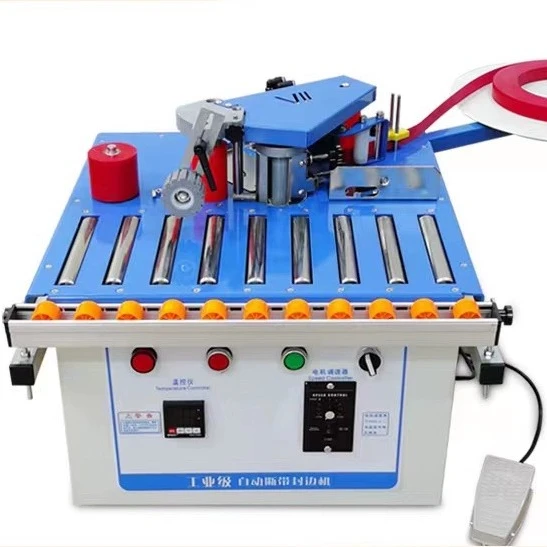
Precision Tolerance Verification — Every ZDSF50 leaving the floor is tested against actual MDF and plywood samples at your specified thickness before crating.
Technical Specifications
| Parameter |
Value |
| Model |
ZDSF50 |
| Product Type |
Mini Edge Banding Machine |
| Rated Power |
1.2 kW |
| Voltage |
220V (frequency 50/60 Hz to be confirmed per destination market) |
| Rated Air Pressure |
0.4–0.6 MPa |
| Edge Strip Thickness Range |
0.5–1.5 mm |
| Sheet Thickness Range |
10–60 mm |
| Glue Pot Capacity |
1000 ml |
| Heating Time |
5–10 min |
| Feed Speed |
0–6 m/min |
| Overall Dimensions |
54 × 54 × 56 cm |
| Net Weight |
26 kg |
| Glue Application Method |
Double-sided gluing via coated rollers |
| Glue Pot Heating |
4 heating tubes |
| Edge Strip Breaking |
Pneumatic device with foot switch; travel switch for straight edges |
| Pressure Rollers |
Adjustable, rubber material |
| Key Features |
Portable benchtop operation, double-side gluing, adjustable bayonet transport, pneumatic belt breaking |
Application Suitability
| Application |
Material or Output |
| Custom curved panel edge sealing |
MDF and plywood with PVC edge strips |
| Small-batch shaped board finishing |
Particleboard with melamine or veneer banding |
| On-site repair and touch-up banding |
Solid wood panels with thin veneer strips |
| Joinery workshop short-run production |
Plywood shelving and cabinet components |
| Prototype and sample edge finishing |
Mixed substrates with 0.5–1.5 mm strip material |
Why the Voltage Question Should Come Before the Price on Any Mini Edge Banding Machine
Confirm your local single-phase supply matches the machine winding before anything else moves forward.
I have watched entire container loads of small woodworking equipment sit idle on dock floors in West Africa and South Asia because the buyer assumed 220V meant the same thing everywhere. Frequency mismatches cause the heating tubes to run outside their designed thermal curve, and the glue pot never stabilizes at the temperature the PVC adhesive actually requires. A mini edge banding machine specifications sheet that omits frequency confirmation is incomplete, and the consequences only show up after the crate is opened and the first panel comes off the rollers with cold glue [NEED_CITE: voltage and frequency standards by export market].

Double-Sided Gluing and What It Means for Curved Work
Most portable banders in this class apply adhesive to the strip only, leaving the substrate side dependent on heat transfer through the strip itself. The ZDSF50 uses coated rollers to apply glue to both the edge strip and the panel edge simultaneously, which matters when you are working a curved profile where contact time is shorter and the glue must bond immediately on contact. The 1000 ml glue pot with four heating tubes reaches working temperature within minutes, so short production runs do not waste material waiting for thermal equilibrium.
Pneumatic Strip Breaking for Shaped Edges
Hand-tearing edge strip on a curved panel leaves uneven overhang that creates extra trimming work downstream. The foot-switch-controlled pneumatic breaker on this mini edge banding machine specifications package gives the operator hands-free control over strip cutoff, while the travel switch handles straight runs automatically. For a joinery shop alternating between curved chair components and straight shelving panels in the same shift, that dual-mode breaking reduces the operator attention required at the end of each pass.
How Sheet Thickness and Feed Speed Interact on a Benchtop Unit
The 10–60 mm sheet thickness range covers everything from thin shelving stock to thick workbench tops, but the practical feed speed depends on which end of that range you are working. At 10 mm MDF with a 0.5 mm PVC strip, the 0–6 m/min variable feed lets you move steadily without overwhelming the pressure rollers. At 60 mm solid wood with a 1.5 mm veneer strip, you will naturally slow the feed to allow the double-sided glue application to wet out fully before the rubber pressure rollers make contact [NEED_CITE: substrate thickness effect on adhesive open time in edge banding]. The adjustable bayonet transport adjusts to strip height, keeping the material aligned through the glue zone regardless of which combination you are running.
What Happens When You Skip the Air Pressure Check
A pneumatically controlled belt breaking device needs stable air supply to function. If the workshop compressor is undersized or the line has pressure drop from running multiple tools, the foot switch responds sluggishly and the strip tears instead of cutting cleanly. This shows up as ragged overhang on curved panels that must be hand-trimmed, defeating the purpose of having a machine in the first place. Buyers who focus only on electrical specs and overlook the 0.4–0.6 MPa air requirement often discover this mismatch on the first day of production [NEED_CITE: compressed air system sizing for pneumatic woodworking tools].
Why Procurement Through a Specification-Focused Channel Matters
Every ZDSF50 inquiry gets matched against an engineer-led configuration check that verifies your local voltage and frequency before a quotation is issued, not after the machine is built. The pre-shipment test uses your actual panel material and edge strip type, so you see a factory test record showing the glue temperature and feed speed that produced a clean bond on your substrate. Four-stage quality control covers incoming component inspection through final verification, and the portable format of this machine means benchtop placement and single-phase power connection can be confirmed from the specification sheet alone without a factory visit.
Documentation & Verification
- CE declaration of conformity covering portable woodworking edge banding equipment
- Machine specification sheet listing verified 220V rating and 1.2 kW power draw
- Electrical schematic confirming heating tube wiring for your destination frequency
- Factory test record on your panel thickness and edge strip material before dispatch
- Operation and maintenance manual supplied in your operator's working language
Installation, Commissioning & Support
- Benchtop placement requires a stable work surface supporting the 26 kg net weight and operating vibration
- Dedicated 220V single-phase circuit with appropriate breaker rating for the 1.2 kW draw
- Pneumatic connection to workshop compressor delivering stable 0.4–0.6 MPa at the machine inlet
- First-run glue temperature calibration using your specific PVC or veneer strip material
- Pressure roller adjustment walkthrough for the full 10–60 mm sheet thickness range
- Replacement heating tubes and rubber pressure rollers identified in the spare parts list
What to Include With Your Inquiry
Send us the exact panel material and thickness you run most often, along with the edge strip type and thickness. Tell us your local voltage and frequency so we confirm compatibility before quoting. If your workshop handles curved profiles, describe the typical radius so we can verify the pneumatic breaking setup matches your geometry.
Frequently Asked Questions
Q: How do I verify actual feed speed and glue temperature under working conditions?
A: Request the pre-shipment factory test record, which documents feed speed and glue pot temperature readings taken while running your specified panel material and edge strip combination. This gives you a verified baseline to compare against once the machine is installed in your workshop.
Q: Will the 220V rating work with my local single-phase power supply?
A: The ZDSF50 is wound for 220V single-phase operation, but frequency must be confirmed as 50 Hz or 60 Hz depending on your market. We verify this match during the quotation stage and document it in the electrical schematic provided before shipment.
Q: What edge strip materials work within the 0.5–1.5 mm thickness range?
A: PVC, ABS, melamine, and thin wood veneer strips within that thickness band are all compatible. The double-sided gluing system and adjustable bayonet transport accommodate different strip stiffness levels, though glue temperature settings vary by material type.
Q: When should I choose a portable mini edge bander over a full-automatic machine?
A: Portable units suit workshops handling curved profiles, short runs, or on-site work where a full-automatic line cannot be justified. If your daily volume consists entirely of straight panels at consistent thickness, an automatic feed-through machine is the more appropriate choice.