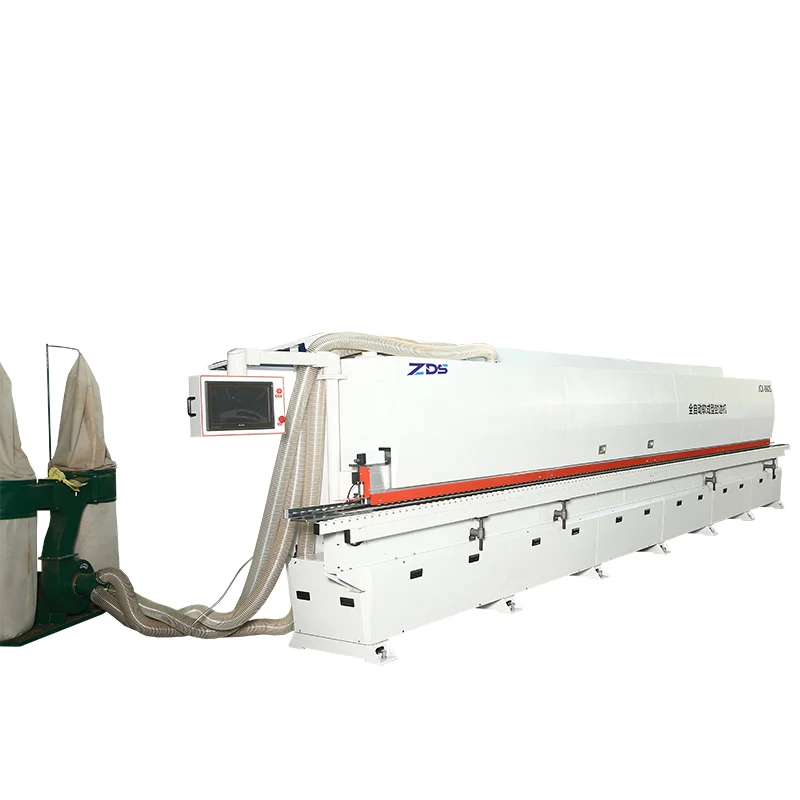
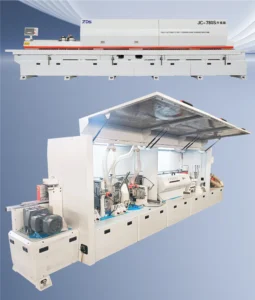
Verified Tolerance, Verified Power — every ZDSJCX-880S specification sheet ships with a factory test record run on the buyer's own panel stock, so ±0.02 mm is measured before the crate closes.
Technical Specifications
| Parameter |
Value |
| Model |
ZDSJCX-880S |
| Product Type |
Automatic Edge Banding Machine with Pre-Milling and Corner Trimming |
| Total Power |
47.1 kW |
| Voltage |
380V (frequency to be confirmed — 50 Hz or 60 Hz) |
| Overall Dimensions (L × W × H) |
8.82 × 1.07 × 1.85 m |
| Total Weight |
3200 kg |
| Panel Thickness Range |
18–22 mm |
| Edge Banding Thickness Range |
0.5–0.8 mm |
| Edge Banding Width |
58 mm |
| Minimum Sheet Width |
150 mm |
| Minimum Sheet Length |
300 mm |
| Feed Speed |
6–8 m/min |
| Air Supply Requirement |
0.6–0.8 MPa |
| Dust Extraction Port |
Ф100 × 6 |
| Machining Shape Capability |
15+ profile types — J, C, oblique straight, left/right semi-pass, water drop, rhombus, triangle |
| Pre-Milling Station |
Included |
| 45° Bevel Trimming |
Included |
| Corner Trimming Station |
Included |
| Control System |
To be confirmed — PLC or relay logic available |
| Warranty |
1 year |
| Certification |
CE, ISO 9001 |
Application Suitability
| Application |
Material or Output |
| Custom cabinet door edge banding |
MDF and particleboard with PVC or veneer strips |
| Drawer side and shelf panel finishing |
Plywood panels with 0.5–0.8 mm edge banding |
| Wardrobe and modular furniture production |
Solid wood panels with ABS or melamine edge |
| Small-batch bespoke furniture runs |
Mixed substrate batches requiring quick profile changes |
| Panel processing plant edge lines |
High-frequency MDF and particleboard throughput |
Why Voltage Confirmation Matters More Than Feed Speed
A machine that cannot start is a machine with zero feed speed.
I once watched a fully automatic edge bander sit idle for three weeks in a Southeast Asian furniture factory because the electrical spec on the quotation said 380V/50Hz while the local grid delivered 440V/60Hz. The contactor tripped on day one, and the variable frequency drive refused to initialise. That factory lost an entire production cycle before anyone thought to check the nameplate against the transformer. When evaluating Automatic Edge Banding Machine specifications, the voltage and frequency line should be the first row you read, not the last. [NEED_CITE: voltage and frequency standards by export market]
Mapping the ZDSJCX-880S Spec Sheet to Your Production Floor
The ZDSJCX-880S covers a panel thickness window of 18–22 mm, which aligns with standard cabinet-grade MDF and particleboard used across most custom furniture factories. If your typical stock sits at 18 mm, this machine accommodates your core volume without requiring spacer adjustments between every batch. The 150 mm minimum sheet width means narrow drawer-side panels and shelf dividers can pass through the feed chain without manual shimming, reducing operator intervention on mixed-batch runs.
What the 47.1 kW Power Draw Means for Your Workshop
A total connected load of 47.1 kW demands a dedicated circuit with adequate breaker capacity and cable cross-section. Before this machine arrives, your electrical contractor needs to confirm that the workshop distribution board can support this draw alongside existing CNC nesting routers and dust extraction fans. [NEED_CITE: CE machinery directive requirements for industrial equipment] Under-provisioning the supply circuit leads to voltage sag during pre-milling startup, which degrades edge adhesion quality on the very first panels through the machine each morning.
Reading the Specs That Actually Affect Edge Quality
The pre-milling station removes saw marks and minor chip-out left by the panel saw, creating a flat substrate surface before the glue roller applies adhesive. Without this step, visible telegraphing appears on light-coloured PVC edge banding, especially on particleboard with coarse core structure. The feed speed range of 6–8 m/min positions this machine for steady single-shift throughput, matching the output rhythm of a typical CNC nesting cell cutting 40–60 panels per cycle. The six Ф100 dust extraction ports must connect to a centralised collection system with sufficient static pressure; inadequate extraction allows adhesive dust to settle on the pressure rollers, causing intermittent bonding failures downstream. Corner trimming combined with 45° bevel trimming produces a finished edge profile that eliminates the hand-routing step entirely, which matters when panel volumes justify removing manual intervention from the workflow.

The Cost of Skipping the Specification Cross-Check
When a buyer sources an edge bander without confirming minimum sheet dimensions against their actual cut list, the machine arrives and immediately stalls on narrow panels that slip past the feed rollers. When air supply pressure is never verified against the 0.6–0.8 MPa requirement, the pneumatic trimming cylinders hesitate mid-stroke and leave ragged corners that require manual rework. These are not catastrophic failures — they are quiet, daily losses that accumulate across every shift. [NEED_CITE: common causes of edge banding quality inconsistency in panel furniture factories] The production manager discovers the mismatch weeks after installation, when throughput data reveals a bottleneck that no one budgeted for.
Why Technical Buyers Source This Model Here
Every ZDSJCX-880S leaves the factory with a voltage confirmation document matched to the buyer's declared grid specification, preventing the three-week idle scenario described above. The four-stage quality control process — incoming material, in-process, finished product, and pre-shipment verification — means the edge banding tolerance is measured on actual panel stock, not assumed from a calibration block. Engineers provide a formal configuration quotation within 24 hours that addresses feed height compatibility with the buyer's existing upstream and downstream equipment. Custom control panel language and voltage options from 110V to 440V are treated as standard configuration steps, not special requests. The patented cutting mechanism design holds the stated tolerance across the full 15+ profile range without requiring mid-run tooling adjustments.
Documentation & Verification
- Machine specification sheet with confirmed voltage and frequency for the destination country
- Electrical schematic showing main circuit breaker sizing for the 47.1 kW total load
- Factory test record demonstrating edge quality on buyer's specified panel thickness and material
- Operation and maintenance manual translated into the operator's agreed language
- Spare parts list covering trimming cutters, glue roller, and feed chain wear components
- Packing photographs and customs documentation support for the 3200 kg shipment
Installation, Commissioning & Support
- Foundation must support 3200 kg concentrated load across the 8.82 m machine length with level tolerance
- Dedicated 380V circuit with breaker rated for 47.1 kW inrush, confirmed before machine arrival
- Machine ships fully assembled; reconnection of dust extraction Ф100 ports and pneumatic lines on site
- First-run parameter setting for panel thickness 18–22 mm and edge banding width 58 mm by engineer guidance
- Operator training covers profile changeover across all 15+ machining shapes using the confirmed control interface
- Wear parts schedule for pre-milling cutters and corner trimming blades based on daily feed hours
What to Share with Your Inquiry
To receive an accurate configuration recommendation for this Automatic Edge Banding Machine, provide your standard panel material and thickness, your local voltage and frequency, and the control panel language your operators require. If your workshop runs upstream CNC nesting equipment, share the typical batch dimensions and cycle output so the feed speed can be matched accordingly. For buyers evaluating a complete edge line, note which trimming profiles your furniture designs require most frequently from the available 15+ shape range.
Frequently Asked Questions
Q: How can I verify the ±0.02 mm tolerance on my own panel stock before ordering?
A: Request a factory test run using your exact panel material and thickness shipped to the facility in advance. The test record documents measured edge gap and trimming deviation on your stock, not on a reference calibration board. This pre-shipment verification is part of the standard four-stage quality control process.
Q: What happens if my factory operates on 440V or 60Hz instead of 380V/50Hz?
A: Voltage and frequency are configurable from 110V to 440V, and the correct configuration is confirmed during the quotation stage. The electrical schematic and voltage confirmation document are issued before production begins, ensuring motor winding, transformer, and drive components match your local grid specification exactly.
Q: Which edge banding materials work within the 0.5–0.8 mm thickness range?
A: PVC, veneer, and ABS edge banding materials all fall within this thickness specification at standard widths up to 58 mm. The glue pot temperature and feed speed are adjusted during commissioning based on the specific adhesive type and banding material you confirm during the configuration proposal stage.
Q: How do the 15+ profile types translate to actual furniture edge designs?
A: Profiles such as J-type, C-type, water drop, and rhombus correspond to common cabinet door edge treatments, rounded shelf fronts, and decorative furniture edges. During the configuration stage, specify which profiles your product catalogue requires most frequently so the correct trimming tooling is installed and tested before shipment.