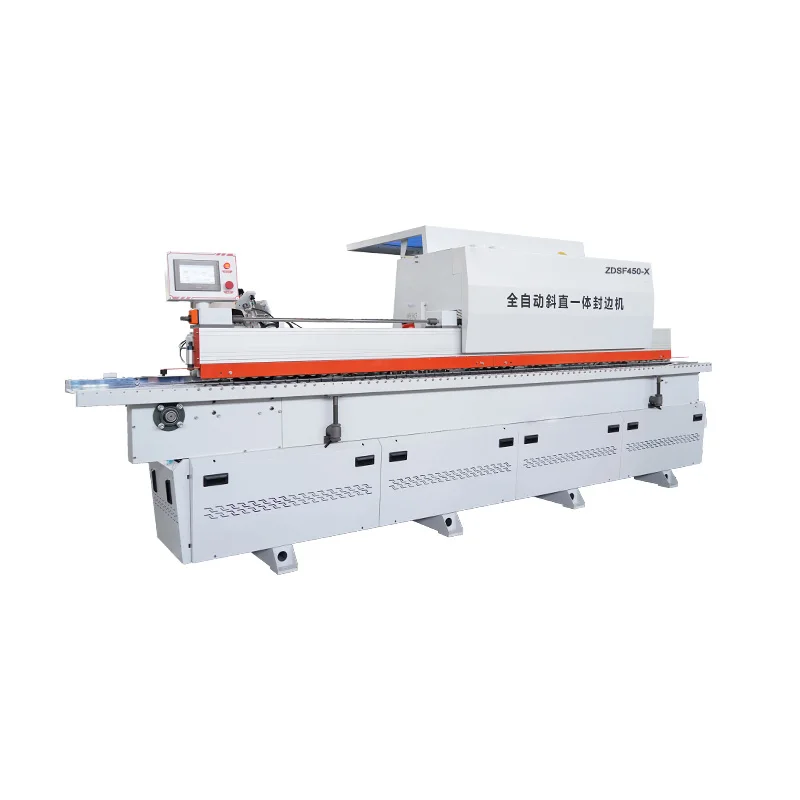
Verified Tolerance Mapping — every motor rating and feed parameter on this automatic bevel edge banding machine is listed line-by-line so you can cross-check against your panel cutting output before committing.
Technical Specifications
| Parameter |
Value |
| Product Type |
Automatic Edge Banding Machine |
| Overall Dimensions |
4350 × 920 × 1650 mm |
| Total Power |
17.5 kW |
| Voltage & Frequency |
380V / 3-phase 5-wire / 50Hz |
| Conveying Motor |
380V 2.2 kW with frequency converter |
| Feed Speed |
0–12 m/min variable, straight and bevel edge |
| Edge Strip Thickness |
Up to 1.2 mm depending on material |
| Edge Strip Width |
20–50 mm |
| Panel Thickness Range |
18 / 22 / 25 mm |
| Minimum Panel Width |
>100 mm |
| Minimum Panel Length |
>250 mm |
| Edge Banding Material |
PVC |
| Glue Pot Temperature |
150–170 °C |
| Glue Pot Capacity |
2000 mL |
| Glue Pot Heating Power |
1.2 kW |
| Heat Gun Power |
2 kW |
| Trimming Motor |
380V 0.75 kW × 2 |
| End Trimming Motor |
380V 0.37 kW × 2 |
| Edge Scraping Motor |
380V 0.18 kW with inverter |
| Buffing Motor |
380V 0.37 kW × 2 |
| Slotted Motor |
220V 0.8 kW |
| Milling Motor B |
380V 3.5 kW |
| Selection Motor |
380V 4 kW |
| Lifting Motor |
380V 0.25 kW with inverter |
| Air Source Pressure |
0.6–0.8 MPa |
| Air Storage Tank Volume |
5 L |
| Dust Extraction Port |
?100 mm |
| Touch Screen |
Xinjie industrial touch screen |
| Inverter |
Xinjie industrial inverter |
| Bevel Capability |
45 degree |
| Control System |
PLC with touch screen interface |
| Assembly State |
Fully assembled, KD packing for spare parts |
| Warranty |
1 year |
| Certification |
CE, ISO 9001 |
Application Suitability
| Application |
Material or Output |
| Custom cabinet door edge finishing |
MDF with PVC banding, straight and 45° bevel |
| Wardrobe panel edge processing |
Particleboard with PVC, standard thicknesses 18–25 mm |
| Furniture component banding |
Plywood panels for drawer sides and shelving |
| Bevel-edged decorative panels |
MDF routed at 45° for visible furniture edges |
Why the Voltage Question Comes Before the Price on Any Automatic Bevel Edge Banding Machine
A machine quoted without confirmed local voltage and frequency arrives as dead weight on your shop floor.
I watched a workshop in Foshan take delivery of an edge bander wired for 380V/50Hz, only to discover their facility ran on a 440V supply shared with heavy presses. The control board fried during the first heat-up cycle, and the factory waited weeks for a replacement PLC module. That failure had nothing to do with build quality and everything to do with skipping a five-minute voltage conversation. [NEED_CITE: voltage and frequency standards by export market]
When you are comparing automatic bevel edge banding machine specifications across suppliers, the electrical configuration should be the second thing you verify — right after whether the panel thickness range actually covers your production mix. A 4 kW selection motor and a 3.5 kW milling motor draw serious current; running them outside their design voltage degrades torque and shortens bearing life long before any visible fault appears.

Matching Feed Speed to Your Upstream CNC Output
The 0–12 m/min variable feed speed on this machine, regulated by a Xinjie inverter on the 2.2 kW conveying motor, is designed to let you dial the line rate to match what your CNC panel saw or beam saw is actually pushing out. Running the edge bander faster than upstream cutting creates bottlenecks at the loading station; running it slower wastes the trimming and buffing stations' capacity. For a typical custom furniture line cutting cabinet sides and shelves, most operators settle somewhere in the mid-range for straight edges and drop to the lower third for 45-degree bevel work where the trimming motors need more engagement time per linear meter.
Bevel Station Power Budget and What It Means for Edge Quality
The 45-degree bevel capability adds a layer of complexity that straight-only machines do not face. The 3.5 kW milling motor and the 4 kW selection motor together handle the angled cut profile, while the two 0.75 kW trimming motors clean up the PVC strip along the bevel face. If any one of these stations is underpowered relative to the feed speed you select, the result shows up as chatter marks on the bevel surface or incomplete trimming at the leading edge of the panel. This is where automatic bevel edge banding machine specifications diverge most sharply between entry-level and production-grade units.
How Panel Thickness Range and Glue Temperature Interact
The three fixed thickness settings — 18, 22, and 25 mm — cover the majority of MDF, particleboard, and plywood used in cabinet and furniture production. What matters just as much is the glue pot temperature window of 150–170 °C across its 2000 mL capacity. Thicker panels absorb more heat from the glue film before it sets, so running 25 mm particleboard at the lower end of that range risks incomplete bonding on the core-facing side of the PVC strip. [NEED_CITE: hot melt adhesive open time relative to substrate thermal mass] The 1.2 kW glue pot heater and 2 kW heat gun work in sequence to keep the adhesive at the right viscosity from the application roller through to the pressure zone, and that sequence only holds if your feed speed stays within the range where dwell time is sufficient.
The Hidden Cost of Specifying Edge Banders on Price Alone
I have seen custom furniture factories buy machines where the trimming motors were rated half of what the feed speed demanded, and the result was edge banding that looked acceptable on the first pass but peeled after a few weeks of humidity cycling. The buyer blamed the glue; the real problem was that the 0.37 kW end trimming motors could not keep up with the rated throughput on high-density particleboard. When you skip the spec comparison and choose on price, the failures do not appear on day one — they appear after the machine has been in production long enough for tool wear and thermal drift to compound. [NEED_CITE: common edge banding failure modes in panel furniture production]
Why Technical Buyers Source This Configuration Here
In-house manufacturing with patented cutting mechanisms means the tolerance you read in the specification table is traceable to the actual machining process, not borrowed from a trading company's brochure. The full product family — from entry-level straight-edge units to this 45-degree bevel model — lets a workshop scale its edge banding capability without qualifying a new supplier. Voltage and control language customization is treated as standard configuration, not a special order. Four-stage quality control with pre-shipment verification catches wiring and alignment issues before the crate leaves the factory. An engineer-led configuration review ensures the automatic bevel edge banding machine specifications you receive match your actual panel mix, local power supply, and upstream throughput before a formal quotation is issued within 24 hours.
Documentation & Verification
- Machine specification sheet confirming every motor rating and dimension listed above
- Electrical schematic with voltage and frequency locked to your facility supply
- Factory test record on your specified panel thickness and PVC material before dispatch
- Operation and maintenance manual translated into the language your operators read
- CE declaration of conformity covering the complete assembled unit
- Packing photographs showing crate condition and component placement prior to sealing
Installation, Commissioning & Support
- The 4350 × 920 mm footprint requires a level concrete floor with clearance on both long sides for panel loading and unloading
- A dedicated 380V 3-phase 5-wire circuit rated for the 17.5 kW total draw, separate from welding or compressor lines
- Machine ships fully assembled; only minor spare parts are KD-packed for transport protection
- First-run commissioning covers glue pot temperature calibration at 150–170 °C and inverter tuning across the 0–12 m/min range
- Operator training on the Xinjie touch screen covers parameter recall for each of the three panel thickness settings
- Dust extraction via the ?100 mm port must connect to a centralized collection system rated for continuous MDF and PVC particulate
What to Include in Your Inquiry
Send your panel material type and the exact thicknesses you run most often, along with the edge banding strip width and thickness you intend to use. Confirm your facility voltage, phase configuration, and frequency so the electrical system is built correctly before assembly begins. If your line includes upstream CNC equipment, share its typical output rate so the feed speed range can be matched to your actual throughput rather than a theoretical maximum.
Frequently Asked Questions
Q: How do I verify the 45-degree bevel tolerance on my specific panel material?
A: Request a factory test record where the machine processes your exact MDF or particleboard at 45 degrees. The test should document trimming finish and edge adhesion at the feed speed you plan to run. This gives you a measurable baseline before the machine ships rather than relying on general tolerance claims that may not apply to your substrate density.
Q: Can the voltage be configured for markets outside the 380V/50Hz standard?
A: Voltage customization from 110V to 440V is available as a standard configuration option. Confirm your local supply voltage and frequency at the inquiry stage so the motors, heaters, and PLC are matched correctly. This avoids costly rewiring or component replacement after the machine arrives at your facility.
Q: How should I match the 0–12 m/min feed speed to my CNC cutting output?
A: Calculate the linear meters of edging your upstream saw produces per hour and set the bander feed speed to match that rate with a small buffer. Running significantly faster than your cutting station creates idle time at the loader; running slower wastes the multi-station trimming capacity and reduces overall line throughput.
Q: What if my production uses panel thicknesses outside 18, 22, or 25 mm?
A: The three standard thickness settings cover most furniture and cabinet applications, but non-standard thicknesses require a configuration review. Share your exact panel dimensions during inquiry so the lifting motor and pressure roller settings can be evaluated for compatibility before quotation.
Q: How does the glue pot temperature range affect bonding on different substrates?
A: The 150–170 °C range suits PVC edge banding on MDF, particleboard, and plywood. Denser substrates like high-density particleboard absorb heat faster and typically need the upper end of the range to maintain proper adhesive open time. The 1.2 kW heater and 2 kW heat gun maintain this window across the full 2000 mL pot capacity.