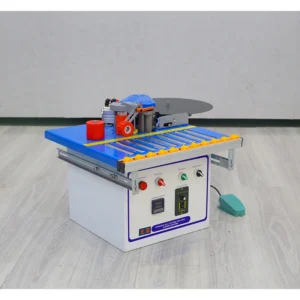
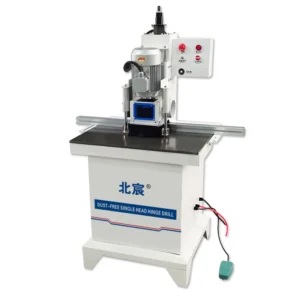
Verified Tolerance in Production — Patented cutting mechanisms hold ±0.02mm edge accuracy on the DW802, validated through four-stage QC before dispatch.
Technical Specifications
| Parameter |
Value |
| Model |
DW802 |
| Product Type |
Automatic Edge Banding Machine |
| Total Power |
4200W |
| Voltage & Frequency |
220V / 380V / Customization |
| Control System |
PLC |
| Standard Features |
Edge banding, trimming, polishing, automatic head and tail cutting, vacuum hold-down |
| Minimum Sheet Length |
25 cm |
| Minimum Sheet Width |
10 cm |
| Edge Banding Height Range |
0–50 mm |
| Edge Banding Thickness Range |
0.3–3 mm |
| Edge Feed Power |
140W |
| Transmission Power |
140W |
| Trimming Power |
800W × 2 |
| Polishing Power |
180W × 2 |
| Vacuum Power |
1200W |
| Air Source Pressure |
0.4–0.8 MPa |
| Glue Pot Capacity |
4000 ml |
| Overall Dimensions (L×W×H) |
130 × 60 × 95 cm |
| Net Weight |
135 kg |
| Language Options |
Chinese and English (customizable to Spanish, French, or other languages) |
| Assembly State |
Fully assembled |
Application Suitability
| Application |
Material or Output |
| Custom cabinet door edge sealing |
MDF and plywood panels with PVC or melamine edge banding |
| Wardrobe side panel finishing |
Particleboard with 0.3–3 mm veneer or PVC strips |
| Home decoration shelving |
Solid wood board and ecological board requiring trimming and polishing |
| Small batch joinery components |
Narrow panels down to 25 cm length and 10 cm width |
Why Voltage Confirmation Must Precede Your Automatic Edge Banding Machine Specifications Order
Machines wired for the wrong supply voltage sit idle on the workshop floor until an electrician rewinds the motor or replaces the transformer.
I once configured an edge bander for a buyer who later discovered their workshop ran on a different phase arrangement than stated in the initial inquiry. The machine arrived, the motor hummed but refused to start, and the commissioning delay cost the shop a full production week. With the DW802, the voltage question gets settled before the quotation is finalized, not after the crate is opened. Electrical mismatches remain one of the most common reasons imported woodworking equipment fails at startup [NEED_CITE: voltage and frequency standards by export market]. Confirming the exact supply characteristics early prevents this category of failure entirely.

Matching the DW802 to Your Workshop Throughput
The DW802 fits into small and mid-size workshops where operators are moving past hand-held edge banders but do not yet need a continuous-feed line. Its 130 cm footprint allows placement against a wall or between a panel saw and a boring station without reconfiguring the entire floor layout. The 4000 ml glue pot capacity supports extended runs without frequent refill stops, which matters when you are processing a batch of cabinet sides in sequence.
How the Integrated Trimming Stations Affect Edge Finish
This automatic edge banding machine specifications sheet lists two trimming motors at 800W each, followed by two polishing motors at 180W. The dual trimming stations handle both top and bottom edge overhang in a single pass, eliminating the secondary routing step that slows down manual workflows. Polishing then removes the micro-scratches left by trimming, producing a finished edge ready for assembly without additional hand work [NEED_CITE: edge finishing quality standards in furniture panel production].
Reading the Automatic Edge Banding Machine Specifications for Production Impact
The edge banding thickness range of 0.3–3 mm covers the three most common strip materials in custom furniture: thin melamine for cost-sensitive cabinet interiors, mid-range PVC for wardrobe doors, and thicker veneer for visible shelving edges. The 0–50 mm height range accommodates standard panel thicknesses from 16 mm particleboard up to thicker solid wood stock used in tabletops. The vacuum hold-down system at 1200W stabilizes lighter panels such as hollow-core MDF that tend to drift on gravity-feed machines, directly affecting edge straightness. Air source pressure between 0.4 and 0.8 MPa drives the pneumatic cutters for head-and-tail trimming; insufficient compressor capacity here causes incomplete cuts that require manual cleanup downstream.
What Happens When Specifications Are Ignored During Selection
Buying an edge bander without verifying panel dimension compatibility leads to situations where the machine physically cannot accept the sheets your saw produces. If the minimum sheet width on your edge bander exceeds the narrow offcuts from your nesting layout, those pieces must be edged by hand or scrapped entirely. Similarly, specifying a glue pot too small for your batch size means operators stop mid-run to refill, breaking the rhythm of a production sequence [NEED_CITE: production line bottlenecks in small furniture workshops]. These mismatches do not appear in the quotation stage but surface during the first week of actual operation.
Why Source the DW802 Through This Configuration Process
Every DW802 ships with its electrical schematic and voltage confirmation document reviewed before production begins, ensuring the motor and control panel match your local supply. The PLC control panel arrives configured in the language your operators actually read, preventing the commissioning stalls that occur when menus are in an unfamiliar script. Our four-stage QC process includes a pre-shipment test using panel material representative of your production, so tolerance verification happens at the factory rather than on your floor. Engineer-led configuration recommendations are delivered as a formal quotation within 24 hours of receiving your requirements, reducing the back-and-forth that delays equipment decisions.
Documentation & Verification
- CE declaration of conformity referencing the DW802 model and its electrical classification
- Electrical schematic confirming your specified voltage and phase arrangement before production
- Machine specification sheet with verified power ratings, dimensions, and pneumatic requirements
- Factory test record using panel thickness and edge material matching your production mix
- Operation and maintenance manual delivered in your selected language with illustrated diagrams
- Packing photographs documenting the machine condition and accessory completeness before crating
Installation, Commissioning & Support
- The 130 × 60 × 95 cm footprint requires a level concrete floor with clearance on the feed and exit sides
- A dedicated circuit matching the confirmed voltage must supply the 4200W total power draw
- The machine arrives fully assembled, requiring only pneumatic hose connection and power hookup
- First-run commissioning includes setting the 0.4–0.8 MPa air pressure and verifying the vacuum hold-down
- Operator training covers PLC menu navigation in the configured language and glue pot refill procedures
- Spare parts list identifies consumable trimmer blades and polishing wheels for local procurement planning
Preparing Your Inquiry for Accurate Configuration
Provide the specific panel materials you process — MDF, particleboard, plywood, or solid wood — along with the edge banding type and thickness range your products require. Confirm your workshop voltage, phase, and frequency so the electrical system is built to match. Let us know if upstream panel saws or downstream boring stations constrain the physical placement or feed direction of the DW802 in your layout.
Frequently Asked Questions
Q: How do I verify the DW802 voltage matches my workshop supply before placing an order?
A: The DW802 supports 220V, 380V, or custom voltage configurations. Before quotation, we request your exact supply voltage, phase arrangement, and frequency. An electrical schematic confirming these parameters is provided for your approval before production begins, ensuring the motor, PLC, and heating elements are wired correctly for your facility.
Q: Which edge banding materials and thicknesses can the DW802 process?
A: The machine handles edge banding strips from 0.3 mm to 3 mm thick, covering PVC, melamine, and wood veneer. The edge banding height range extends from 0 to 50 mm, accommodating standard furniture panel thicknesses. Specific material behavior varies, so we recommend a test run with your actual strip stock before finalizing production parameters.
Q: How is the control panel language set for my operators?
A: The PLC control system ships configured in Chinese or English as standard, with customization available for Spanish, French, or other languages. The language selection is confirmed during the specification stage so that menus, alarms, and parameter labels are readable by your team upon arrival, avoiding commissioning delays caused by untranslated interfaces.
Q: What minimum panel dimensions does the DW802 accept, and how does that affect nesting layouts?
A: The minimum sheet length is 25 cm and the minimum width is 10 cm. When planning nesting layouts on your panel saw, ensure that the smallest offcut intended for edge banding exceeds these dimensions. Panels below this threshold will need to be edged manually or processed on a dedicated small-part edge bander.
Q: How does the DW802 throughput align with upstream panel saws and downstream boring stations?
A: The DW802 is designed for small-to-medium batch processing rather than continuous high-volume lines. Its feed speed and trimming cycle suit workshops where a panel saw cuts batches that move through edging and then to boring or assembly. Matching throughput across stations depends on your specific batch sizes and panel complexity, which we review during the configuration recommendation stage.