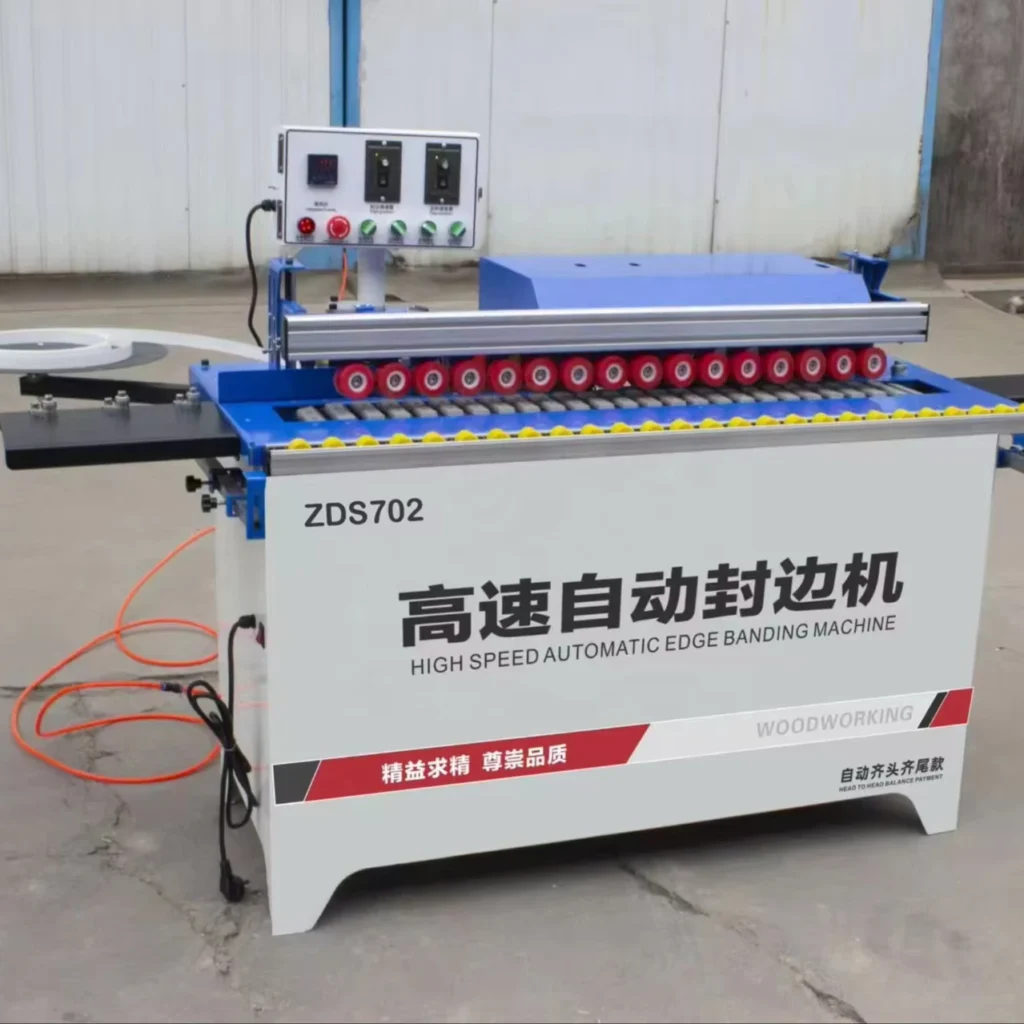
Voltage customization as standard — ensuring your local electrical supply matches the machine configuration before it leaves the factory, verified through schematic documentation and pre-shipment testing for each ZDS702 unit.
Technical Specifications
| Parameter |
Value |
| Model |
ZDS702 |
| Product Type |
Automatic Edge Banding Machine |
| Function |
Automatic plate feeding, end cutting, upper and lower polishing, head and tail trimming, built-in dust collector |
| Edge Type |
Straight line |
| Rated Voltage |
220V / 380V / customization available |
| Rated Power |
3.8 kW |
| Heating Power |
1000 W (warm-up 5–10 min) |
| Rated Air Pressure |
0.4–0.6 MPa |
| Feed Speed |
0–10 m/min |
| Panel Thickness Range |
5–50 mm |
| Edge Banding Thickness |
0.3–3 mm |
| Glue Pot Capacity |
1000 ml |
| Overall Dimensions |
120×55×120 cm |
| Machine Weight |
105 kg |
| Conveyor Belt |
Silicone material |
| Pressure System |
One-piece pressure beam, double rows of pressure wheels |
| Dust Extraction |
Integrated vacuum / dust collector |
| Warranty |
1 year |
Application Suitability
| Application |
Material or Output |
| Custom cabinet door and carcass production |
MDF and particleboard with 0.4–2 mm PVC edge banding |
| Small-batch plywood shelving and storage units |
Plywood panels with veneer or PVC straight-edge banding up to 3 mm |
| Workshop transition from manual to machine edge finishing |
Solid wood panels and board substrates within 5–50 mm thickness |
| Compact joinery operations with limited floor space |
Single-station gluing, trimming and polishing on furniture components |
What Feed Speed Ratings Leave Out About Your Actual Daily Output
The 0–10 m/min feed range only holds its stated tolerance when the substrate density, edge banding material and glue temperature are all matched to the workpiece — not quoted in isolation.
When I first started configuring edge banders for small cabinet shops, a common call came a few weeks after delivery: the machine runs fine, but the daily output is well below what the brochure suggested. The feed speed dial says 10 m/min, but high-density particleboard at 50 mm thickness demands a slower feed to let the trimming unit keep up without chipping the PVC edge. Buyers who selected a machine based on the top-end speed number alone ended up running at half that rate in practice. [NEED_CITE: relationship between substrate density and effective feed speed in edge banding operations]
Matching the Machine to Your Panel Range
The ZDS702 covers a panel thickness range from 5 mm to 50 mm, which spans most substrates a small custom furniture workshop handles — from thin MDF back panels to thick particleboard shelving stock. The key selection task is confirming where the bulk of your daily work falls within that range, because trimming accuracy and feed stability behave differently at the extremes.
Edge Banding Thickness and Material Compatibility
The 0.3–3 mm edge banding thickness window accommodates both thin PVC strips used on cabinet carcasses and thicker veneer or PVC profiles applied to visible furniture edges. Switching between these materials requires adjusting the glue pot temperature and pressure wheel contact, which the one-piece pressure beam and double-row pressure wheel arrangement supports without requiring separate tooling changes. Each material combination demands its own feed speed setting within the 0–10 m/min range to maintain edge finish quality. [NEED_CITE: PVC and veneer edge banding material behaviour at different glue temperatures]

How Trimming Height, Glue Capacity and Air Pressure Shape Output Quality
The 5–50 mm panel thickness range determines which boards the trimming unit can engage cleanly — boards outside this window will either pass without contact or jam the trimming heads. The 1000 ml glue pot capacity suits low-to-medium volume production where the machine cycles on and off throughout the day rather than running continuous shifts; a larger pot maintains thermal stability over longer uninterrupted runs. Rated air pressure of 0.4–0.6 MPa drives the pneumatic end cutting and trimming actions — pressure below this range causes incomplete cuts, while excessive pressure accelerates seal wear. The integrated dust collector reduces airborne particle accumulation around the conveyor and pressure wheels, which directly affects edge finish consistency over a production run.
When the Wrong Voltage Reaches Your Workshop
A machine configured for 380V three-phase arriving at a site with only 220V single-phase supply cannot be commissioned without external transformer equipment — a delay that stalls production and may void warranty terms if the operator attempts an unauthorised rewiring. The ZDS702 is available with voltage customization, but the exact configuration must be confirmed against the site electrical supply before the order enters production. Requesting the electrical schematic and voltage confirmation document early in the inquiry process prevents this scenario entirely. [NEED_CITE: industrial equipment voltage mismatch consequences in export markets]
What This Configuration Delivers at the Workshop Level
The ZDS702 carries Ruiqi's patented cutting mechanism design, which maintains trimming tolerance within the stated specification across the full 0.3–3 mm edge banding thickness range. Voltage customization from 220V to 380V is treated as a standard configuration step rather than a special request, so the machine arrives matched to the installation site. The four-stage quality control process includes a pre-shipment verification run using the voltage and panel thickness parameters specified in the order. Engineer-led configuration review happens before the formal quotation, ensuring the selected model variant aligns with the buyer's actual substrate and throughput requirements rather than a generic catalogue recommendation. Sample processing tests using the buyer's own panel material and edge banding stock are available before order commitment, providing a verifiable benchmark for edge finish quality.
Documentation & Verification
- Machine specification sheet listing confirmed ZDS702 variant parameters and dimensions
- Electrical schematic matched to your site voltage and frequency before production begins
- Factory test record documenting edge finish results on your specified panel thickness
- Operation and maintenance manual produced in the operator's working language
- Spare parts list identifying consumables and wear items with reorder references
Installation, Commissioning & Support
- Requires a dedicated circuit matching the confirmed 220V or 380V supply with appropriate breaker rating for the 3.8 kW total load
- Machine footprint of 120×55 cm needs level floor placement with clearance on the feed and discharge sides
- Arrives assembled; connect power supply, compressed air line at 0.4–0.6 MPa and dust extraction ducting before first run
- Initial commissioning includes setting glue pot temperature, feed speed and trimming head alignment for your panel material
- Silicone conveyor belt and double-row pressure wheels require periodic cleaning to maintain scratch-free panel transport
- Integrated dust collector filter maintenance scheduled according to production hours and substrate dust generation rate
What to Include in Your First Inquiry
Send the specific panel substrates you process most often — MDF, particleboard, plywood or solid wood — along with their typical thickness range and the edge banding material and thickness you use. Include your workshop's available voltage and phase configuration so the electrical setup is confirmed before quoting. If you have upstream cutting or downstream boring equipment already in place, note the feed heights and throughput expectations so the ZDS702 configuration fits within your existing workflow without bottlenecks.
Frequently Asked Questions
Q: How do I decide between the ZDS702 and the 802 variant for my workshop?
A: The choice depends on your daily panel volume and the edge banding materials you run. The ZDS702 carries a 1000 ml glue pot suited to intermittent production, while the 802 variant offers a larger 4000 ml pot for sustained runs. The 802 also carries a higher rated power of 4 kW and different overall dimensions. Review your typical daily panel count and shift pattern to determine which variant aligns with your output rhythm.
Q: What happens if the voltage configuration does not match my site supply?
A: A machine built for 380V will not operate on a 220V supply without external transformer equipment, and attempting to rewire it without authorisation may void the warranty. Voltage and frequency must be confirmed during the inquiry stage before the order enters production. The factory provides an electrical schematic and voltage confirmation document so both parties verify compatibility before the machine is built.
Q: Which substrates and edge banding materials work reliably within the stated specifications?
A: The ZDS702 handles MDF, particleboard, plywood and solid wood panels between 5 mm and 50 mm thick, with PVC and veneer edge banding from 0.3 mm to 3 mm. High-density substrates may require reduced feed speed within the 0–10 m/min range to maintain trimming accuracy. A sample processing test using your own material stock confirms the achievable edge finish before order commitment.
Q: How can I verify feed speed and edge trimming accuracy before accepting delivery?
A: Request a factory test run using your panel material and edge banding stock at the feed speed you plan to use in production. The pre-shipment verification covers trimming tolerance and edge finish quality under those specific conditions. The factory test record documenting these results ships with the machine as part of the standard documentation package.
Q: Are spare parts and control panel language options available for markets outside China?
A: A spare parts list identifying consumables and wear items ships with every ZDS702 unit. The operation and maintenance manual is produced in the language agreed during the order process. Control panel language options should be confirmed during the inquiry stage so the interface matches the operator's working language upon delivery.