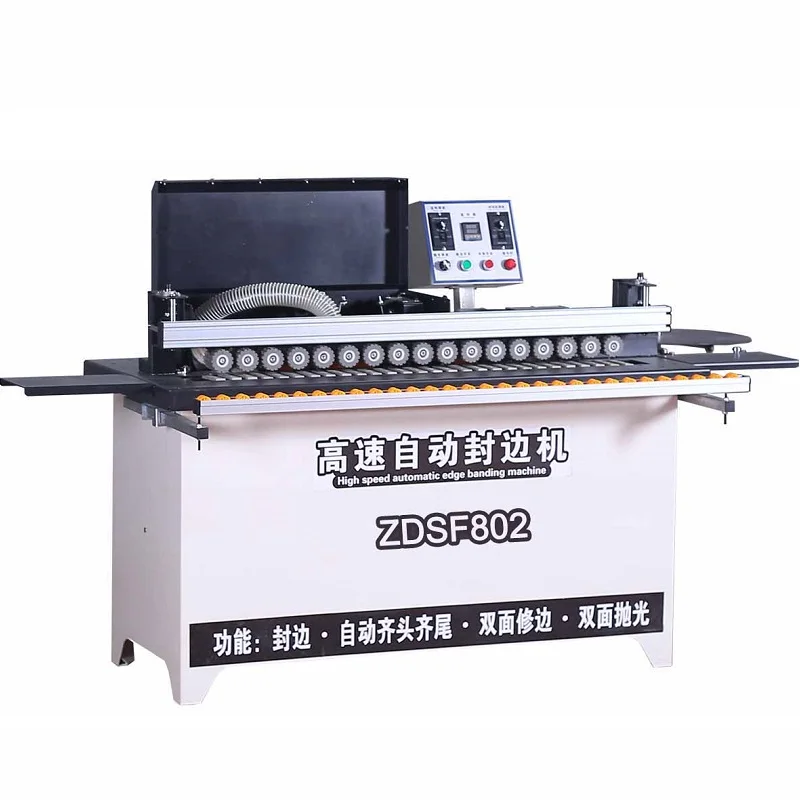
Specification-First Approach — every ZDSF802 parameter, from 0–10 m/min feed speed to 4000 ml glue pot, is documented so you can validate fit against your line before sending an inquiry.
Technical Specifications
| Parameter |
Value |
| Model |
ZDSF802 |
| Product Type |
Automatic Edge Banding Machine |
| Function Sequence |
Plate feeding, end cutting, trimming, polishing, dust extraction |
| Edge Type |
Straight line |
| Rated Voltage |
220V |
| Rated Power |
4 kW |
| Trimming Power |
800 W × 2 |
| Polishing Power |
180 W × 2 |
| Heating Power |
1000 W (5–10 min heat-up) |
| Suction Power |
1200 W (integrated vacuum) |
| Feed Speed |
0–10 m/min |
| Conveyor Belt Speed |
0–10 m/min |
| Strip Thickness Range |
0.5–2.5 mm |
| Sheet Thickness Range |
10–50 mm |
| Glue Pot Capacity |
4000 ml |
| Glue Application |
Double-sided gluing |
| Rated Air Pressure |
0.4–0.6 MPa |
| Pressure System |
Integrated pressure beam, double-row pressure rollers |
| Conveyor Belt Material |
Silicone |
| Control System |
Digital display with independent switches |
| Overall Dimensions |
130 × 65 × 75 cm |
| Machine Weight |
150 kg |
Application Suitability
| Application |
Material or Output |
| Cabinet door edge finishing |
MDF and particleboard with PVC edge banding |
| Custom furniture panel processing |
Plywood panels up to 50 mm thickness |
| Small workshop production runs |
Straight-line PVC and veneer strips 0.5–2.5 mm |
| Shelving and carcass components |
Particleboard and MDF with double-sided glue application |
Why "Automatic Edge Banding Machine Specifications" Matter Before You Commit
A spec sheet is only useful when every number can be traced to a verifiable test condition.
I once configured an edge bander for a customer who insisted his particleboard was standard density. The machine arrived, and the glue line on every single cabinet door was visible — a full batch reworked because the density was higher than stated. That experience is why I now treat automatic edge banding machine specifications as the starting conversation, not the final word. Feed speed, glue pot volume, and trimming power only mean something when matched to your actual panel substrate and strip material [NEED_CITE: panel density variation and its effect on adhesive bonding in edge banding]. When the numbers on paper meet the material on your shop floor, the difference between a clean edge and a rejected batch becomes clear.

Mapping Feed Speed to Your Upstream Panel Saw
The ZDSF802 runs at 0–10 m/min, which gives you flexibility when matching throughput with a sliding table saw or panel sizing station upstream. A slower feed speed allows the double-sided glue application to penetrate denser substrates like high-density particleboard, while the upper range suits MDF or plywood panels where the adhesive bonds readily. If your panel saw cuts a batch every few minutes, this feed range keeps the edge bander from becoming a bottleneck. The variable speed also lets operators slow down for thicker strips approaching the 2.5 mm upper limit, where consistent pressure through the double-row rollers matters more than raw throughput.
Glue Pot Volume and Continuous Run Behavior
A 4000 ml glue pot means fewer interruptions during a long production run. On smaller machines, operators stop to refill frequently, and each stop introduces temperature fluctuation that affects glue viscosity. The 1000 W heating element on this unit brings the pot to working temperature within 5–10 minutes, and the larger volume holds that temperature more steadily across consecutive panels [NEED_CITE: thermal stability of hot-melt adhesive pots in continuous edge banding operations]. For a workshop running cabinet carcasses in batches, this reduces the chance of cold glue spots that only show up when the customer installs the doors.
How Panel Thickness and Trimming Stations Define Edge Quality
The 10–50 mm sheet thickness range covers everything from thin shelving to thick worktops. What matters here is how the trimming and polishing stations handle that range. The ZDSF802 carries two 800 W trimming motors — upper and lower — followed by two 180 W polishing motors. On a 50 mm panel with a 2 mm PVC strip, the trimming motors must remove excess material cleanly without chipping the substrate edge. The integrated pressure beam and double-row pressure rollers keep the strip seated against the panel face during this sequence. If you are processing mixed thicknesses in a single shift, the digital display with independent switches lets the operator adjust station engagement without rewiring or mechanical recalibration. The 1200 W built-in vacuum captures trimming dust at the source, keeping the polishing motors free from debris that would otherwise score the finished edge.
The Cost of Skipping Specification Verification
When a buyer selects an edge bander based on a single advertised number — usually feed speed — without checking panel thickness range or glue application method, the mismatch surfaces during the first real production run. Panels that exceed the stated thickness range jam the pressure beam. Strips thicker than the trimming stations can handle leave proud edges that require manual scraping, turning an automatic process back into a manual one. Voltage incompatibility is another frequent oversight: a machine wired for a different frequency arrives at the dock and will not start without a costly transformer or rewinding [NEED_CITE: voltage and frequency mismatches in imported woodworking machinery]. These are not theoretical problems — they show up on the shop floor within the first week.
Why Source This Machine Through a Specification-Driven Process
In-house manufacturing with patented cutting mechanisms means tolerance claims on the ZDSF802 can be verified at the factory before shipment, not guessed from a brochure. The full product family — from entry-level to full-function models — lets a workshop scale production volume without switching suppliers mid-line. Voltage and control panel language are configurable at the order stage, so the machine arrives ready for the local grid and the operator who will run it. A four-stage QC process covers incoming material inspection through pre-shipment verification, catching tolerance drift before the crate is sealed. An engineer reviews your panel samples and production requirements before issuing a formal quotation, typically within one working day.
Documentation & Verification
- Machine specification sheet with confirmed ZDSF802 voltage and frequency for your grid
- Electrical schematic showing wiring configuration and independent switch layout
- Factory test record run on your submitted panel samples at agreed feed speed
- Operation and maintenance manual in the language your operators read
- Spare parts list identifying trimming cutters, polishing pads, and conveyor belt sections
- Packing photographs documenting machine condition before crate closure
Installation, Commissioning & Support
- 130 × 65 × 75 cm footprint requires a level floor with clearance for panel infeed and outfeed
- 220V single-phase supply on a dedicated circuit rated for the 4 kW total draw
- Machine ships assembled; operator connects air supply at 0.4–0.6 MPa before first run
- Initial commissioning includes heat-up cycle verification and feed speed calibration on your panels
- Trimming and polishing motor alignment checked against your specific strip thickness range
- Silicone conveyor belt inspection and replacement interval documented in the maintenance manual
What to Include in Your Inquiry
Send your panel material type, typical sheet thickness, and the strip material and thickness you run most often. Include your workshop voltage and frequency so the electrical configuration is confirmed before production begins. If you have upstream panel saws or downstream assembly stations, note their cycle times so the feed speed can be matched to your line rather than operated in isolation.
Frequently Asked Questions
Q: How can I verify actual feed speed and trimming tolerance before placing an order?
A: Submit representative panel samples and your preferred edge banding strip. The factory runs a processing test on the ZDSF802 at your specified feed speed, documents the trimming result with photographs and measurements, and ships the finished samples back. You evaluate edge quality and glue line visibility on your own material before committing to the purchase.
Q: What voltage and frequency options are available for different markets?
A: The ZDSF802 is configurable across common industrial voltage ranges at the order stage. You confirm your local supply voltage and frequency during the quotation process, and the electrical schematic reflects that configuration. The machine ships with the correct motor winding and heating element specification already installed.
Q: How do I match this edge bander throughput with my existing panel saw?
A: Note the cutting cycle time of your panel saw and the number of edges per panel that require banding. The 0–10 m/min variable feed speed on the ZDSF802 allows you to set a pace that keeps panels flowing without queuing at the infeed or starving the assembly station downstream.
Q: Which panel materials and strip types work within the stated thickness ranges?
A: The 10–50 mm sheet range and 0.5–2.5 mm strip range cover MDF, particleboard, and plywood with PVC or veneer edge banding. Higher-density substrates may require slower feed speeds and longer glue open time. A sample test on your specific material confirms compatibility before order.
Q: Can the control panel be supplied in my operator's language?
A: The digital display and independent switch labels can be specified in your preferred language at the quotation stage. This is confirmed alongside the voltage configuration so the machine arrives with readable controls, reducing commissioning delays and operator errors during the first production runs.