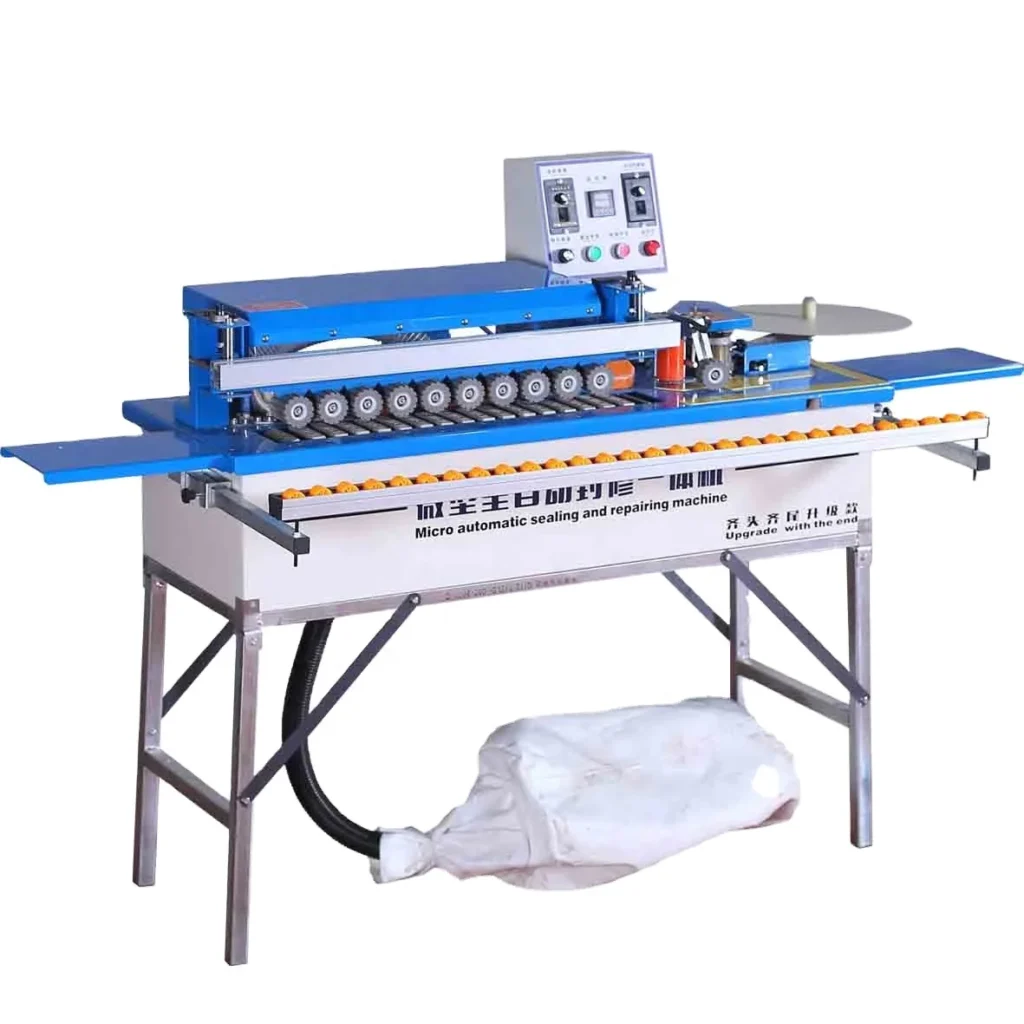
Compact Footprint — this miniature straight-and-curve bander fits a 120 cm floor length while still carrying independent trimming and polishing stations, so a small workshop can evaluate every automatic edge banding machine specification against its actual panel stock before committing.
Technical Specifications
| Parameter |
Value |
| Product Type |
Automatic Edge Banding Machine (Straight and Curve, Miniature) |
| Voltage |
220V (configurable from 110V to 440V) |
| Suction Power |
1200W |
| Belt Power |
25W |
| Transmission Power |
60W |
| Polishing Power |
180W × 2 |
| Trimming Power |
800W × 2 |
| Conveying Speed |
0–15 m/min |
| Edging Speed |
0–6 m/min |
| Edge Height Range |
10–60 mm |
| Edge Thickness Range |
0.3–3 mm |
| Overall Dimensions (L×W×H) |
120×54×72 cm |
| Control Panel |
Individual function controls with separate switches |
| Gluing Method |
Double-sided adhesive application |
| Gluing Device Rotation |
180° for curved edge banding |
| Trimming Stations |
Up and down trimming with dust suction |
| Polishing Stations |
Up and down cross polishing |
| Feed Mechanism |
Double-row rubber pressure wheels |
Application Suitability
| Application |
Material or Output |
| Small-scale custom furniture edge banding |
MDF and particleboard panels with PVC edging |
| Cabinet door and drawer front finishing |
Plywood substrates with veneer or melamine banding |
| Joinery workshop semi-automatic production |
Straight and curved panel profiles up to 60 mm height |
| Low-volume bespoke furniture runs |
Mixed board stock requiring quick changeover between straight and curve modes |
Why the Voltage Question Must Come Before the Quotation
A machine wired for the wrong supply is dead weight on your shop floor the day it arrives.
Every automatic edge banding machine specification sheet starts with power ratings, yet the voltage and frequency confirmation often gets buried beneath feed speed and trimming details. I have seen compact banders shipped to workshops running 110V single-phase, only to sit idle for weeks while a step-up transformer was sourced locally. The 220V baseline on this unit is configurable across the 110V to 440V range, but that configuration must be locked before production begins — not discovered during unpacking [NEED_CITE: voltage and frequency standards by export market]. Matching the control panel language to the operator at this same stage prevents commissioning stalls that no amount of on-site troubleshooting can quickly resolve.

Mapping Feed Speed to Your Actual Panel Mix
The automatic edge banding machine specifications list two distinct speed ranges: conveying at 0–15 m/min for straight runs and edging at 0–6 m/min when the gluing device rotates to follow a curved profile. That gap is not a limitation — it reflects the physical reality that adhesive contact time on a radius must be longer to achieve the same bond integrity as a straight edge. When you calculate daily throughput, the curve speed governs any job involving shaped cabinet doors or rounded shelving, and planning around the lower figure prevents missed delivery dates.
Reading the Trimming and Polishing Station Layout
Two 800W trimming motors handle up and down cuts in a single pass, while the integrated dust suction port captures offcut material at the point of generation. Downstream, the paired 180W cross-polishing wheels finish the edge flush to the panel face. For a workshop processing both PVC and thin veneer, this station sequence means you evaluate cut finish and surface quality together rather than discovering a polishing defect after the trimming tolerance has already been locked in [NEED_CITE: CE machinery directive requirements for edge banding equipment].
How Board Thickness and Edge Height Govern Your Setup
The 10–60 mm edge height window and 0.3–3 mm edge thickness range define which banding stock this machine can run without mechanical adjustment. Thicker PVC at the 3 mm end demands full trimming motor engagement and slower feed to prevent tear-out, while 0.3 mm veneer requires reduced pressure wheel force to avoid crushing the material against the double-row rubber feed mechanism. Understanding these boundaries before purchase means your operator spends time producing panels rather than reconfiguring the machine between jobs.
The Hidden Cost of Ignoring Substrate Compatibility
I once watched a customer specify a compact bander based entirely on its straight-line feed speed, only to discover that the high-density particleboard he actually ran caused glue penetration issues the machine was never tested against. Output dropped to roughly half the expected volume, and visible glue lines appeared on curved sections where the 180° rotation could not compensate for poor adhesive bonding. Requesting a sample panel test before the order is confirmed costs a few days but prevents weeks of production loss and disputed warranty claims [NEED_CITE: substrate and adhesive compatibility in edge banding operations].
What This Purchase Path Actually Delivers
The four-stage quality control process covers incoming material inspection through pre-shipment verification, so the machine you receive matches the specification sheet you signed off on. Voltage, control panel language, and plug configuration are confirmed as line items before production starts, not left as assumptions. The in-house manufacturing setup means trimming motors and polishing wheels are sourced and assembled under one roof, reducing the finger-pointing that happens when components come from disconnected suppliers. A factory test record using your actual panel sample ships with the documentation package. Engineer-led configuration support means the quotation you receive within 24 hours reflects your workshop's real board mix and daily volume, not a generic catalogue entry.
Documentation & Verification
- CE declaration of conformity covering the full machine assembly
- Machine specification sheet confirming voltage and frequency for your supply
- Factory test record run on your panel thickness and edge material
- Electrical schematic matching your workshop circuit and plug type
- Operation and maintenance manual in your operator's agreed language
Installation, Commissioning & Support
- 120×54×72 cm footprint requires a level floor section with clearance for panel infeed and outfeed
- Dedicated 220V circuit rated for the combined 1200W suction and dual 800W trimming motor draw
- Machine arrives fully assembled; operator connects dust extraction hose and verifies rotation direction
- First-run parameter setting covers feed speed, pressure wheel tension, and trimming depth on your sample stock
- Spare parts list identifies trimming blades and polishing wheels as primary consumables with replacement intervals
What to Include in Your Inquiry
Send your actual panel material type, board thickness range, and the PVC or veneer edge banding stock you plan to run so the configuration matches your production cell. Confirm your workshop voltage, frequency, and plug standard to avoid a transformer workaround on arrival. If you are processing curved profiles, include the minimum radius and the daily volume split between straight and curved jobs so the throughput estimate reflects reality.
Frequently Asked Questions
Q: How do I verify the trimming tolerance on my specific panel material?
A: Request a factory test record where the machine processes your exact board sample and edge banding stock. The record documents the achieved edge finish and dimensional result, letting you confirm compatibility before the order enters production rather than discovering issues after delivery.
Q: Can this machine be wired for 110V or 380V instead of the standard 220V?
A: Yes, the voltage is configurable across the 110V to 440V range. Specify your local supply voltage and frequency during the quotation stage so the motor windings, control transformer, and plug are configured correctly before the machine leaves the factory.
Q: How does the curved edging speed affect my daily output planning?
A: The 0–6 m/min curved edging speed is lower than the straight conveying speed because the gluing device rotates 180° to follow the profile. Plan your daily throughput around the curve speed for any job involving shaped panels to avoid scheduling shortfalls.
Q: What panel and edge combinations work without reconfiguration?
A: The machine handles edge heights from 10 to 60 mm and edge thicknesses from 0.3 to 3 mm. Within that envelope, switching between PVC and veneer banding requires only feed speed and pressure adjustment, not mechanical station changes.
Q: What happens if a trimming or polishing motor faults after installation?
A: The spare parts list identifies the 800W trimming and 180W polishing motors as serviceable units. The operation manual includes removal and replacement procedures, and the electrical schematic provides wiring detail so a local technician can perform the swap without returning the machine.