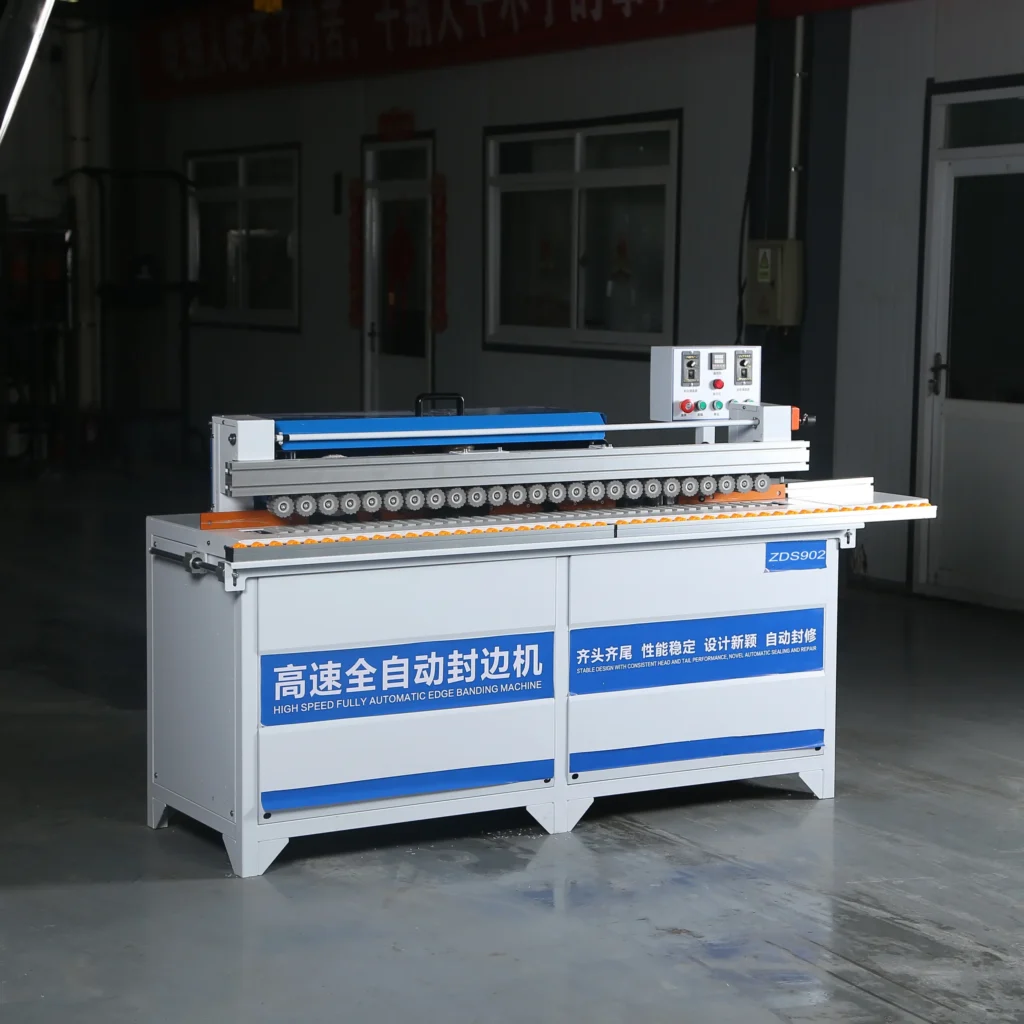
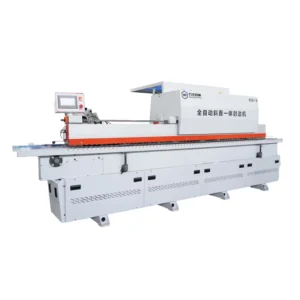
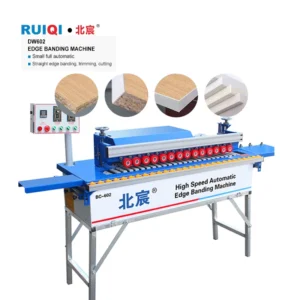
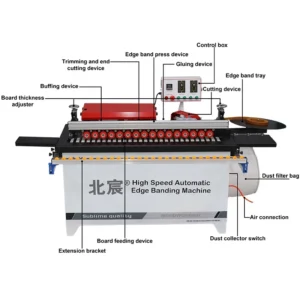
Verified Tolerance and Patented Mechanisms — this high-speed fully automatic edge banding machine delivers ±0.02mm precision-ground trimming results backed by factory test records on your actual panel material before shipment.
Technical Specifications
| Parameter |
Value |
| Product Type |
Automatic Edge Banding Machine |
| Voltage |
220V |
| Total Power |
4200W |
| Overall Dimensions (L×W×H) |
207 × 60 × 122 cm |
| Net Weight |
245 kg |
| Edge Banding Type |
Linear Edge Banding Machine |
| Edge Band Height Range |
0–35 mm |
| Edge Band Thickness Range |
0.5–2.5 mm |
| Glue Pot Capacity |
4000 ml |
| Pressure Beam |
Integrated with adjustable handle |
| Conveyor Belt |
Silicone material, double rows of pressure wheels |
| Edge Strip Cutting |
Pneumatically controlled |
| Trimming Configuration |
Double high-speed trimming motors, up and down |
| Polishing Configuration |
Two polishing motors, up and down |
| Temperature Control |
Intelligent temperature control |
| Feed Speed |
(basis to be confirmed) |
| Panel Thickness Range |
(basis to be confirmed) |
| Warranty |
One year |
Application Suitability
| Application |
Material or Output |
| Custom furniture panel edge banding |
MDF, particleboard with PVC edge banding |
| Cabinet door and carcass production |
Plywood and melamine-faced boards with veneer banding |
| Joinery workshop scaling from manual to machine |
Solid wood panels with thin PVC or veneer strips |
| Small-batch bespoke furniture runs |
Mixed panel materials requiring quick changeover |
Why Automatic Edge Banding Machine Specifications Matter More Than the Brochure Photo
The numbers on the spec sheet either match your production floor or they do not — and tolerance is the first thing to verify.
I have seen workshops purchase machines based entirely on polished photographs and a single feed-speed figure, only to discover during assembly that panel edges drift beyond acceptable limits. The edge band lifts slightly on particleboard substrates, or the trimming motors leave a visible step on veneer. When a cabinet maker tries to fit a door into its carcass and the gap is uneven, the root cause almost always traces back to a machine whose actual tolerance was never tested on the buyer's own material [NEED_CITE: woodworking assembly tolerance standards for panel furniture]. This is why reading Automatic Edge Banding Machine specifications with a critical eye is the single most valuable step before placing an order.

Mapping Edge Band Thickness to Your Panel Mix
A 0.5–2.5 mm edge band thickness range covers the majority of PVC and veneer materials used in custom furniture production. Thinner veneer strips demand precise glue application and lower trimming pressure, while 2.5 mm PVC requires the double high-speed trimming motors to remove excess material cleanly in a single pass. Matching the banding material to the machine's trimming station configuration avoids secondary hand-finishing that slows down the line.
Glue Pot Capacity and Continuous Run Planning
The 4000 ml glue pot capacity determines how long the machine runs between refills during a production shift. For a small workshop processing a few dozen panels per day, this volume provides comfortable margin. A higher-volume cabinet factory running full shifts should calculate refill intervals against their daily panel count to avoid mid-run stoppages that interrupt glue temperature stability. Intelligent temperature control helps maintain consistent viscosity, but frequent cold refills still introduce variation [NEED_CITE: hot-melt adhesive temperature stability in edge banding applications].
Reading the Trimming and Polishing Station Layout
The double high-speed trimming motors working up and down remove overhanging edge banding from both faces simultaneously, which is the configuration that produces flush edges on standard panel thicknesses. The two polishing motors that follow smooth the trimmed edge to a finish suitable for visible surfaces such as cabinet doors and shelf fronts. When processing veneer banding, polishing pressure must be lighter to avoid burning through the thin material, making the independent operating platform a practical feature for separating trimming and polishing adjustments. Pneumatically controlled edge strip cutting ensures the strip is severed cleanly at panel length without dragging or chipping the leading edge.
The Cost of Ignoring Voltage and Infrastructure Compatibility
A machine rated at 220V and 4200W total power draws significant current, and workshops operating on aging single-phase supplies may experience voltage drops under load. When the glue pot heater and trimming motors run simultaneously, an undersized circuit breaker trips repeatedly, halting production. I have visited factories where the machine sat idle for weeks because the local supply frequency did not match what the motor windings required, and rewinding was neither quick nor inexpensive [NEED_CITE: electrical supply frequency compatibility for imported industrial motors]. Confirming voltage, phase, and frequency before the machine ships prevents this entirely avoidable delay.
Why Sourcing This Machine Here Makes Sense
In-house manufacturing with patented cutting mechanisms means the tolerance claimed on the specification sheet is produced on the same factory floor, not outsourced and relabeled. The four-stage quality control process — incoming material, in-process, finished product, and pre-shipment verification — catches deviation before the crate is sealed. Voltage and language customization come as standard options rather than expensive afterthoughts, so a 220V machine with a control panel in the operator's language ships directly from the line. Every unit can be tested on the buyer's own panel material and edge banding stock before dispatch, providing a factory test record that verifies trimming and polishing results on the exact substrate that will run in production. Engineer-led configuration recommendations arrive as a formal quotation within 24 hours, mapping each specification to the buyer's stated throughput and panel mix.
Documentation & Verification
- CE declaration of conformity covering the complete machine assembly
- Machine specification sheet with verified tolerance and trimming test values
- Electrical schematic confirming 220V wiring and 4200W load distribution
- Factory test record showing edge finish on your specified panel and banding material
- Operation and maintenance manual in the agreed language with spare parts list
- Packing photographs and customs documentation support for export clearance
Installation, Commissioning & Support
- Allocate floor space for the 207 × 60 × 122 cm footprint with rear access for dust extraction hookup
- Provide a dedicated 220V circuit rated above the 4200W total power draw to prevent voltage sag
- Some components ship KD packed; follow the included video teaching for reassembly sequence
- First-run commissioning includes setting intelligent temperature control to match your glue type
- Adjust the integrated pressure beam handle to match the thickest panel in your production mix
- Keep trimming blades and polishing wheels from the spare parts list on hand for scheduled replacement
Before You Request a Quote
To recommend the correct configuration, share the panel materials and thicknesses you process most frequently, the edge banding type and thickness you plan to run, and your workshop's confirmed voltage and frequency. If you are integrating this machine into an existing line, note the upstream and downstream equipment so feed height and throughput can be matched. Sample processing tests on your own material are available before order confirmation.
Frequently Asked Questions
Q: How can I verify the edge banding tolerance before committing to an order?
A: Request a factory test record produced on your exact panel material, thickness, and edge banding stock. The record documents trimming and polishing results with measured deviation values. A pre-shipment test run witnessed via video call or in-person visit provides additional confirmation that the machine holds tolerance under continuous operation.
Q: What happens if my workshop voltage does not match the 220V rating?
A: Voltage mismatch causes motor overheating, inconsistent glue temperature, and potential control system failure. Confirm your local supply voltage and frequency before ordering. The machine is available with voltage customization from 110V to 440V, and the electrical schematic is adjusted accordingly to ensure every component receives correct power.
Q: How do I match glue pot capacity to my daily production volume?
A: The 4000 ml glue pot supports extended runs, but actual consumption depends on panel perimeter length and glue application rate. Calculate total linear meters of edge banding per shift and compare against the glue replenishment interval. Frequent cold refills disrupt temperature stability, so planning bulk refill during scheduled breaks maintains consistent adhesion quality.
Q: Which trimming setup works better for PVC versus veneer edge banding?
A: The double high-speed trimming motors handle PVC up to 2.5 mm thickness by removing excess material from both faces in one pass. For thinner veneer banding, trimming feed pressure and polishing wheel selection must be adjusted to prevent surface damage. The independent operating platform allows these settings to be stored and recalled for each material type.