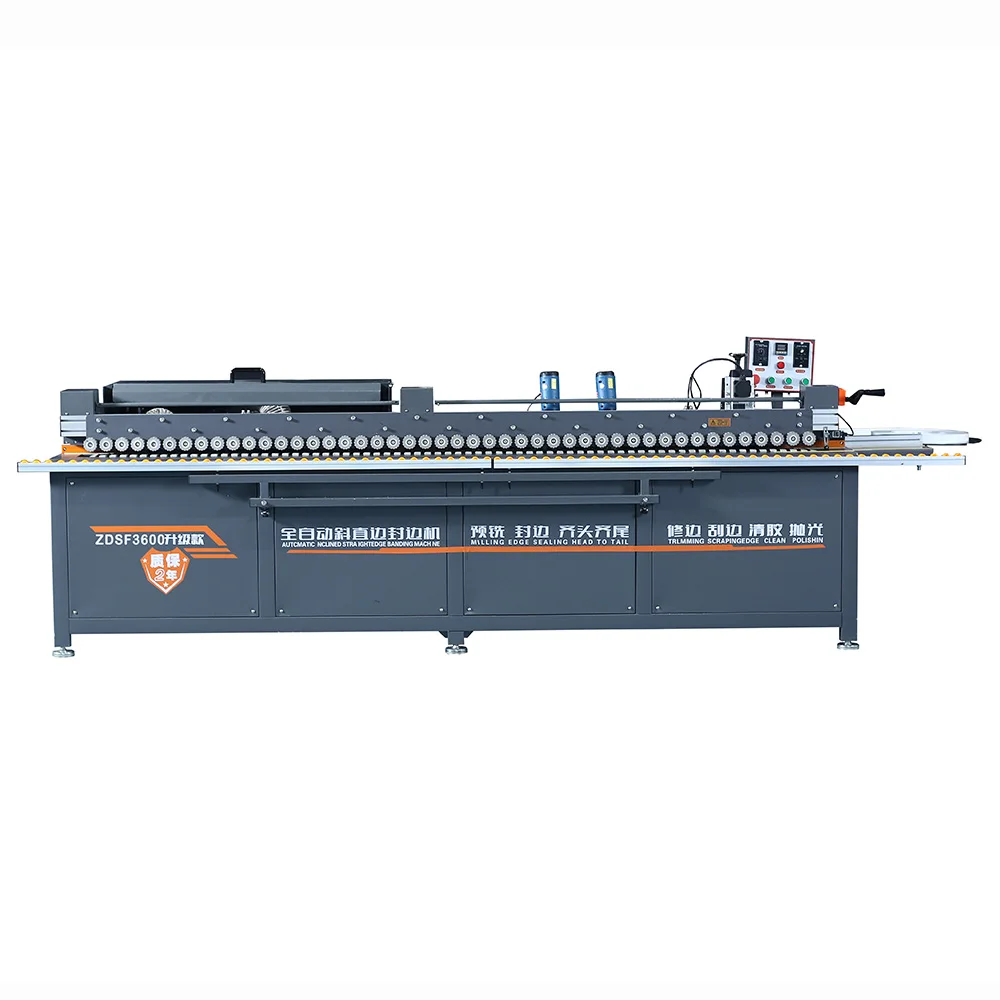
Patented Cutting Tolerance — The ZDS-3600 bevel-straight edge banding machine maintains a verifiable ±0.02mm edge tolerance through proprietary milling mechanisms, giving technical buyers measurable specification data rather than unverified claims.
Technical Specifications
| Parameter |
Value |
| Model |
ZDS-3600 |
| Product Type |
Bevel-Straight Edge Banding Machine |
| Edge Speed |
0–12 m/min |
| Panel Thickness Range |
18–45 mm |
| Total Power |
8.9 kW |
| Voltage |
380V (frequency to be confirmed) |
| Working Pressure |
0.5–0.7 MPa |
| Bevel Angle Range |
30°–90° |
| Glue Pot Capacity |
4000 ml |
| Glue Pot Heating |
2 kW |
| Oven Lamp Heating |
2 kW × 2 |
| Edge Feed Motor |
0.12 kW |
| Milling Motor |
2.2 kW |
| Trimming Motor |
2.2 kW × 2 |
| Slotting Motor |
65 W |
| Polishing Motor |
0.37 kW × 2 |
| Overall Dimensions (L×W×H) |
3320 × 650 × 1180 mm |
| Net Weight |
450 kg |
| Control System |
PLC with panel operation |
| Pressure Beam |
One-piece aluminum alloy with digital display height adjustment |
| Pressure Roller |
Chrome-plated, adjustable for bevel angles |
| Trimming Configuration |
Dual high-speed motors with 4-edged alloy cutter heads |
| Function Sequence |
Straight edge → Beveled straight edge → Pressing/gluing → Pre-milling → Preheating → Edge trimming → Edge scraping → Clear glue → Polishing |
Application Suitability
| Application |
Material or Output |
| Cabinet panel edging with bevel profiles |
MDF and particleboard with PVC edge banding |
| Custom furniture mixed straight and bevel edges |
Plywood panels with veneer edge banding |
| Joinery workshop single-pass edge finishing |
Solid wood panels from 18 mm to 45 mm thickness |
| Small to mid-scale production runs |
Melamine-faced boards requiring hot-air assisted glue activation |
What "30°–90° Bevel Range" Actually Demands From the Pressure System
A bevel-straight edge banding machine must hold the panel against a chrome-plated roller that pivots across a 60-degree arc without losing contact pressure.
When I first started commissioning edge banders in the Pearl River Delta workshops, the bevel function looked straightforward on paper. The reality is that shifting from a standard 90° straight edge down to a 30° bevel changes how gravity, feed force, and glue viscosity interact at the pressure roller. If the roller cannot maintain uniform contact across that full angular sweep, you get intermittent glue starvation on the leading edge and visible seam lines on the trailing edge [NEED_CITE: edge banding adhesion failure modes on bevel profiles]. The ZDS-3600 bevel straight edge banding machine specifications list a chrome-plated adjustable roller paired with a one-piece aluminum alloy pressure beam — this combination addresses the contact consistency problem, but only if the digital display height adjustment is calibrated to the exact panel thickness before the first feed.

Matching Feed Speed to Bevel Geometry on Real Panel Stock
The 0–12 m/min variable feed speed on this bevel-straight edge banding machine is not a single throughput number you can apply across all profiles. At a 30° bevel on 45 mm particleboard, the effective contact area between edge banding and substrate narrows considerably, which means the glue must achieve full tack in a shorter dwell window. Running at the upper end of the speed range under these conditions risks incomplete bonding before the trimming station engages. Production managers comparing bevel straight edge banding machine specifications should cross-reference their typical panel thickness against feed speed to identify the sustainable operating window rather than the theoretical maximum.
Two-Stage Heating and Its Role in Mixed Material Runs
The 2 kW glue pot paired with two 2 kW oven lamps creates a two-stage heating profile that matters when a workshop switches between PVC and veneer edge banding in the same shift. PVC typically requires a higher activation temperature at the glue line, while veneer is more sensitive to heat-induced warping if the secondary oven lamps run too aggressive [NEED_CITE: thermal requirements for PVC versus veneer edge banding adhesives]. The ZDS-3600 separates these heating zones so the operator can dial back the oven lamp intensity for veneer without dropping the glue pot below its minimum effective temperature. This separation is what makes the machine viable for custom furniture factories that run short batches across different edge materials throughout the day.
Reading the Motor Breakdown Against Your Production Requirements
The specification sheet lists seven distinct motor ratings, and each one maps to a specific station in the function sequence. The 2.2 kW milling motor handles pre-milling of the panel edge before glue application — if your upstream panel saw leaves a rough cut, this station carries the burden of squaring the edge to within tolerance before the banding meets the substrate. The dual 2.2 kW trimming motors with 4-edged alloy cutter heads perform both rough and fine trimming in sequence, which directly determines the final edge profile quality. Meanwhile, the 0.37 kW × 2 polishing motors finish the edge surface, and their relatively modest power rating reflects the light-contact nature of that final station. Technical buyers evaluating bevel straight edge banding machine specifications should match the milling and trimming motor ratings against the abrasiveness and density of their typical panel stock [NEED_CITE: motor load requirements for edge trimming on high-density MDF].
When Specification Data Gets Ignored Before Shipment
I have walked into workshops where the edge bander sat idle for weeks because the local supply was 220V three-phase and the machine arrived wired for 380V. The voltage mismatch is not something you discover until the electrician opens the cabinet on installation day. A related failure mode happens when the control panel arrives in a language the operator cannot read, turning what should be a straightforward commissioning into a multi-day troubleshooting exercise with translated manuals [NEED_CITE: commissioning delays from operator interface language barriers]. These are not machine defects — they are specification gaps that should have been resolved during the quotation stage, and they cost far more to fix on-site than to address before production begins.
Why the Specification Sheet Is Your Primary Procurement Document
The ZDS-3600 ships with a full electrical schematic that confirms voltage and frequency for your facility before the machine leaves the factory floor. The four-stage quality control process includes a pre-shipment test run on your specified panel thickness range, generating an actual tolerance measurement rather than a catalog claim. The operation and maintenance manual is produced in your operator's language, covering PLC parameter adjustment and bevel angle calibration. Spare parts documentation itemizes trimming cutter heads, pressure roller assemblies, and glue pot components so reorder decisions can be planned before consumables run out on the floor. Every bevel straight edge banding machine specifications claim on this page corresponds to a verifiable component in the build documentation.
Documentation & Verification
- CE declaration of conformity covering the ZDS-3600 bevel-straight edge bander assembly
- Electrical schematic confirming voltage and frequency matched to your facility supply
- Pre-shipment factory test record measured on your specified panel thickness range
- Operation and maintenance manual written in your operator's working language
- Itemized spare parts list for trimming cutter heads, pressure roller, and glue pot
Installation, Commissioning & Support
- Dedicated 380V circuit required matching the 8.9 kW total power draw of the ZDS-3600
- Floor space allocation of approximately 3320 × 650 mm plus operator clearance on both sides
- 0.5–0.7 MPa compressed air supply with clean, dry filtration at the working pressure inlet
- Digital display pressure beam height calibrated to your panel range during commissioning
- PLC control panel configured in your operator's language before the machine ships
- Initial spare parts package covering 4-edged alloy cutter heads and glue pot consumables
Requesting an Accurate Configuration Proposal
Send your typical panel material, thickness range, and the edge banding type you run most frequently — whether PVC, ABS, or veneer. Confirm your facility voltage and frequency standard so the electrical system can be matched before assembly. If you process both bevel and straight edge profiles, specify the angle range and production volume so the feed speed and heating configuration can be validated against your throughput requirements.
Frequently Asked Questions
Q: How do I verify the 0–12 m/min feed speed against my actual edge profile requirements?
A: The feed speed range depends on panel thickness, bevel angle, and edge banding material. At a 30° bevel on 45 mm stock, the effective bonding window narrows, so the sustainable speed may sit below the maximum. Request a test run using your actual panel and edge material to establish the reliable operating window before committing to a throughput target.
Q: Can the 380V supply be confirmed or customized for my local electrical standard?
A: The standard configuration is 380V, but voltage and frequency must be confirmed against your facility supply before production begins. The manufacturer will provide an electrical schematic showing the confirmed configuration. If your local standard differs, the machine can be built to match, but this must be specified at the quotation stage to avoid on-site rewiring.
Q: How is the PLC control panel language set for my operator before delivery?
A: The control panel language is configured during assembly based on the language you specify in the order. The operation and maintenance manual is also produced in that same language. Confirming the operator's working language at the quotation stage prevents commissioning delays caused by interface misunderstandings on the factory floor.
Q: What does the 18–45 mm panel thickness range mean for pressure beam adjustment?
A: The one-piece aluminum alloy pressure beam uses digital display height adjustment to match your panel thickness within that range. Each time you switch between different panel stock, the operator resets the beam height using the digital readout. This ensures consistent pressure roller contact across both straight and beveled edge profiles throughout the run.
Q: Which spare parts ship with the machine and what is the reorder process for consumables?
A: The shipment includes an itemized spare parts list covering trimming cutter heads, pressure roller components, and glue pot consumables. The specific initial spare package is confirmed during the quotation stage. Reorder lead times for standard wear items like 4-edged alloy cutter heads are typically short, but this should be verified against your production schedule before the first order.