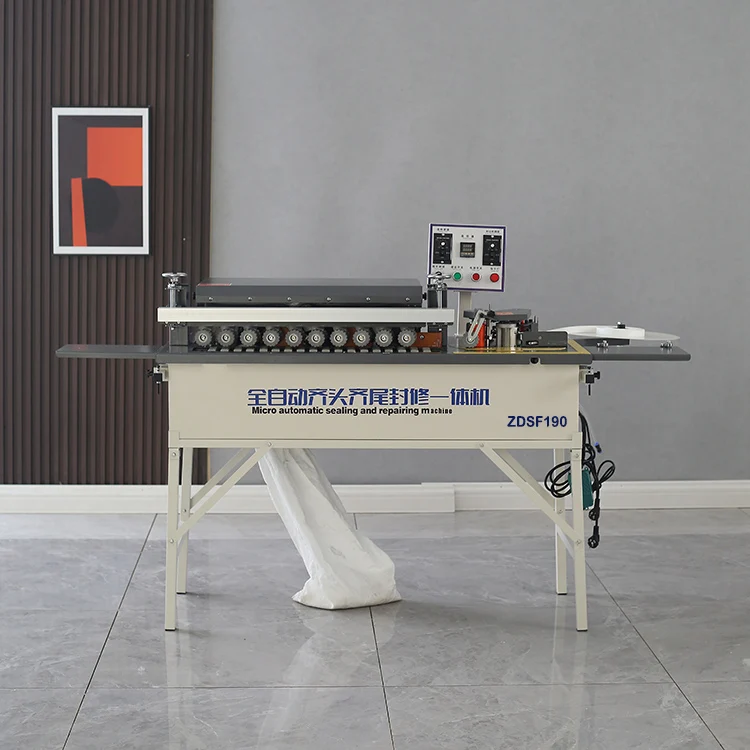
Precision-Verified Configuration — The ZDSF190 specification sheet confirms rated power, voltage, feed speed and panel range so your workshop can match throughput without guessing.
Technical Specifications
| Parameter |
Value |
| Model |
ZDSF190 |
| Product Type |
Miniature Fully Automatic Curved and Straight Dual-purpose Edge Banding Machine |
| Rated Power |
4 kW |
| Voltage |
220V 50Hz |
| Conveyor Belt Speed |
0-14 m/min |
| Sheet Thickness Range |
10-50 mm |
| Strip Thickness Range |
0.5-2.5 mm |
| Glue Capacity |
1000 ml |
| Suction Power |
1200 W |
| Trimming Power |
800 W × 2 |
| Polishing Power |
180 W × 2 |
| Heating Power |
800 W |
| Transmission Power |
120 W |
| Belt Power |
25 W |
| Rated Air Pressure |
0.4-0.6 MPa |
| Pressure Beam |
Adjustable aluminum alloy |
| Trimming Mechanism |
4-edge arc-shaped alloy cutter head, 2 high-speed trimming motors |
| Control System |
Multi-function button operation panel |
| Transmission |
Steel rod slide rails |
| Dust Collection |
Large-diameter surrounding vacuum, dual dust collectors, collection effect up to 99% |
| Limit Switch |
Push-type |
| Overall Dimensions |
1900 × 560 × 1300 mm |
| Net Weight |
120 kg |
Application Suitability
| Application |
Material or Output |
| Straight edge banding for cabinet panels |
MDF, particleboard, plywood with PVC edge strips 0.5-2.5 mm |
| Curved profiling for custom furniture |
Shaped panels and radiused components up to 50 mm thick |
| Small to medium joinery workshop production |
Board stock 10-50 mm thick at feed speeds up to 14 m/min |
| Cabinetry door and drawer front finishing |
Both straight and curved contours without machine changeover |
Why the Voltage Question Must Come Before the Quotation
Confirming your local supply voltage and frequency against the machine nameplate prevents a machine from arriving unusable on your shop floor.
I once watched a custom cabinet maker in Shandong receive a machine wired for a supply that did not match the local grid, and commissioning stalled for days while an electrician sourced the correct transformer. When you review edge banding machine specifications, the voltage line is easy to overlook next to feed speed and trimming power, yet a mismatch stops production before the first panel is edged [NEED_CITE: voltage and frequency standards by export market]. Always verify that 220V 50Hz matches your facility or request a reconfigured motor and control panel before the crate is sealed.

Matching Feed Speed to Your Panel Volume
The ZDSF190 runs a variable conveyor speed from 0 to 14 m/min, which lets operators dial in the pace for different board densities and glue cure times. A slower feed on thick particleboard gives the adhesive more dwell time under the pressure wheels, while lighter MDF stock can move faster without sacrificing bond strength. When you compare how to choose edge bander models, feed speed range determines whether a single machine handles your full material mix or forces you to bottleneck on heavy panels.
Dual-Purpose Curved and Straight Operation in One Footprint
Most workshops that handle custom furniture need both straight runs and curved profiles, and moving panels between two machines adds handling time and alignment errors. This unit rotates to accommodate curved workpieces while keeping the same trimming and polishing stations active, so operators do not reconfigure between jobs. The adjustable aluminum alloy pressure beam with double-row rubber pressure wheels stabilizes large panels during curved passes, which is where most edge quality failures originate [NEED_CITE: edge banding adhesion failure causes in small workshops].
Reading the Specification Sheet Against Your Assembly Tolerances
The dual 800W trimming motors paired with 4-edge arc-shaped alloy cutter heads remove excess banding in a single pass on both top and bottom edges. Trimming power and cutter geometry directly affect whether the finished edge sits flush or leaves a visible lip that shows after painting. The 10-50 mm sheet thickness range covers most furniture panels, but verify that your thickest stock plus the strip thickness stays within the pressure beam travel before ordering. The 1000 ml glue pot capacity suits small to medium batch runs without frequent refills, though high-volume straight-line production may require a larger glue reservoir.
What Happens When Specifications Are Ignored at Purchase
Buying a single edge bander without checking how its feed height aligns with upstream saws and downstream boring machines creates a mismatch that only appears once the line is running. Panels arrive at the bander too thick for the pressure beam, or the conveyor speed cannot synchronize with the next station, forcing operators to hand-feed and introducing edge defects. These incompatibilities rarely show up in a brochure but surface quickly on the shop floor [NEED_CITE: production line throughput mismatch in furniture workshops]. The cost is not the machine itself but the rework hours and delayed shipments that follow.
Why Source This Configuration Here
In-house manufacturing with patented cutting mechanisms means the trimming tolerances on the ZDSF190 are verified on the assembly floor, not claimed from a third-party catalog. Voltage, language and specification customization is treated as standard procedure rather than a special request, so your operator receives a control panel they can actually read. A four-stage QC process with pre-shipment verification catches wiring and pressure calibration issues before crating. Engineer-led configuration recommendations with a formal quotation arrive within 24 hours, giving you time to compare edge banding machine specifications against your production schedule without losing bidding windows.
Documentation & Verification
- Factory test record on your specified panel thickness range and edge strip material before dispatch
- Electrical schematic confirming 220V 50Hz or your requested voltage and frequency configuration
- Operation and maintenance manual translated into your operator's working language
- Machine specification sheet listing all rated power values, air pressure and conveyor speed ranges
- Packing photographs showing crating, blocking and moisture protection before container loading
Installation, Commissioning & Support
- Requires a dedicated 220V circuit rated above 4 kW with appropriate breaker sizing for motor inrush
- Overall dimensions of 1900 × 560 × 1300 mm fit through standard workshop doors without disassembly
- Rated air pressure of 0.4-0.6 MPa requires a clean, dry compressed air line at the machine inlet
- First-run calibration covers pressure beam height, trimming motor alignment and glue temperature settings
- Dual dust collectors with 1200W suction need duct routing to your central extraction or standalone filters
- Spare parts list covers cutter heads, limit switches, pressure wheels and heating elements for local stocking
Before You Request a Quotation
Send your panel material types, thickness range and edge strip specifications so the configuration matches your actual stock. Include your local voltage, frequency and preferred control panel language to avoid field rewiring. If you are integrating this unit into an existing line, share the feed height and conveyor speed of upstream and downstream equipment so throughput stays balanced.
Frequently Asked Questions
Q: How do I verify that the 0-14 m/min feed speed matches my daily panel volume?
A: Calculate your average panel length and required daily output, then divide total edge length by 14 m/min to estimate machine hours needed. If the result exceeds your available shift time, you may need a higher-speed model or a second unit rather than pushing this one beyond its rated range.
Q: Can the ZDSF190 be reconfigured for a different voltage if my facility runs on 380V or 110V?
A: Voltage customization from 110V to 440V is available as a standard configuration option. Request the electrical schematic and voltage confirmation document with your quotation so the motor, heating element and control transformer are all matched to your supply before shipment.
Q: When should I use curved profiling versus straight trimming on this machine?
A: Use curved profiling for radiused cabinet doors, rounded shelving and custom furniture contours where the edge follows a non-linear path. Straight trimming handles standard rectangular panels and cabinet sides where the edge runs parallel to the panel face.
Q: Does the ZDSF190 throughput align with typical upstream panel saws and downstream boring stations?
A: At 0-14 m/min, this machine suits small to medium workshops where cutting and boring stations operate at comparable cycle rates. For high-volume lines running faster upstream equipment, verify that the bander conveyor speed does not become the bottleneck before committing to the configuration.
Q: What language options are available for the multi-function button operation panel?
A: Multilingual control panels are configured based on your operator's language before production. Specify your preferred language during the quotation stage so the panel labels and any digital readouts are legible at commissioning, avoiding the delays that come from relabeling in the field.