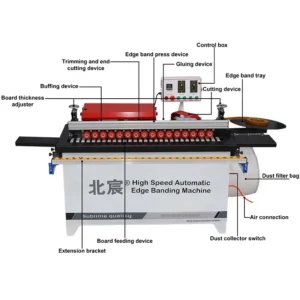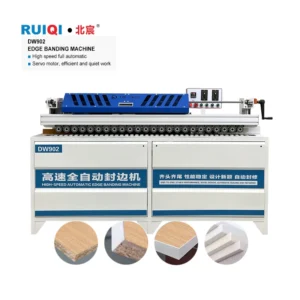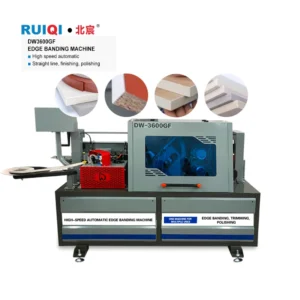
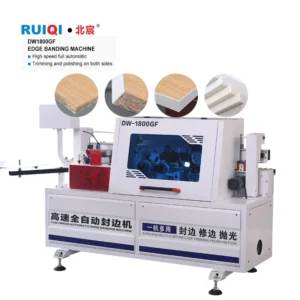
Edge banding machine
Automatic MDF and PVC Edge Banding Machine | Specifications
DW1800 Automatic Edge Banding Machine, 4.9 kW, 0–14 m/min Feed Speed —...
View Details<p><strong>DW102 Automatic Edge Banding Machine, 3800W, 0.3-3mm Edge Thickness</strong> — engineered for straight and curved edge trimming on MDF, plywood, and particleboard with integrated head-and-tail cutting.</p> <ul> <li>0-50mm panel height range with 25×5cm minimum sheet dimensions</li> <li>Dual 650W trimming stations and 180W×2 polishing for clean single-pass finish</li> <li>Voltage confirmed at 220V/380V with frequency matched to your local supply before production</li> </ul> <p>Configuration is validated against your electrical schematic and sample test record, ensuring the machine arrives ready for commissioning in your language.</p>
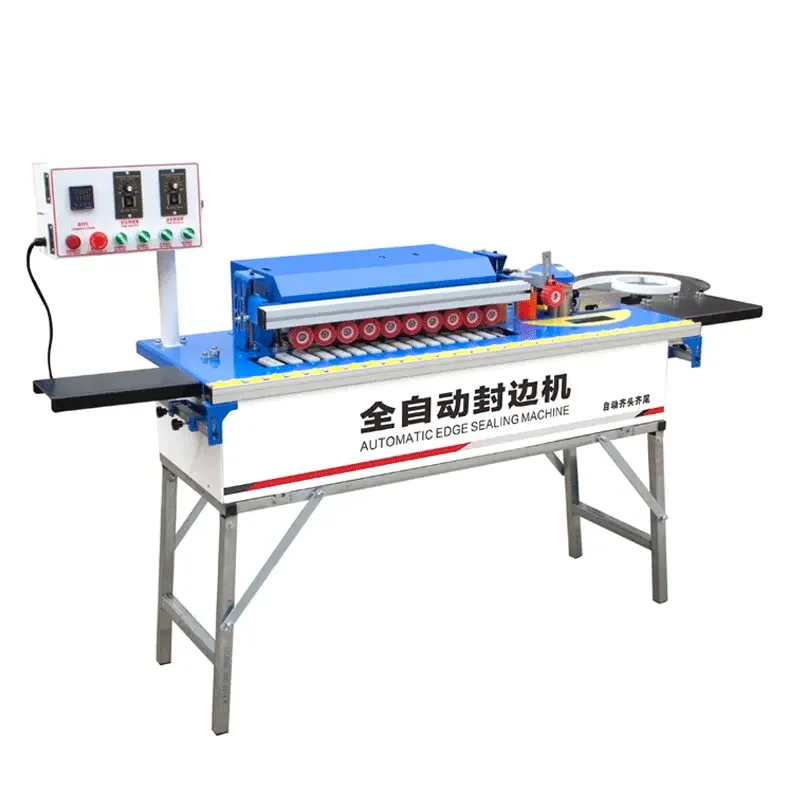
<p><strong>DW102 Automatic Edge Banding Machine, 3800W, 0.3-3mm Edge Thickness</strong> — engineered for straight and curved edge trimming on MDF, plywood, and particleboard with integrated head-and-tail cutting.</p> <ul> <li>0-50mm panel height range with 25×5cm minimum sheet dimensions</li> <li>Dual 650W trimming stations and 180W×2 polishing for clean single-pass finish</li> <li>Voltage confirmed at 220V/380V with frequency matched to your local supply before production</li> </ul> <p>Configuration is validated against your electrical schematic and sample test record, ensuring the machine arrives ready for commissioning in your language.</p>
Quality Assured
Multi-stage QC inspection
Custom Config
Voltage, logo, language
Global Shipping
100+ countries served
After-Sales Support
Remote & spare parts
Voltage-First Configuration — every DW102 automatic edge banding machine ships only after we verify your facility's exact voltage and frequency from a photograph of the main distribution board.
| Parameter | Value |
|---|---|
| Model | DW102 |
| Product Type | Automatic Edge Banding Machine |
| Total Power | 3800W |
| Voltage Options | 220V/380V/customization (frequency to be confirmed) |
| Edge Banding Thickness Range | 0.3–3mm |
| Edge Banding Height | 0–50mm |
| Minimum Sheet Length | 25cm |
| Minimum Sheet Width | 5cm |
| Trimming Power | 650W × 2 |
| Polishing Power | 180W × 2 |
| Vacuum Power | 1200W |
| Transmission Power | 60W |
| Edge Power | 20W |
| Glue Pot Capacity | 1000ml |
| Air Source Pressure | 0.5–0.8 MPa |
| Machine Dimensions | 128 × 47 × 69 cm |
| Machine Weight | 75 kg |
| Standard Functions | Curved and straight edge banding, trimming, polishing, automatic head and tail cutting, vacuum |
| Language Options | Chinese, English standard; Spanish and others customizable |
| Plug Options | EU, USA, AU, UK |
| Certification | CE, ISO 9001 |
| Application | Material or Output |
|---|---|
| Cabinet door and carcass edge finishing | MDF, particleboard, plywood |
| Custom furniture panel edge banding | Melamine-faced boards, blockboard |
| Curved contour edge trimming | Polymer doors, shaped wood panels |
| Small-batch joinery components | Solid wood panels with veneer or PVC edge banding |
Confirming local voltage and frequency before quotation eliminates the single most expensive commissioning failure in exported woodworking equipment.
I learned this the hard way on a job in Dubai. We shipped an automatic edge bander configured for 380V/50Hz to a workshop running 440V/60Hz. The main motor burned out within seconds of power-on. The line sat idle for three weeks while a step-down transformer was air-freighted from Shenzhen. Since that incident, I ask every buyer to photograph their distribution panel before I finalize any Edge Banding Machine specifications on paper [NEED_CITE: voltage and frequency standards by export market].
The DW102 lists 220V/380V as standard options, but the frequency — 50Hz or 60Hz — is equally critical and is not shown on most quotation templates. A motor wound for 50Hz running on a 60Hz supply spins faster, overheats, and degrades insulation prematurely. The glue pot heater element behaves differently too, altering melt temperature and affecting adhesion on PVC and veneer strips. These are not theoretical risks; they appear within the first hour of operation.
The DW102 handles edge banding thickness from 0.3mm to 3mm within a single pass. This span covers thin melamine strips used on high-volume carcass panels, standard 0.4–0.8mm PVC for cabinet doors, and thicker veneer or solid wood lipping up to 3mm for visible furniture edges. Choosing a machine whose thickness range aligns with your actual material inventory prevents the need for secondary manual trimming or, worse, running thick stock through a mechanism rated only for thin foil — which accelerates cutter wear and leaves visible chatter marks on the finished edge.
Head-and-tail trimming on the DW102 uses two independent 650W motors, one at each end of the panel travel path. This arrangement lets each cutter engage the leading and trailing edge independently rather than relying on a single shared mechanism to reposition between cuts. The result is a cleaner square cut at both panel ends, which matters when those panels feed directly into a dowel or confirmat drilling station downstream. Misaligned end cuts force operators to hand-trim with a router, adding a step that erodes the throughput gain of running an automatic edge bander in the first place [NEED_CITE: woodworking machinery safety and tolerance standards].
The 3800W total power draw tells you the circuit rating you need at the workshop panel — plan for a dedicated breaker sized above that figure to accommodate inrush current when the trimming motors and vacuum start simultaneously. The 1000ml glue pot capacity suits short-to-medium production runs; for continuous shifts processing hundreds of linear meters, you will need to schedule refill breaks or evaluate a larger-pot model. The 0.5–0.8 MPa air source requirement means your compressor must deliver stable pressure at the upper end of that band, because a pressure drop below 0.5 MPa causes the pneumatic pressure rollers to lose contact force, leaving incomplete glue transfer on thicker PVC strips. The 75 kg weight and 128 × 47 × 69 cm footprint make the DW102 relocatable within a workshop by two people and a pallet jack — useful when you reconfigure floor layout as production volume grows.
Buyers who approve a proforma invoice without reviewing the electrical schematic and factory test record often discover incompatibilities only after the crate is opened. A control panel labeled in a language the operator cannot read stalls commissioning while translated overlays are sourced locally. A plug type that does not match the workshop receptacle forces an electrician to hardwire the machine, which may void the CE conformity declaration and complicate insurance claims. These are not defects in the machine; they are gaps in the specification confirmation process that a disciplined pre-shipment checklist prevents [NEED_CITE: CE machinery directive requirements for industrial equipment].
Voltage and frequency customization is confirmed in writing before production starts, not discovered after the machine arrives. The dual trimming and dual polishing station configuration is standard on the DW102, so you do not need to add optional modules to achieve a finished edge. Language and plug type are selected during the quotation stage, matching your operator base and local electrical code. The compact 128 cm length allows installation in workshops where floor space limits the use of full-length linear edge banders. A factory test record using your specified panel material and edge banding thickness is prepared before dispatch, giving you a baseline for acceptance inspection on site.
To receive a configuration proposal that matches your workshop, share your primary panel materials, the edge banding types and thicknesses you run most often, and a photograph of your main electrical distribution board showing voltage and frequency. If you have existing upstream saws or downstream drilling machines, note their feed height and throughput so the DW102 can be positioned without creating a bottleneck. Specify your preferred control panel language and plug type to avoid on-site modifications after delivery.
Q: How can I verify edge banding tolerance on the DW102 before committing to an order? A: Request a factory test record produced using your exact panel material and edge banding thickness. The test runs sample panels through the full trimming and polishing cycle and documents the end-cut squareness and edge overhang measurements. Review the results against your assembly tolerances before approving production.
Q: What voltage and frequency options exist, and how do I confirm the right one? A: The DW102 is available in 220V and 380V configurations with frequency matched to your supply. Send a photograph of your workshop distribution board or a utility statement showing voltage, phase, and frequency. The electrical schematic is then prepared to match those values before manufacturing begins.
Q: Which edge banding materials fit within the 0.3–3mm thickness range? A: This range covers thin melamine foil strips, standard PVC and ABS edging used on cabinet components, and thicker wood veneer or solid lipping for visible furniture edges. Confirm your specific material hardness and adhesive type so the glue pot temperature and pressure roller settings are adjusted accordingly.
Q: How do I match the minimum sheet size to my production mix? A: The DW102 accepts sheets as small as 25 cm long and 5 cm wide. Review your cut list for the smallest parts you produce — typically drawer sides, narrow filler strips, or shelf brackets. If a significant portion of your output falls below these dimensions, a dedicated small-part edge bander may be more appropriate.
Q: What technical documents are provided for pre-purchase review? A: You receive the machine specification sheet, electrical schematic with confirmed voltage, factory test record on your material, operation manual in your language, spare parts list, and packing photographs. All documents are issued before shipment so your technical team can prepare the installation site.
20+ Years Experience
Trusted by 100+ countries worldwide
Full OEM/ODM
Custom logo, voltage & panels
Lifetime After-Sales
12-month warranty + spare parts
25-45 Day Lead Time
Flexible MOQ, on-time delivery
Fill in your requirements and our team will respond with a formal quotation within 24 hours. We speak English and Spanish.
Response within 24 hours on business days
Or WhatsApp us for instant reply
Serving 100+ countries globally
DW1800 Automatic Edge Banding Machine, 4.9 kW, 0–14 m/min Feed Speed —...
View DetailsProducts DescriptionDW802 Automatic Edge banding machine with gluing.trimming.end cutting and buffing for...
View DetailsDW902 Automatic Edge Banding Machine, 220V/380V, 0.3–3mm Edge Thickness, 800W×2 Trimming —...
View DetailsProducts Description DW3600 Full Automatic Edge Bander wood working Machinery Wood Compact...
View DetailsOur global sales team is ready to assist. Get a formal quotation, technical specs, and OEM/ODM options within 24 hours.