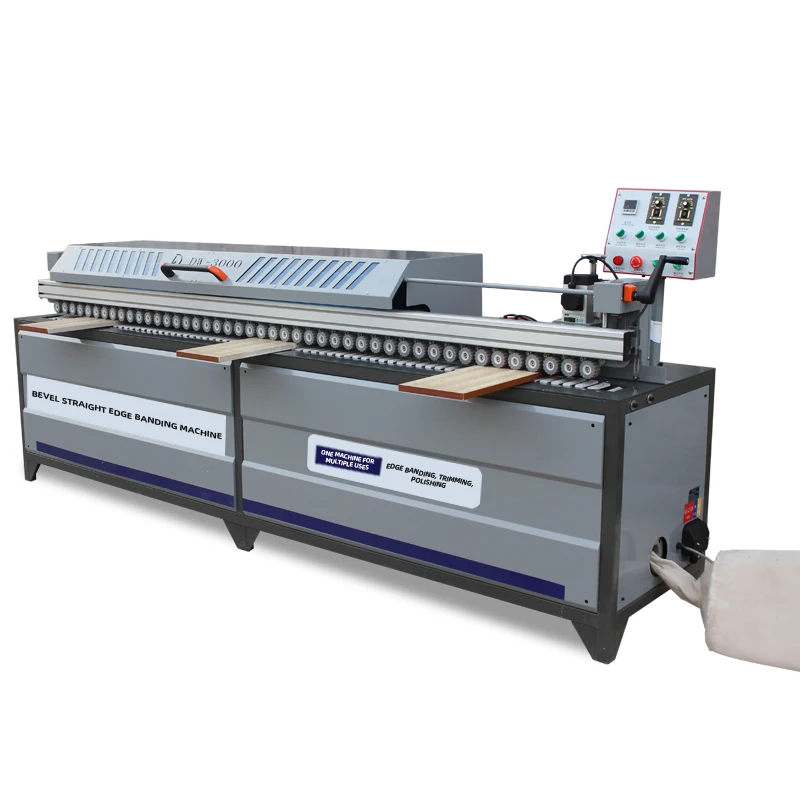
Verified Tolerance on Every Station — the DW3000 full-automatic edge bander holds ±0.02 mm accuracy from pre-milling through polishing, backed by a four-stage QC record covering each functional group before the machine leaves the assembly floor.
Technical Specifications
| Parameter |
Value |
| Model |
DW3000 |
| Product Type |
Automatic Edge Banding Machine |
| Rated Power |
11 kW |
| Voltage & Frequency |
380V / 415V (source value — verify against manufacturer catalog) |
| Feed Speed |
0–12 m/min |
| Edge Banding Thickness Range |
0.3–3 mm |
| Edge Banding Height Range |
0–50 mm |
| Minimum Panel Length |
300 mm |
| Minimum Panel Width |
150 mm |
| Pre-milling Motor |
2.2 kW |
| Heating Power |
2.2 kW × 2 (dual heat gun) |
| Trimming Motor |
2.2 kW × 2 |
| Polishing Motor |
0.4 kW × 2 |
| Vacuum Power |
550 W |
| Edge Feeding Motor |
160 W |
| Transmission Motor |
180 W |
| Glue Pot Capacity |
4000 ml |
| Air Source Pressure |
0.5–0.7 MPa |
| Oblique Pressure Wheels |
8 sets, adjustable 30°–90° |
| Overall Dimensions |
2990 × 650 × 1300 mm |
| Net Weight |
430 kg |
| Standard Functions |
Pre-milling, gluing, trimming, scraping, polishing, slotting, alignment, flexible edge scraper |
Application Suitability
| Application |
Material or Output |
| Panel furniture straight edge banding |
MDF, particleboard, plywood |
| 45-degree oblique edge finishing |
MDF and solid wood panels |
| Cabinet door and carcass edge treatment |
PVC and veneer edge banding |
| Custom furniture batch production |
Panels from 150 mm minimum width |
| Mixed straight and bevel workflows |
0.3–3 mm edge band thickness |
Edge Banding Machine Specifications: Why Matching Feed Speed to Your Panel Line Matters
Feeding panels at a rate your upstream saw cannot sustain is the most common cause of edge bander idle time.
When a cabinet factory pairs a high-speed panel saw outputting shorter batches with an edge bander set near maximum feed speed, the operator ends up throttling back or letting the machine idle between panels. I have seen this mismatch on multiple shop floors in South America where buyers chose the edge bander on maximum speed alone without mapping actual throughput [NEED_CITE: panel saw and edge bander throughput matching principles]. The Edge Banding Machine specifications sheet for the DW3000 shows a 0–12 m/min adjustable feed range, which matters less as a headline number and more as a dial the operator can match to the rhythm of whatever is feeding it.

Dialing Feed Speed to Actual Workshop Rhythm
The variable feed control from 0 to 12 m/min lets production managers set the DW3000 to whatever pace the upstream cutting station delivers. Running the machine at maximum speed on short batch cabinet work creates micro-stops that leave visible marks on the edge band. A technical buyer evaluating Edge Banding Machine specifications should map the typical panel size and daily batch count before selecting a feed speed target.
Pre-milling and Trimming as a Paired System
The 2.2 kW pre-milling motor prepares the panel edge before the glue station, removing saw marks that would otherwise telegraph through thin PVC or veneer. Downstream, the twin 2.2 kW trimming motors remove excess banding flush with the panel face. Together these stations handle the tolerance that determines whether cabinet doors close with even gaps [NEED_CITE: woodworking tolerance standards for panel furniture assembly]. A weak pre-milling stage forces the trimming motors to remove more material, increasing tool wear and degrading edge straightness over a long production run.
Heat Distribution Across Edge Band Thickness
The dual 2.2 kW heat gun arrangement targets different zones of the glue application path. Thicker PVC edge banding at the upper end of the 0.3–3 mm range absorbs heat differently than thin veneer strips, and a single heat source often leaves the trailing edge under-activated. During a trial run in Chile, we processed a matte-finish PVC that required both heat guns active and the pressure wheel angle adjusted to maintain consistent adhesion along the full panel length. The eight sets of oblique pressure wheels, adjustable from 30 to 90 degrees, let the operator fine-tune contact pressure for both straight edges and 45-degree bevel cuts in the same pass.
Reading Edge Banding Machine Specifications Against Your Material
Panel thickness range, minimum panel dimensions, and air pressure requirements interact in ways that do not appear on a single spec line. The DW3000 accepts panels as short as 300 mm and as narrow as 150 mm, which covers most cabinet component sizes but excludes very small drawer parts that may require a separate compact unit. The 0.5–0.7 MPa air pressure range drives the pneumatic cylinders at each station, and insufficient compressor capacity causes pressure wheels to lose grip mid-cycle [NEED_CITE: pneumatic system requirements for woodworking edge banders]. The 4000 ml glue pot capacity supports continuous runs without frequent refill stops, relevant when a factory schedules long batch days.
The Cost of Skipping Spec Verification Before Order
Choosing an edge bander based on a single headline number — feed speed, motor power, or edge thickness range — without cross-checking against your actual panel stock and edge banding material leads to commissioning delays. Operators spend days re-tuning glue temperature and wheel pressure when the machine arrives configured for a different material profile than what the factory runs. In one case I witnessed, a buyer discovered after delivery that the control panel language was set to a script none of the operators could read, stalling first production for several days [NEED_CITE: control panel language customization for exported industrial machinery]. Verifying every station specification against your production mix before the order enters manufacturing avoids these losses.
Sourcing Depth Behind the Specification Sheet
In-house manufacturing with patented cutting mechanisms means the tolerance values on the DW3000 spec sheet come from the same facility that grinds the components and assembles the frame. The four-stage quality control process — incoming material inspection, in-process checks, finished product testing, and pre-shipment verification — produces a written record you can review before the machine ships. Voltage and frequency customization is handled during the specification confirmation stage, not as an afterthought at the packing bench. Language options for the control panel, including Chinese, English, and additional languages by request, are locked in before production begins. Factory visits are welcome so buyers can run their own panel samples through a DW3000 before committing to an order.
Documentation & Verification
- Machine specification sheet confirming all station motor ratings for the DW3000
- Electrical schematic and voltage confirmation matched to your facility supply
- Factory test record on your specified panel material and edge band type
- Operation and maintenance manual in your selected language with spare parts list
- CE declaration of conformity and ISO 9001 certificate on file
- Packing photographs and customs documentation support
Installation, Commissioning & Support
- Floor space planning around the 2990 × 650 × 1300 mm footprint with clearance for panel infeed
- Dedicated 380V/415V circuit sized for the 11 kW total rated power draw
- Compressed air line delivering 0.5–0.7 MPa to the pneumatic station manifold
- First-run calibration of all eight pressure wheel sets against your edge banding material
- Operator training on feed speed adjustment and pre-milling depth for panel types in use
- Spare parts list covering trimming blades, scraper elements, and polishing pads
Requesting a Configuration Proposal
Share the panel material types and thicknesses you process most frequently, along with the edge banding material and thickness range. Specify your facility voltage, frequency, and the control panel language your operators require. If you have upstream panel saws or downstream boring machines, provide their throughput so we can recommend a feed speed target that keeps the full line balanced.
Frequently Asked Questions
Q: How can I verify the DW3000 feed speed and trimming quality on my actual material?
A: Request a factory test using your own panel stock and edge banding material. We run the machine through pre-milling, gluing, trimming, and polishing at your target feed speed, then provide a written test record with measured edge quality and tolerance readings before you confirm the order.
Q: What voltage configurations are available and how is this confirmed?
A: The DW3000 is configurable across voltage and frequency options to match local supply standards. Voltage is confirmed in writing during the specification stage before manufacturing begins, and the electrical schematic shipped with the machine documents the exact configuration installed.
Q: How do I switch between straight and 45-degree oblique edge banding?
A: The eight sets of pressure wheels adjust from 30 to 90 degrees to accommodate both straight and bevel edge profiles. The operator selects the angle setting based on the panel edge geometry, and the machine processes both types without requiring station changes or tool swaps.
Q: What control panel languages can I specify for my operators?
A: Chinese and English are standard options, with additional languages available by request. The language preference is confirmed during the ordering stage and loaded onto the control system before the machine undergoes pre-shipment testing.
Q: How do I match the DW3000 throughput with my panel saw and boring machine?
A: Provide the model and typical cycle times of your upstream and downstream equipment. We calculate a target feed speed within the 0–12 m/min range that prevents bottlenecks and idle time, then document the recommended setting in the configuration proposal.