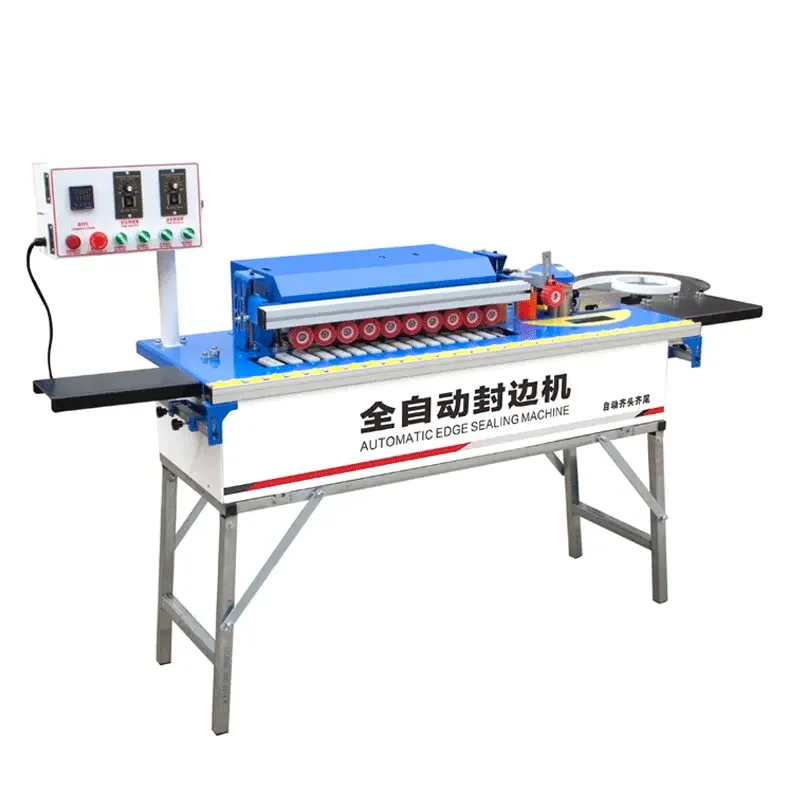
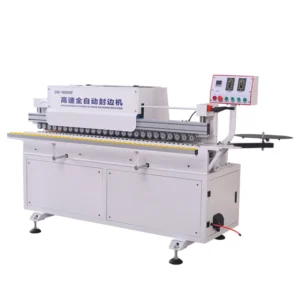
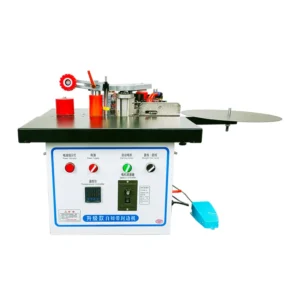
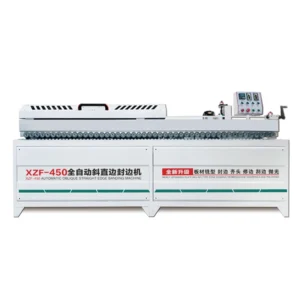
Verified Tolerance Mapping — every station power, dimensional limit, and utility requirement on the DW102 is published so technical buyers can validate line compatibility before requesting a quotation.
Technical Specifications
| Parameter |
Value |
| Model |
DW102 |
| Product Type |
Automatic Edge Banding Machine |
| Total Power |
3800 W |
| Voltage & Frequency |
220V / 380V customizable (50Hz/60Hz to be confirmed) |
| Trimming Power |
650 W × 2 |
| Polishing Power |
180 W × 2 |
| Vacuum Power |
1200 W |
| Edge Feed Power |
20 W |
| Transmission Power |
60 W |
| Edge Banding Height Range |
0–50 mm |
| Edge Banding Thickness Range |
0.3–3 mm |
| Minimum Sheet Length |
25 cm |
| Minimum Sheet Width |
5 cm |
| Glue Pot Capacity |
1000 ml |
| Air Source Pressure |
0.5–0.8 MPa |
| Overall Dimensions (L×W×H) |
128 × 47 × 69 cm |
| Net Weight |
75 kg |
| Key Features |
Curved and straight edge banding, edge trimming, polishing, automatic head and tail cutting, vacuum function |
| Language Options |
Chinese, English, other languages customizable |
| Plug Options |
EU, USA, AU, UK |
Application Suitability
| Application |
Material or Output |
| Cabinet door and carcass edge finishing |
MDF and particleboard with PVC edge banding |
| Drawer side and shelf bracket banding |
Plywood and blockboard small-format panels |
| Polymer door panel edge sealing |
Polymer composite boards with matching edge tape |
| Curved contour edge trimming |
Shaped MDF and plywood furniture components |
| Custom furniture short-run production |
Wood panels and veneer edge banding materials |
Why the Voltage Question Must Precede Every Edge Banding Machine Specifications Comparison
Confirming local supply voltage and frequency before evaluating any other parameter prevents a machine from arriving electrically incompatible with the workshop.
I have watched workshops take delivery of edge banders only to discover the motor winding was configured for a grid that does not exist in their region. The DW102 supports 220V and 380V configurations, yet frequency must be explicitly locked in — a 50Hz motor running on a 60Hz supply will overspeed, overheat, and fail prematurely. [NEED_CITE: voltage and frequency standards by export market] When technical buyers skip this step, the entire Edge Banding Machine specifications exercise becomes irrelevant because the unit cannot run long enough to demonstrate its rated capabilities.
Mapping Station Power to Substrate Hardness
The 650 W × 2 trimming motors and 180 W × 2 polishing motors define what this edge banding machine can cleanly process. Harder substrates like high-density MDF or thick PVC edge banding demand sustained trimming torque; undersized motors stall, leave chatter marks, and require repeated passes. Technical buyers comparing edge banding machine specifications should match these per-station ratings against their heaviest intended material combination rather than relying on total power alone.
Dimensional Envelope and Small-Part Viability
The 25 cm minimum sheet length and 5 cm minimum sheet width set the lower boundary for workpiece acceptance. [NEED_CITE: typical drawer side dimensions in cabinet manufacturing] Workshops producing small-format components like shelf brackets, drawer fronts, or narrow divider panels must verify that their smallest production piece clears both the feed rollers and the pressure zone. The 0–50 mm edge banding height range and 0.3–3 mm thickness capacity further constrain which tape-and-panel pairings the machine will accept on a given run.
Interpreting the Power and Utility Profile
The 3800 W total power draw and 1200 W dedicated vacuum motor mean this unit requires a circuit capable of sustained draw without voltage sag — a shared line with other heavy equipment risks tripping mid-cycle. The 1000 ml glue pot capacity suits short to medium production runs but requires planned refill intervals during longer batches. Air source pressure at 0.5–0.8 MPa must be stable; pneumatic cylinders driving the pressure rollers and trimming units lose force below the lower threshold, producing uneven glue lines and incomplete head-tail cuts. The 128 × 47 × 69 cm footprint and 75 kg net weight allow placement in compact workshops, but operators must reserve clearance on both the infeed and outfeed sides for panel handling.

The Hidden Cost of Ignoring Unspecified Parameters
Feed speed, control system type, tolerance band, and glue pot temperature range are absent from the published data. [NEED_CITE: edge banding tolerance requirements for dowel and confirmat assembly] Buyers who assume these values match a comparable model often discover mismatches only during commissioning — a relay-controlled machine behaves differently from a PLC-driven one when processing curved contours, and an unverified tolerance claim surfaces as misaligned dowel holes downstream. Requesting cycle time data and factory test records on actual panel stock before ordering eliminates this category of surprise.
Why Source This Machine Through a Specification-Driven Process
In-house manufacturing with patented cutting mechanisms means tolerance claims on the DW102 can be verified against physical test panels rather than catalogue promises. The four-stage quality control protocol — incoming material, in-process, finished product, and pre-shipment verification — applies to every unit before crating. Voltage, plug type, and control panel language are confirmed as order-line items, not afterthoughts discovered on the dock. Engineer-led configuration recommendations arrive as a formal quotation within 24 hours, mapping the buyer's panel dimensions and edge material to the correct station setup. Factory visits are welcomed so buyers can witness a live test run on their own stock.
Documentation & Verification
- CE declaration of conformity covering the DW102 electrical and mechanical safety scope
- Machine specification sheet confirming voltage, frequency, and plug type for destination country
- Electrical schematic showing circuit protection ratings and motor winding configuration
- Factory test record demonstrating trimming finish on buyer-supplied panel and edge tape samples
- Operation and maintenance manual delivered in the agreed operator language before shipment
Installation, Commissioning & Support
- Dedicated circuit rated for the 3800 W total draw with appropriate breaker sizing confirmed pre-delivery
- Air line delivering stable 0.5–0.8 MPa plumbed to the machine inlet before first start-up
- Glue pot loaded with adhesive matched to the edge banding material and ambient workshop temperature
- Trimming and polishing station offsets calibrated on buyer's actual panel thickness during commissioning
- Spare parts list reviewed with focus on trimming blades, polishing wheels, and glue pot consumables
Preparing Your Technical Inquiry
Provide your heaviest panel substrate, the edge banding material and thickness you intend to run, and the smallest workpiece dimensions in your production mix. Confirm your workshop supply voltage, frequency, and available air pressure. Specify the control panel language your operators require. State whether curved contour banding is part of your regular output so the configuration can account for it.
Frequently Asked Questions
Q: Feed speed is not published — how do I verify throughput for my production target?
A: Request cycle time data from the manufacturer for your specific panel size and edge material. Provide a representative workpiece dimension and tape thickness, and ask for a timed run record. This gives a realistic pieces-per-hour figure rather than a generic claim that may not match your actual production mix.
Q: Will the DW102 operate correctly on my local electrical supply?
A: The machine supports 220V and 380V configurations with EU, USA, AU, and UK plug options. However, frequency must be confirmed at the order stage — a 50Hz motor on a 60Hz grid will run outside design parameters. Specify both voltage and Hz when requesting your quotation to ensure winding compatibility.
Q: What panel thickness does the 0–50 mm edge banding height actually cover?
A: The edge banding height range defines the maximum tape width the feed and trimming stations can accommodate. Panel thickness must be evaluated separately against the pressure roller clearance and trimming cutter travel. Request a factory test on your thickest panel to confirm the machine handles the combination cleanly.
Q: How does the DW102 compare to full-automatic models on edge finish quality?
A: The DW102 is positioned for moderate-volume workshops where curved and straight banding flexibility matters more than continuous high-speed throughput. Full-automatic models typically add pre-milling, multi-stage scraping, and higher feed speeds. Compare station-level power ratings and published tolerance data rather than model tier alone.