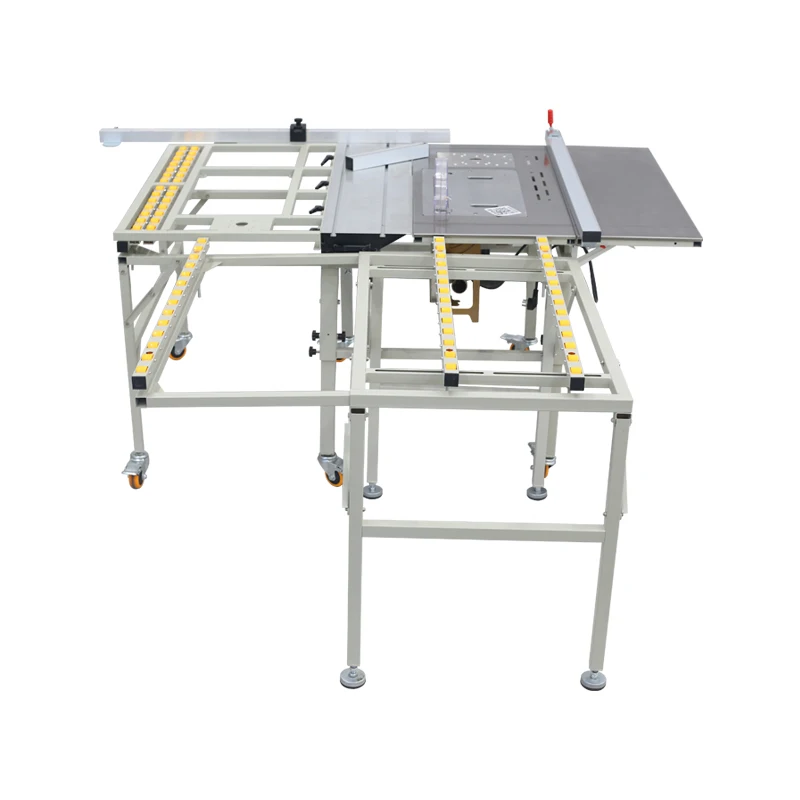
Precision-ground components — The JT-550S sliding table saw delivers verified cutting tolerance through multi-stage inspection, eliminating the guesswork when panels must fit perfectly on the assembly bench.
Technical Specifications
| Parameter |
Value |
| Model |
JT-550S |
| Product Type |
Sliding Table Saw |
| Blade Tilt |
45/90 degrees via aluminum alloy flip plate |
| Motor Type |
Copper wire motor |
| Saw Head |
Integrated sub and master saw, aluminum alloy chip design |
| Dust Extraction |
Dust protection cover with integrated absorption port |
| Extension Bracket |
Sliding roller extension bracket |
| Plug Options |
EU, USA, AU, UK |
| Language Options |
Chinese, English (customizable to Spanish or other languages) |
| Assembly State |
Fully assembled in wooden box packaging |
| OEM Capability |
Custom logo printing, production to buyer drawings |
| Certification |
CE |
Application Suitability
| Application |
Material or Output |
| Panel cutting for custom furniture |
MDF, particleboard, plywood |
| Cabinet door and carcass sizing |
Melamine-faced chipboard, veneered panels |
| Solid wood joinery preparation |
Hardwood and softwood solid panels |
| Miter and cross-cut operations |
45° and 90° angled cuts on sheet stock |
Why Voltage Verification Matters Before Sliding Table Saw Specifications
Confirming local voltage and frequency prevents a machine from arriving electrically incompatible with your workshop supply.
One of the most common failures I see in export machinery has nothing to do with mechanics. A sliding table saw can have excellent build quality, but if the motor is wound for a frequency or voltage that differs from the buyer's local grid, the machine either cannot start or burns out the winding within weeks [NEED_CITE: voltage and frequency standards by export market]. The copper wire motor in this unit can be configured across a range of voltages, but the configuration must be locked in before production begins, not after the container arrives at the port.

How the Flip Plate Eliminates Repetitive Angle Setup
Workshops that alternate between 90-degree cross-cuts and 45-degree miters lose significant time resetting the fence and blade angle on conventional saws. The aluminum alloy flip plate on the JT-550S locks into both positions without requiring the operator to recalibrate the sliding table saw specifications each time. This means a cabinet maker cutting carcass panels at 90 degrees can switch to miter cuts for face frames without stopping to measure and re-square the blade, keeping the cutting sequence continuous.
Integrated Sub and Master Saw for Double-Sided Clean Cuts
Particleboard and melamine-faced MDF are prone to chipping on the underside of the cut where the blade exits the material. The integrated sub and master saw configuration scores the bottom face before the main blade completes the through-cut, producing a clean edge on both sides of the panel. The aluminum alloy chip design of the saw assembly contributes to rigidity, reducing vibration that would otherwise manifest as saw marks on the finished edge [NEED_CITE: woodworking machinery vibration and surface finish correlation]. This matters when the cut edge will be visible on a finished cabinet or shelf unit.
Reading the Numbers That Affect Your Daily Output
The blade tilt mechanism and motor type tell you more about daily usability than almost any other sliding table saw specifications. A copper wire motor dissipates heat more effectively than aluminum alternatives during extended cutting sessions, which matters when a workshop runs the saw continuously through a shift. The sliding roller extension bracket expands the effective support area, allowing a single operator to handle oversized panels without an extra pair of hands. Dust extraction is handled through the integrated protection cover, keeping the sliding rails clear of fine particle accumulation that accelerates wear. When comparing options, buyers should look at how these features combine rather than isolating any single figure.
The Cost of Underspecifying the Motor and Dust System
A saw purchased for occasional use that is then pressed into daily production will show wear on the sliding carriage and motor winding degradation far earlier than expected. I have seen edge banders and panel saws of this class fail in workshops where the buyer assumed a light-duty motor could handle continuous MDF cutting [NEED_CITE: equipment duty cycle misclassification in woodworking]. Without adequate dust extraction at the source, fine MDF powder infiltrates the sliding mechanism, creating abrasive paste that scores the rails and introduces play into the carriage. The result is panels that no longer square up, discovered only when carcass sides refuse to assemble flush.
What Separates This Build from Generic Imports
The JT-550S is produced in a facility where four-stage quality control covers incoming material, in-process machining, finished assembly, and pre-shipment verification. Every saw undergoes a factory test run before crating, and the test record can be provided to the buyer. Voltage confirmation is part of the formal quotation process, not an afterthought at shipping. The OEM capability means a distributor can specify custom branding and documentation language, while the engineering team provides configuration recommendations based on the buyer's actual panel materials and daily volume rather than defaulting to a standard build.
Documentation & Verification
- CE declaration of conformity applicable to the JT-550S model range
- Machine specification sheet confirming motor rating and cutting capacity
- Electrical schematic with voltage and frequency matched to your facility
- Factory test record demonstrating cut accuracy on your specified panel material
- Operation and maintenance manual delivered in the agreed language
- Spare parts list identifying wearing components for first-year planning
Installation, Commissioning & Support
- Requires a level concrete floor with adequate clearance for the sliding roller extension bracket
- Dedicated electrical circuit matching the confirmed voltage and frequency specification
- Arrives fully assembled in wooden crate, requiring only unpacking and positioning
- First-run calibration of the flip plate and sub-saw alignment verified against test panels
- Operator familiarization covering blade changes, dust port connection, and daily rail cleaning
- Wearing parts guidance for sliding carriage bearings and saw blades included in documentation
Before You Request a Quote
To match the right configuration to your workshop, we need to know the primary panel materials you cut, the thickness range you work with most often, and your local voltage and frequency. Share whether operators will need a control language other than Chinese or English, and whether you require a sample cut test on your own stock material before shipment.
Frequently Asked Questions
Q: How do I verify cutting tolerance before the machine ships?
A: Request the pre-shipment factory test record, which documents actual cut results on a specified panel material and thickness. This record shows the tolerance achieved under test conditions, not a generic specification sheet. You can also specify your own panel stock for the test or arrange a factory visit to witness cutting in person.
Q: What voltage and frequency options are available for my country?
A: The motor can be configured for voltages from 110V to 440V, and the correct configuration depends on your local grid standard. Confirm your facility voltage and frequency during the quotation stage so the winding is matched before production. A mismatch discovered after delivery cannot be corrected with a simple transformer.
Q: Can the manual and control labels be provided in Spanish or another language?
A: Yes, the operation and maintenance manual and any operator-facing labels can be customized beyond the standard Chinese and English options. Specify your required language when confirming the order so documentation is prepared in parallel with machine assembly rather than added as a delayed afterthought.
Q: How do I match the JT-550S to my production volume?
A: Share your typical daily cutting hours, the panel materials and thicknesses you process, and whether cuts are predominantly straight or include frequent 45-degree miters. The engineering team will confirm whether the copper wire motor duty cycle and sliding carriage rating align with your workload, or recommend a higher-tier model if needed.
Q: Which spare parts should I order with the machine to avoid downtime?
A: The spare parts list provided with documentation identifies wearing components specific to this model, including sliding carriage bearings, sub and master saw blades, and dust cover seals. Ordering a first-year consumables package at the time of purchase ensures replacements are on hand before the original parts reach end of service life.