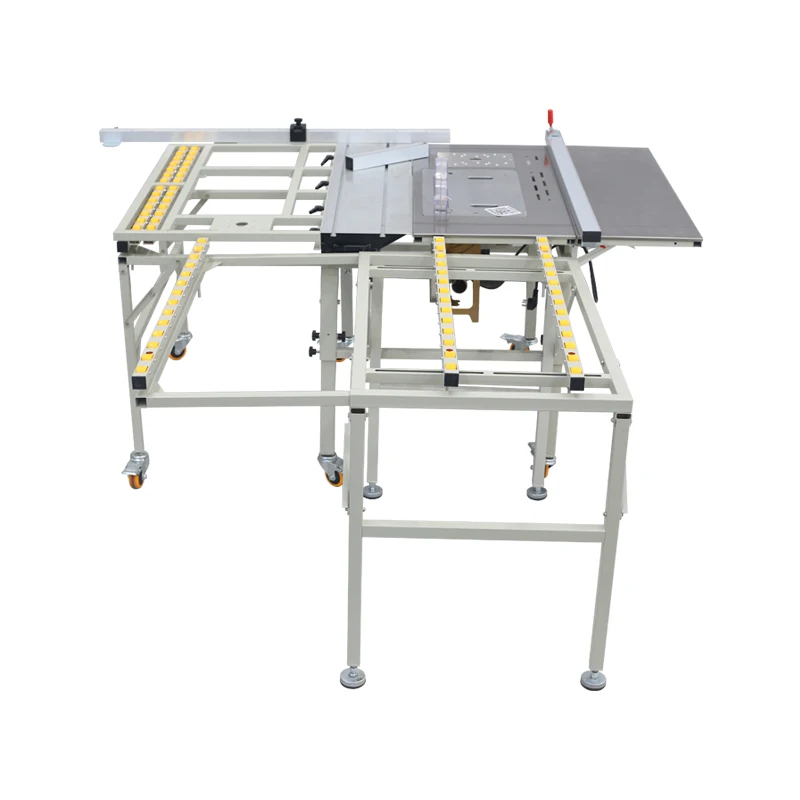
Precision Specification Matching — every JT-550S sliding table saw leaves the factory with voltage, frequency, and control language verified against your workshop's actual power supply and operator requirements, eliminating the most common commissioning failures we see in the field.
Technical Specifications
| Parameter |
Value |
| Model |
JT-550S |
| Product Type |
Sliding Table Saw |
| Tilt Angle |
45° / 90° |
| Saw Blade Configuration |
Integrated sub and master saw (aluminum alloy chip design) |
| Motor Type |
Copper wire motor |
| Table Feature |
Aluminum alloy flip plate |
| Dust Management |
Dust protection cover with integrated dust absorption system |
| Extension Support |
Sliding roller extension bracket |
| Plug Options |
EU / USA / AU / UK (confirm local requirement) |
| Control Panel Language |
Chinese and English (customizable to Spanish or other languages) |
| Voltage & Frequency |
Configurable to local requirement (confirm before order) |
| Packaging |
Wooden box |
Application Suitability
| Application |
Material or Output |
| Custom cabinet panel sizing |
MDF, particleboard, melamine-faced chipboard |
| Plywood crosscutting for joinery |
Plywood sheets up to standard panel dimensions |
| Solid wood dimensioning |
Hardwood and softwood boards for furniture frames |
| Small-batch furniture production |
Mixed panel materials with frequent angle changes |
Why the Voltage Question Must Come Before the Sliding Table Saw Specifications
Confirming your facility's voltage, frequency, and phase before configuration prevents the most expensive mistake in equipment procurement.
I once visited a workshop in Shandong where a perfectly good panel saw sat unplugged for three weeks because the importer ordered a 380V machine for a facility running on a different supply. The electrician had to rewire the entire workshop circuit before the machine could power on. That delay cost more than the machine itself in lost production time [NEED_CITE: voltage and frequency standards by export market]. When buyers focus solely on Sliding Table Saw specifications like cutting capacity and tilt range while skipping electrical compatibility, the machine arrives as dead weight. The JT-550S is configured only after we receive your exact power supply details, documented in the electrical schematic before production begins.

Tilt Mechanism and Flip Plate Design for Repeated Angle Work
The 45° and 90° tilt capability on the JT-550S covers the majority of miter and square cuts in cabinet and furniture panel processing. The aluminum alloy flip plate eliminates the manual angle adjustment step that operators typically struggle with on older saws, reducing setup time between cut types. For workshops running short batches where panel dimensions change frequently, this directly affects how many finished pieces leave the bench each shift. The Sliding Table Saw specifications around tilt range matter less than how quickly and repeatably the operator can move between angles during a real production run.
Copper Wire Motor Behavior Under Continuous Panel Cutting Loads
Copper wire motors maintain more stable thermal performance during extended cutting sessions compared to aluminum wound alternatives commonly found in entry-level equipment. When a joinery workshop processes dense MDF or thick plywood sheets back to back, motor heat buildup directly affects speed consistency and ultimately cut face quality. The JT-550S motor is selected to handle the sustained loads typical of small-to-medium furniture factories running mixed material schedules throughout the day [NEED_CITE: copper vs aluminum wound motor thermal characteristics in woodworking applications]. This matters most when your production schedule does not allow for cool-down breaks between batches.
Reading the Numbers That Actually Affect Your Panel Output
The integrated sub and master saw configuration deserves attention because it determines edge quality on laminated and veneered panels. The sub-saw scores the bottom surface before the main blade completes the cut, preventing the tear-out that makes laminated chipboard edges unusable without secondary sanding. The aluminum alloy chip design in both blades works together with the dust protection cover and absorption system to keep the cutting zone clear, which directly affects operator visibility and cut accuracy over long shifts. The sliding roller extension bracket expands the work envelope for oversized panels that would otherwise require two operators to support manually, reducing both labor requirement and the risk of panel damage during feeding. These Sliding Table Saw specifications collectively determine whether the machine produces finish-ready edges or generates rework downstream [NEED_CITE: sub-saw scoring effect on laminated panel edge quality].
The Hidden Cost of Skipping Configuration Verification
Workshops that order saws without confirming feed height compatibility with their existing workbenches and material handling equipment end up modifying the surrounding setup at their own expense. Control panels delivered in a language the operator cannot read delay commissioning by days while translated instructions are sourced. Dust extraction connections that do not match the workshop's existing ductwork diameter require custom adapters fabricated locally, adding cost and delaying full production [NEED_CITE: common commissioning delays in imported woodworking machinery]. These problems do not appear in any Sliding Table Saw specifications sheet but determine whether the machine runs productively on day one or sits idle while problems get resolved.
What This Configuration Approach Delivers
Voltage and frequency confirmation happens before production starts, documented in a formal electrical schematic matched to your supply. The control panel language is specified to match your operator's working language, not left as a default setting. Every JT-550S goes through pre-shipment testing on actual panel material to verify cutting accuracy and motor performance under load. The four-stage quality process covers incoming component inspection through final dispatch verification, catching tolerance and assembly issues before the crate leaves the factory floor. Engineer-led configuration means the quotation reflects your actual workshop conditions rather than a generic catalog entry.
Documentation & Verification
- Electrical schematic confirming your exact voltage, frequency, and plug configuration
- Machine specification sheet with full dimensional data for workshop layout planning
- Operation and maintenance manual produced in your operator's confirmed language
- Pre-shipment factory test record demonstrating cutting accuracy on your panel material
- Spare parts list matched to your production volume and local supply availability
Installation, Commissioning & Support
- Verify workshop floor space and ceiling height against JT-550S overall dimensions before delivery
- Confirm dedicated circuit capacity matches the copper wire motor rated power requirement
- Inspect aluminum alloy flip plate and sliding roller bracket alignment after unpacking
- Calibrate 45° and 90° tilt positions against your specific panel material before production
- Establish dust absorption ductwork connection matching the integrated cover outlet diameter
- Schedule blade replacement intervals based on your primary material type and daily cut volume
Before You Request a Quotation
Share your workshop's voltage, frequency, and phase supply details so the electrical configuration can be confirmed upfront. Tell us the primary panel materials you cut, including thickness ranges and whether laminated surfaces are involved. If you have existing upstream or downstream equipment, provide the feed height and throughput so we can verify compatibility with the JT-550S sliding table saw in your line.
Frequently Asked Questions
Q: How do I confirm voltage, frequency, and plug type for my local power supply?
A: Send your facility's electrical supply details including voltage, phase, and frequency before we finalize the JT-550S configuration. We produce an electrical schematic confirming all parameters and provide it for your electrician's review before production begins. Plug type is matched to your regional standard from EU, USA, AU, or UK options.
Q: What panel materials and thickness range does the JT-550S handle?
A: The JT-550S cuts MDF, plywood, particleboard, and solid wood panels commonly used in furniture and cabinet production. The integrated sub and master saw configuration is specifically designed for laminated and veneered surfaces where edge tear-out is a concern. Share your specific panel thickness range so we can confirm cutting capacity before quotation.
Q: How does the integrated sub and master saw reduce chipping on laminated boards?
A: The sub-saw scores the bottom laminate layer before the main blade completes the through-cut, preventing the tear-out that typically damages melamine and veneer edges. The aluminum alloy chip blade design clears material efficiently while the dust absorption system keeps the cutting zone clean. This produces finish-ready edges on laminated particleboard without secondary sanding.
Q: Can the control panel and manual be delivered in my operator's language?
A: The standard JT-550S control panel supports Chinese and English, with customization available for Spanish and other languages upon request. The operation and maintenance manual is produced in your confirmed language before shipment, ensuring your operator can read all setup and safety instructions without translation delays during commissioning.
Q: What spare parts and consumables should I stock for the first year?
A: We provide a spare parts list calibrated to your daily production volume and the panel materials you process most frequently. Saw blades for both the sub and master saw positions are the primary consumables, with replacement intervals depending on material density and cut volume. Confirming your typical weekly throughput allows us to recommend appropriate first-year stock quantities.