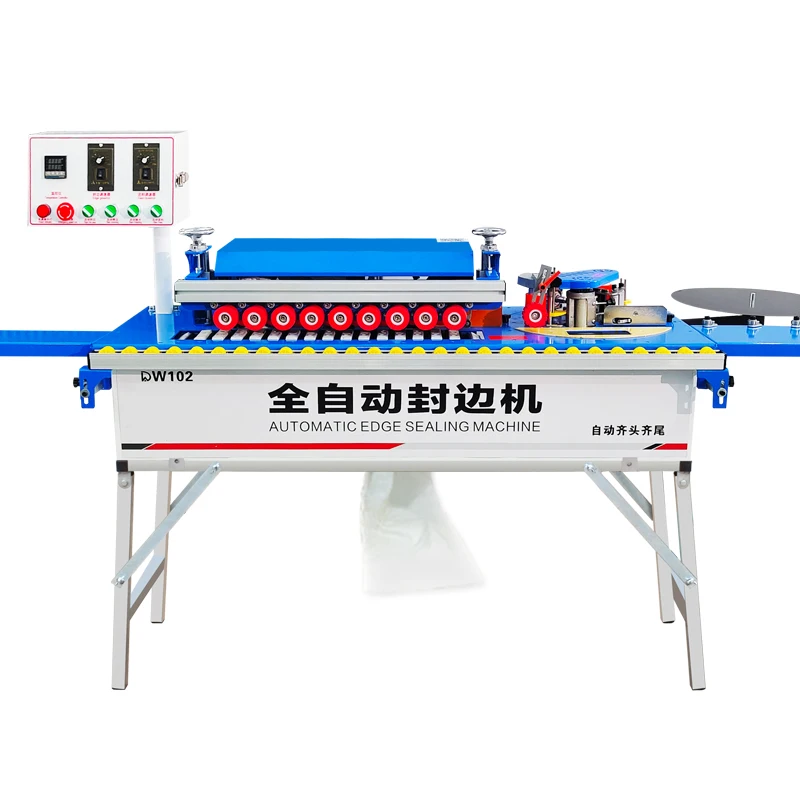
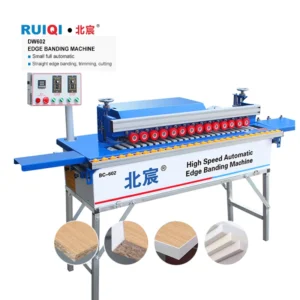
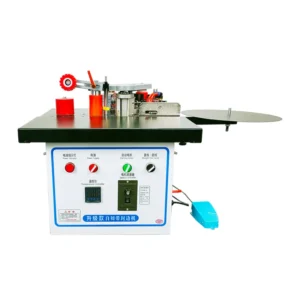
Verified Tolerance Before Shipment — every DW102 mini edge banding machine leaves the factory with a documented test record on your specified panel material and edge thickness, not just a catalog claim.
Technical Specifications
| Parameter |
Value |
| Model |
DW102 |
| Product Type |
Mini Automatic Edge Banding Machine |
| Total Power |
3800W |
| Voltage |
220V (frequency to be confirmed per destination market) |
| Trimming Power |
650W × 2 |
| Polishing Power |
180W × 2 |
| Edge Feed Power |
20W |
| Transmission Power |
60W |
| Vacuum Power |
1200W |
| Edge Banding Thickness Range |
0.3–3 mm |
| Edge Banding Height Range |
0–50 mm |
| Minimum Sheet Length |
250 mm |
| Minimum Sheet Width |
50 mm |
| Glue Pot Capacity |
1000 ml |
| Air Source Pressure |
0.5–0.8 MPa |
| Overall Dimensions (L×W×H) |
1280 × 470 × 690 mm |
| Net Weight |
75 kg |
| Standard Functions |
Curved and straight edge banding, edge trimming, polishing, automatic head and tail cutting, vacuum hold-down |
| Control Language |
Chinese and English (customizable to Spanish or other languages) |
| Plug Options |
EU, USA, AU, UK |
Application Suitability
| Application |
Material or Output |
| Cabinet door and carcass edge finishing |
MDF and particleboard with PVC or melamine edge banding |
| Plywood furniture panel edging |
Plywood panels with veneer or PVC strips up to 3 mm thick |
| Small-batch custom joinery |
Solid wood panels and blockboard requiring curved and straight edge profiles |
| Polymer door frame trimming |
Polymer composite door components with thin-edge application |
| Workshop prototyping and rework |
Mixed substrate samples for fit and finish verification before full production runs |
Why the Voltage Question Must Come Before the Edge Banding Machine Specifications
Confirming local voltage and frequency before production starts prevents weeks of idle time on the shop floor.
I had a customer in Southeast Asia who received a mini unit wired for a supply that did not match their workshop grid. The machine sat unpowered while a transformer was sourced and installed locally, and their production line waited through the delay. Edge banding machine specifications mean little if the motor cannot turn when you plug it in. That experience changed how I approach every quotation — the first document I now request is a photo of the buyer's electrical panel [NEED_CITE: voltage and frequency standards by export market]. The DW102 is configured for 220V supply, but the local frequency must be verified independently because a 50 Hz motor running on a 60 Hz grid will behave differently under load, and the reverse situation can cause overheating during extended trimming cycles.

Per-Station Power Allocation and What It Reveals
The DW102 distributes its 3800W total across dedicated stations rather than relying on a single oversized motor. The twin trimming motors at 650W each provide the torque needed to cut cleanly through PVC and veneer at the banding head and tail without dragging or chipping the substrate edge. Polishing motors at 180W per side are sized to buff the trimmed edge smooth without burning heat-sensitive PVC surfaces. This edge banding machine specifications breakdown matters because it tells a technical buyer whether the machine can handle the specific material mix in their shop — heavier substrates like blockboard demand more trimming authority, while thin melamine on MDF is more forgiving.
Pneumatic and Vacuum Integration for a Stable Workpiece
Edge banding on curved panels requires the workpiece to stay firmly registered against the feed track throughout the glue application and trimming sequence. The DW102 specifies an air source pressure of 0.5–0.8 MPa to drive the pneumatic clamping and automatic head-and-tail cutting mechanisms [NEED_CITE: pneumatic system requirements for compact edge banding equipment]. The integrated 1200W vacuum unit holds the panel against the fence during straight passes, reducing the chance of lateral drift that produces uneven glue lines. Before installing the machine, the workshop must have a compressed air line capable of sustaining the required pressure at the point of connection, not just at the compressor outlet.
Reading the Numbers That Actually Affect Assembly Downstream
The 0.3–3 mm edge banding thickness range covers the most common PVC, melamine, and veneer strips used in cabinet and furniture production. When working with 3 mm PVC on particleboard, the twin 650W trimming motors must shear the overhang cleanly in a single pass — a second pass risks scoring the panel face. The 0–50 mm edge banding height range means the machine handles panels from thin 10 mm shelving stock up to 50 mm thick solid-wood worktops, though the actual panel thickness range for feed compatibility should be confirmed with a test sample before committing to a production batch. The 250 mm minimum sheet length is short enough for small offcut rework and drawer component edging, which matters in a custom joinery shop where panel sizes vary with every order. The 1000 ml glue pot is sized for intermittent rather than continuous production — operators running large batches should plan for periodic refills to maintain consistent glue temperature and viscosity. The 1280 × 470 × 690 mm footprint and 75 kg weight mean the machine can be positioned on a standard workbench and relocated within the workshop as floor layout changes [NEED_CITE: workshop space planning for small-format edge processing equipment].
What Happens When Feed Speed and Substrate Are Mismatched
A mini edge bander pushed beyond its intended duty cycle will show the problem first at the trimming station. If the feed rate exceeds what the 650W trimming motors can cleanly shear, the operator will find chipped corners and torn veneer on finished panels — defects that are caught only at the assembly bench when dowel holes and edge profiles no longer align. Running thick PVC at a pace suited for thin melamine stresses the glue roller, producing visible glue lines that require manual scraping before the panel can ship. These are not catastrophic failures, but they compound across a batch and erode the margin on each cabinet or furniture unit produced [NEED_CITE: edge finish quality standards in furniture manufacturing].
Why Procurement Through This Channel Reduces Configuration Risk
The DW102 is built in a facility with proprietary cutting mechanism patents and a four-stage quality control process covering incoming material through pre-shipment verification, so the trimming accuracy claimed in documentation is tested on actual panels before the crate is sealed. Voltage, plug type, and control panel language are treated as standard configuration variables rather than special requests — the machine ships with EU, USA, AU, or UK plug options and the control interface can be set to English, Spanish, or other agreed languages before dispatch. Engineers provide a formal configuration proposal within 24 hours of receiving the buyer's panel material, edge thickness, and workshop electrical details, which means the specification conversation happens before production starts, not after the machine arrives. Factory visits and sample processing tests are welcomed so the buyer can verify edge quality on their own substrate before the purchase order is signed.
Documentation & Verification
- CE declaration of conformity covering the DW102 electrical and mechanical safety requirements
- Machine specification sheet with confirmed voltage, frequency, and plug type for your market
- Electrical schematic showing per-station motor wiring and control circuit layout
- Factory test record documenting edge banding results on your specified panel material and thickness
- Operation and maintenance manual in your agreed language with illustrated spare parts list
Installation, Commissioning & Support
- Requires a dedicated 220V circuit rated for the 3800W total load with appropriate breaker sizing
- Compressed air line must deliver 0.5–0.8 MPa at the machine inlet for pneumatic clamping and cutting functions
- 1280 × 470 mm footprint fits a standard workbench; allow clearance on the feed and exit sides for panel handling
- First-run commissioning includes glue temperature calibration and trimming depth adjustment for your edge material
- Glue pot capacity of 1000 ml requires scheduled cleaning intervals to prevent adhesive buildup on the roller
- Spare trimming blades and polishing wheels included in the initial shipment for early-stage maintenance
Preparing Your Inquiry for an Accurate Configuration
To match the DW102 to your workshop, share the substrate types you process most frequently, the edge banding material and thickness range you use, and your local voltage and frequency from the electrical panel. If you run both straight and curved panels, note the minimum curve radius so the feed track can be evaluated for your geometry. Operators who need a specific control language should state the preference at inquiry stage so the interface is configured before dispatch.
Frequently Asked Questions
Q: How do I verify edge banding tolerance before the DW102 ships?
A: Request a factory test record showing the machine running your specific panel material and edge thickness. The test documents trimming finish, glue line visibility, and polishing result on sample panels. You may also send your own material to the factory for a processing test, or arrange a visit to witness the run in person before the machine is packed for dispatch.
Q: What if my workshop supply is not exactly 220V at 50 Hz?
A: Confirm your actual supply voltage and frequency by photographing your electrical panel nameplate. The DW102 is configured for 220V, but frequency affects motor speed and trimming behavior. If your grid runs at 60 Hz or has significant voltage fluctuation, the factory can adjust motor winding specifications or recommend a stabilizer before the machine enters production.
Q: Can the control panel be set to a language my operators read?
A: Yes. The standard interface supports Chinese and English, and can be customized to Spanish or other languages at the order stage. Specify the required language when submitting your inquiry so the control firmware is loaded and tested during the pre-shipment quality check, avoiding delays at commissioning.
Q: How do I match the DW102 to my panel saw output?
A: The DW102 is designed for intermittent and small-batch edge processing rather than continuous high-volume lines. Share your daily panel count and typical sheet dimensions with the engineering team so they can assess whether the glue pot refill cycle and feed rate align with your upstream cutting output, or whether a larger-format model is more appropriate.
Q: What spare parts should I stock for routine maintenance?
A: Trimming blades, polishing wheels, and glue pot seals are the primary wear items. The machine ships with an initial set of consumables and a spare parts list identifying part numbers for reordering. Establishing a replenishment schedule based on your weekly operating hours prevents unplanned downtime when consumables reach end of life.